
Vandaag of morgen in huis

Kwaliteit gegarandeerd

Welkomstaanbiedingen ontgrendelen: GRATIS bezorging | Tot 80% korting | Gratis 30 dagen JoyPlus-proefperiode
Download de app
A flat car battery or underinflated tyre usually strikes at the worst time: on your way to work, during a camping trip or when you’re stranded by the roadside on your motorbike. A car jump starter with compressor combines a portable jump starter with a tyre inflator and sometimes a power bank or torch. It can help you deal with many situations yourself.
However, a high amp rating doesn’t tell you everything. Product descriptions may use different measurement methods, and a built-in compressor has its limits. Below, you’ll find the key points to check before buying a 12V car jump starter, a car battery booster with air compressor or an emergency car starter.
A model with a 3000A jump starter sounds powerful, but check the stated engine capacity too. Manufacturers may list separate limits for petrol and diesel engines. Diesel engines generally need more starting power than petrol engines.
Also check whether your vehicle uses a 12V system. A car jump starter isn’t automatically suitable for heavy goods vehicles, buses or other 24V systems. Hybrid and electric cars may also have specific requirements. Never connect a standard 12V jump starter to an electric car’s high-voltage battery.
A rating of 150 PSI doesn’t mean every car tyre will inflate quickly. The actual speed depends on the tyre size, its current pressure, the battery’s condition and the airflow rate, for example 35 litres per minute.
A portable car tyre inflator is particularly handy for adjusting tyre pressure or topping up a tyre after a slow loss of pressure. A compact pump may take longer to inflate a completely flat, large motorhome tyre, or may not be suitable for the job. So check for a digital display, automatic shut-off and the right valve adapters.
Connecting the clamps incorrectly can damage the battery or jump starter. Look for features such as reverse polarity protection, short-circuit protection, overheat protection and overcharge protection. These features don’t replace careful connection, but they can help reduce the risk of user error.
A jump starter power bank isn’t a device you can buy once and then forget about in the boot. Check its charge regularly and recharge it after use. Always follow the manufacturer’s instructions.
Use the stated peak current as a point of comparison, but base your choice mainly on the stated engine capacity. A product suitable for petrol engines up to 9,0 litres may have a different limit for diesel engines, for example 6,5 or 8,0 litres.
Also check the starting procedure. With some models, you need to connect the clamps first, then activate a boost function if the battery voltage is very low. This isn’t guaranteed to work with a completely faulty, damaged or frozen battery.
These features are useful for everyday use:
If possible, check tyre pressure when the tyres are cool. Follow the recommended pressure for your car, usually shown on a sticker inside the door frame or in the handbook.
A larger device may offer more runtime, but it also takes up more space. Check its weight, whether it comes with a storage bag and how it can be charged. A USB output can come in handy for charging a phone, while an LED light is useful if you break down in the dark.
Check the warranty terms and stated charge cycles too. A manufacturer’s claim, such as ‘more than 1000 charge cycles’, is a statement from the brand, not an independent guarantee of how the product will perform in your circumstances.
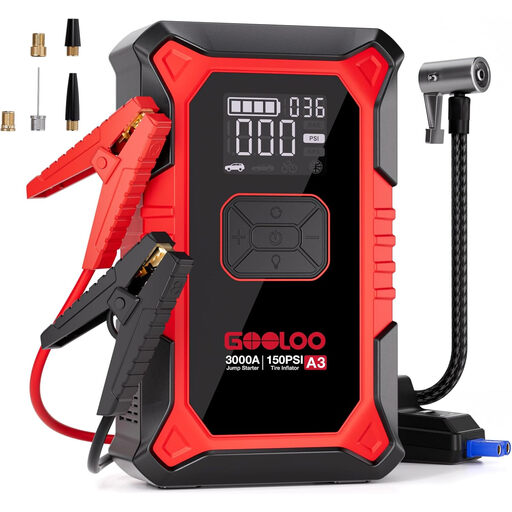
Why it suits this type of user: This model combines jump-starting, tyre inflation, USB charging and a light in one device. According to the product description, it supports petrol engines up to 9,0 litres and diesel engines up to 6,5 litres.
It has a digital display, automatic shut-off, three pressure units and, according to the manufacturer, ten safety features. The compressor is rated at 150 PSI and 35 l/min.
3000A peak current, five inflation modes, an LED light and a stated runtime of up to 45 minutes for cordless inflation.
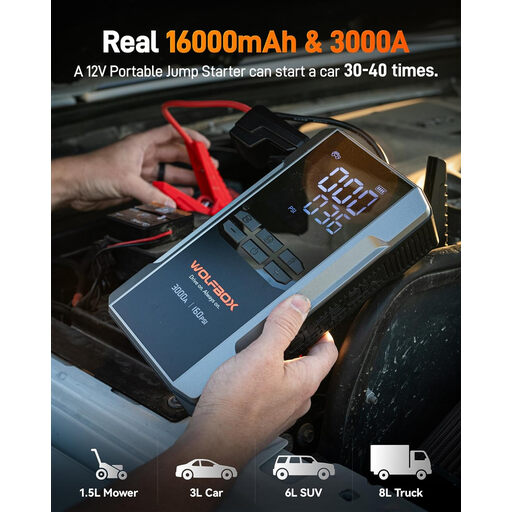
Why it suits this type of user: The combination of a 59,2 Wh battery, 160 PSI compressor, boost function and 65W fast charging makes it a good fit for drivers who want to keep a compact emergency kit in their car.
The product specifications list both the battery capacity and engine limits: up to 8,0 litres for petrol and 6,0 litres for diesel. Always check these against your own vehicle.
160 PSI maximum pressure, 65W charging, boost mode, a light and jump leads included, according to the product information.
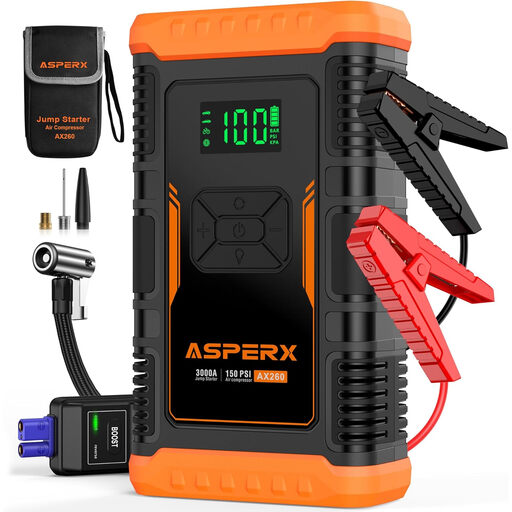
Why it suits this type of user: This model is designed for cars, SUVs, motorbikes, boats and other 12V applications. The brand description states that it supports petrol engines up to 10,0 litres and diesel engines up to 8,0 litres.
The display shows the pressure while inflating, and the automatic shut-off helps prevent overinflation. The manufacturer says it has ten levels of protection.
3000A peak current, 150 PSI, 35 l/min, two USB outputs and a stated compressor runtime of up to 25 minutes.
We’ve put together a complete, up-to-date list of products that meet these strict selection criteria and the current European safety regulations.
First, read the instructions and check that the jump starter is sufficiently charged. Connect the red clamp to the positive terminal and the black clamp to the negative terminal or a suitable unpainted metal earth point, depending on the manufacturer’s instructions. Start the engine briefly, then remove the clamps in the specified reverse order. Don’t use the device with a leaking, damaged or frozen battery.
Its lifespan depends on charge cycles, storage temperature, use and maintenance. Recharge the jump starter after use and check it regularly, even when it’s stored in the car. Keep it somewhere dry and away from heat. Charge-cycle figures or warranty details provided by a brand are specific to that product and don’t guarantee performance in every situation.
You won’t pay separate fuel or mains electricity costs while using it, but its internal battery does need to be charged. The compressor uses a relatively large amount of energy when inflating a tyre. The longer inflation takes, the quicker the battery will run down. So set the correct tyre pressure beforehand and recharge the device after use.
