
Vandaag of morgen in huis

Kwaliteit gegarandeerd

Welkomstaanbiedingen ontgrendelen: GRATIS bezorging | Tot 80% korting | Gratis 30 dagen JoyPlus-proefperiode
Download de app
A flat car battery or soft tyre usually strikes at the worst time. With a car jump starter with compressor, you can start a 12V vehicle yourself in certain situations and inflate your tyres. This makes one an appealing choice for commuters, travellers, campers and drivers of cars, SUVs, vans and motorbikes.
However, not every powerful car jump starter is suitable for every vehicle. Manufacturers also use different measurement methods and marketing terms. So before you order, check the technical specifications, included accessories and safety instructions.
A claim such as 3000A, 5000A or 7000A sounds impressive, but on its own it doesn’t tell you whether the car battery booster is suitable for your engine. Also check:
A jump starter for a car isn’t automatically suitable for a heavy commercial vehicle with a 24V system. Also check whether the battery is damaged, frozen or leaking. In those situations, you shouldn’t simply use the device.
A 150 PSI tyre inflator can theoretically reach a high pressure, but that doesn’t mean it will inflate every tyre equally quickly. For everyday use, airflow, often measured in litres per minute, the maximum operating time and automatic shut-off are important too.
A digital pressure gauge with selectable units such as PSI, bar and kPa helps you set tyre pressure more accurately. Let the compressor cool down between uses if the manual says to. A compact tyre inflator with compressor is designed for emergencies and small adjustments, not necessarily for inflating several tyres in a row over an extended period.
A portable battery booster left unused in your car for months may be flat when you need it. So check:
A car power bank with USB outputs is handy for charging a phone or tablet, but that feature doesn’t replace suitable jump leads and the correct connection procedure.
Choose a model with a stated capacity that exceeds your vehicle’s requirements. According to their product specifications, some models are suitable for petrol engines up to 9 or 10 litres and diesel engines up to 6.5 or 8 litres. Other models are designed for larger diesel engines.
Also consider the difference between a jump starter for diesel cars and a model for a smaller petrol car. Diesel engines generally need more starting power. For an SUV, van or pick-up, an SUV jump starter with suitable diesel support makes more sense than a compact entry-level model.
Useful safety features include:
These features reduce the risk of incorrect use, but they don’t make an incorrect connection safe. Connect the red clamp to the positive terminal and the black clamp to the negative terminal or a suitable earth point, exactly as described in the manual.
For car tyres, 150 PSI, airflow of, for example, 35 or 45 litres per minute, a digital gauge and automatic shut-off are useful features. Check the number of nozzles too. They may let you inflate bicycle tyres, balls or air beds, but always use the correct attachment and pressure.
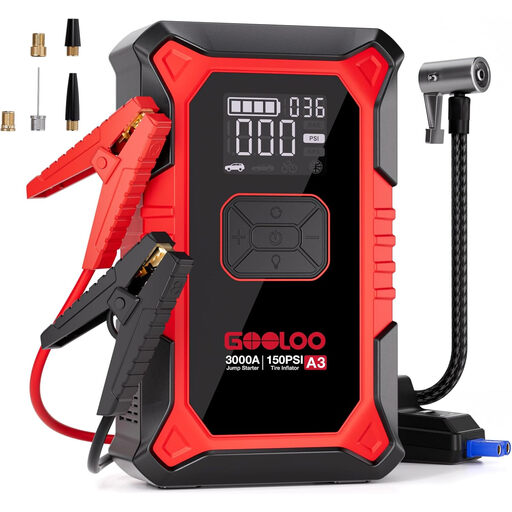
Why it suits this user: This model combines a 12V jump starter, compressor, LED light and power bank in one device. According to the product specifications, it supports petrol engines up to 9.0 litres and diesel engines up to 6.5 litres.
The digital pressure display, automatic shut-off and five inflation modes make it easier to use than a compressor without a display.
3000A peak current, up to 150 PSI, 35 l/min airflow and a stated 18-month warranty.
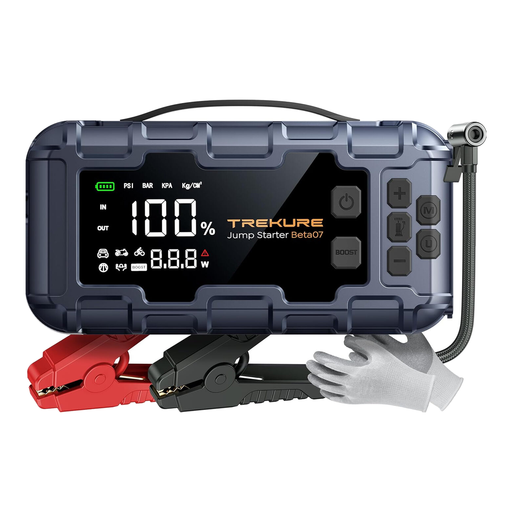
Why it suits this user: The stated specifications are aimed at drivers of larger 12V cars, SUVs and diesel vehicles up to 12 litres. The 3.3-inch display shows the battery status and pressure.
The product specifications list a 45 l/min compressor, five pressure modes and an automatic shut-off function, so maximum PSI isn’t the only measure to consider.
6000A peak current, 160 PSI according to the product specifications, 45W USB-C and a set of insulating gloves included.
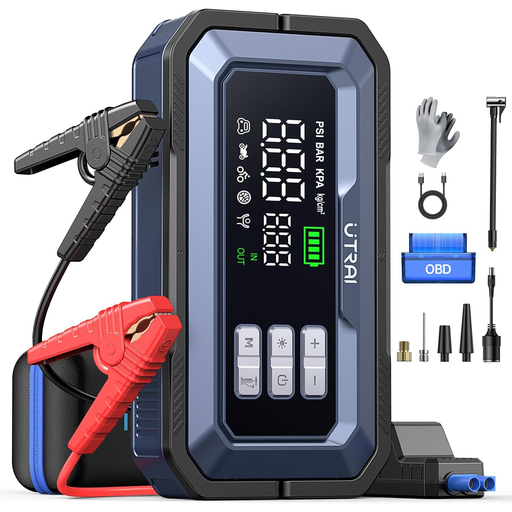
Why it suits this user: This model is designed for larger vehicles and additional uses. According to the product specifications, it supports diesel engines up to 14 litres and features a 160W DC output and an OBD2 diagnostic adapter.
The pressure gauge supports multiple units, and according to the product specifications, the temperature sensor is designed to monitor the battery and pump for overheating.
7000A peak current, 150 PSI compressor, 2000-lumen light, 160W DC output and ten listed safety features.
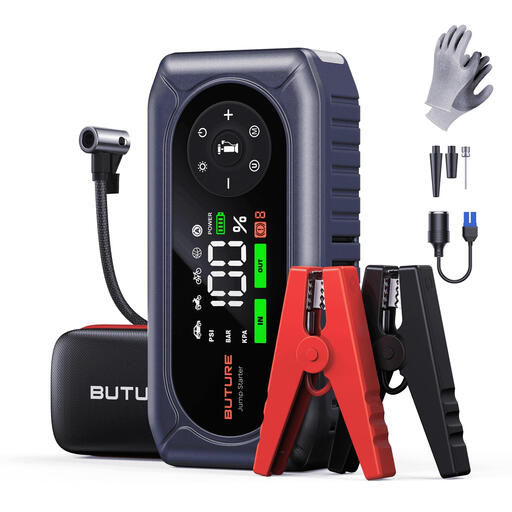
Why it suits this user: A practical choice for drivers who want a compact car battery booster with straightforward controls, a light and a compressor for occasional use.
According to the product specifications, the LCD screen shows the battery status, inflation mode and current tyre pressure. The compressor stops at the set pressure.
4500A peak current, support for petrol engines up to 9 litres and diesel engines up to 8 litres, plus four LED modes.
We’ve put together a complete, up-to-date list of products that meet these strict selection criteria and the applicable European safety regulations.
Store the jump starter battery in a dry place, away from direct sunlight and not in extreme heat for extended periods. Check the charge every few months, even if you haven’t used it.
No. A 12V jump starter is designed for vehicles with a 12V system. Also check the maximum engine capacity and whether the model is suitable for petrol or diesel. A 24V lorry or an electric car’s high-voltage system isn’t automatically compatible.
That depends on the battery type, storage, charging frequency and use. Follow the manufacturer’s maintenance instructions and don’t leave the device completely flat for months. The stated charge cycles and warranty vary by model, so they’re important details to check before you buy.
While inflating, the compressor uses the device’s internal battery. You usually don’t need to leave the engine running, but the charge level will go down. Recharge the jump starter after use so both its starting function and the tyre inflator with compressor are ready when you need them.
