
Vandaag of morgen in huis

Kwaliteit gegarandeerd

Welkomstaanbiedingen ontgrendelen: GRATIS bezorging | Tot 80% korting | Gratis 30 dagen JoyPlus-proefperiode
Download de app
A flat battery or soft tyre usually happens at the worst possible time. A car jump starter with compressor combines a 12V emergency jump starter with a portable air pump, often with a power bank and LED emergency light too. It’s a practical choice for car, SUV and van owners, motorcyclists, campers and travellers.
But not every combination is equally suitable. Manufacturers often highlight high peak currents, 150 PSI and large battery capacities as selling points. Those figures only tell you so much unless you consider vehicle compatibility, running time and safety features too.
A high peak current sounds impressive, but it doesn’t tell you on its own whether the device can actually start a car. Check the following too:
A 12V jump starter isn’t automatically suitable for every car. A diesel engine or large SUV generally needs more starting power than a compact petrol car.
An electric tyre inflator rated at 150 PSI may have a high maximum pressure, but that doesn’t mean it can inflate a car tyre to that pressure quickly. For everyday driving, the recommended tyre pressure is usually considerably lower. You’ll find it on the sticker inside the door frame or fuel flap, or in your car’s manual.
So, check these details too:
Don’t use the maximum pressure in the product description as the recommended tyre pressure. For example, the Baseus has a stated measurement range of 5 to 150 PSI, while use within 120 PSI is supported. According to the product information, the sensor may be damaged if the pressure exceeds 150 PSI.
A car power bank, USB ports and an LED emergency light are useful extras, but they don’t make a jump starter ready for use indefinitely. Lithium batteries slowly lose their charge, particularly when stored in a hot car for a long time.
So, check the following:
Choose a car battery jump starter based on your vehicle, not just the biggest number on the packaging. A compact model may be enough for a small petrol car. For an SUV, van, boat or diesel vehicle, a model with a higher stated capacity and clear compatibility information is a more sensible choice.
Bear in mind that claims such as “starts an engine in extreme cold” come from the brand’s product description. According to the manufacturer, the TREKURE Beta06 works in temperatures from -20 °C to 60 °C and is designed for petrol engines up to 10 litres and diesel engines up to 10 litres. Treat this as a product specification, not a guarantee that every engine will start in all conditions.
A jump starter with air compressor is particularly handy for topping up tyres while you’re on the road. A digital gauge displaying PSI, bar or kPa makes it easier to set the pressure. Automatic shut-off stops the pump once it reaches the selected pressure.
Check the maximum running time too. For example, the BUTURE BC02 instructions say not to use the compressor continuously for longer than 10 minutes. Let the device cool down afterwards. This helps prevent unnecessary heat build-up and is in line with normal use of a compact car tyre inflator.
Battery capacity is often given in mAh, but figures like these aren’t directly comparable when the voltages differ. So, check the weight, dimensions and charging ports too.
A heavier model may offer more connections and a larger battery, but it’ll also take up more space in the boot. A compact model may be more practical for motorcyclists or campers. A corded tyre inflator also depends on a 12V connection in the car, while an integrated compressor with its own battery gives you more freedom to move around.
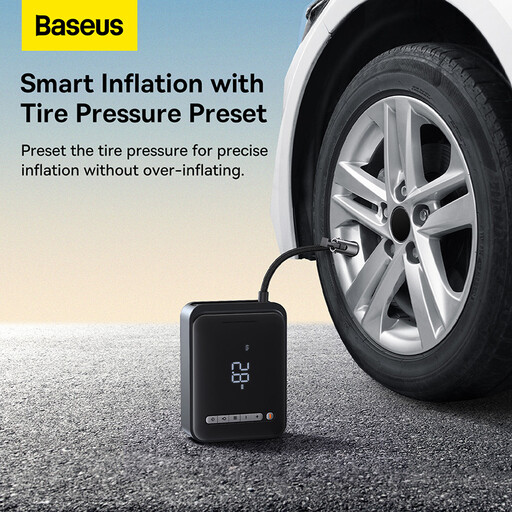
Why it suits this profile: A relatively compact device for drivers who want a car battery jump starter and tyre inflator in one unit. The stated battery capacity is 8000 mAh at 3,7 V and it weighs around 1,360 grams.
The product information gives both a 500A starting current and a 1000A peak current. This makes it easier to tell the figures apart than when just one high number is listed. According to the specifications, the compressor supports pressures up to 120 PSI.
54W pump, USB-C input, two USB outputs and a stated inflation time of around 7 to 9 minutes for an R195 tyre.
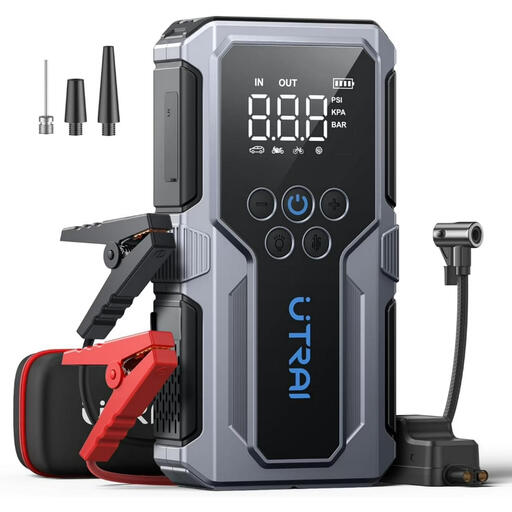
Why it suits this profile: A good fit if you’re looking for a multifunctional emergency car jump starter with a display, USB and USB-C connections, and support for several types of vehicle.
The specifications list a 3000A peak current, a 150 PSI compressor and an LCD display. They also state a maximum compressor running time of 10 minutes.
According to the manufacturer, it’s suitable for 12V vehicles, supporting petrol engines up to 8,5 litres and diesel engines up to 6,5 litres. It also has three light modes and a safety detection cable.
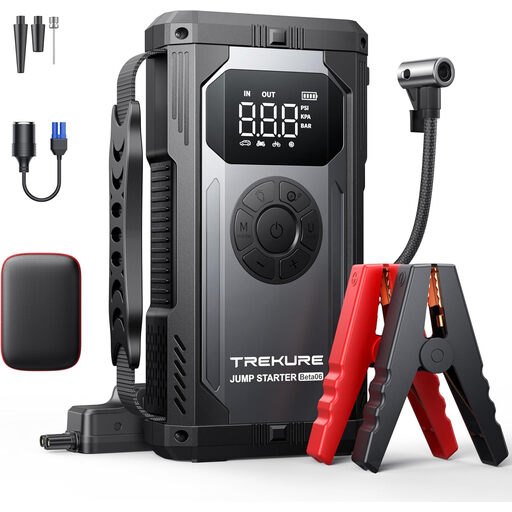
Why it suits this profile: An option for owners of larger cars, SUVs and vans, or vehicles regularly used for travelling and outdoor activities.
The product specifications list a 5500A peak current, a 150 PSI compressor, automatic shut-off and an LCD display with several pressure units. This makes it easy to check the relevant information.
According to the manufacturer, this model is designed for petrol and diesel engines up to 10 litres. The 23800mAh battery, USB outputs, 12V output and SOS light offer extra versatility.
We’ve put together a complete, up-to-date list of products that meet these strict selection criteria and current European safety regulations.
Read the manual before use and fully charge your portable car jump starter. Put the car in park or neutral and switch off the lights and other electronics. Connect the red clamp to the positive terminal and the black clamp to the negative terminal or a suitable earth point, depending on the manufacturer’s instructions.
Don’t use a jump starter with a damaged, leaking or frozen battery. Check the cables, clamps and air hose too. Let the compressor cool down once the stated running time has elapsed.
No. Always check 12V compatibility, the maximum engine capacity, and whether the specifications cover petrol or diesel engines. A higher peak current may make the device suitable for a wider range of uses according to its product specifications, but it doesn’t guarantee that it will start every car or flat battery.
Its lifespan depends on charging habits, storage temperature and how often you use it. Store the device in a cool, dry place and recharge it periodically according to the manual. Don’t leave a lithium battery completely flat for a long time.
It’s usually charged via USB-C, USB or a 12V adapter. The cost of each charge is generally low, but the compressor uses a relatively high amount of power while inflating. Use the automatic shut-off, stick to the recommended running time, and recharge the device afterwards if needed.
