
Vandaag of morgen in huis

Kwaliteit gegarandeerd

Welkomstaanbiedingen ontgrendelen: GRATIS bezorging | Tot 80% korting | Gratis 30 dagen JoyPlus-proefperiode
Download de app
A flat battery or a soft tyre rarely happens at a convenient time: on your way to work, during a holiday in France or in a dark car park. A car jump starter with compressor combines a jump starter with a portable compressor, power bank and emergency LED light. It sounds handy, but not every model is right for every vehicle or situation.
Watch out for these three common pitfalls:
A portable 12V jump starter is designed for vehicles with a 12V system. Next, check which petrol and diesel engines it supports. Diesel engines generally need more starting power than a petrol engine of a similar size.
Before you buy, check:
A stated peak current of, for example, 3,000A, 5,500A or 7,000A is a product specification measured under certain conditions. Don’t treat it as a guarantee that it will start every flat or damaged battery. Use the supplied cables and follow the instructions.
A 150 PSI tyre inflator may be suitable for car and motorbike tyres, bicycles and balls. However, your vehicle’s recommended tyre pressure is shown on the sticker inside the door pillar or fuel filler flap, or in the handbook — not on the tyre sidewall, which shows the maximum operating pressure.
Look out for these features:
A car jump starter contains a lithium battery. Choose a model with clear information about features such as short-circuit protection, reverse-polarity protection, overheat protection and overcharge protection. These features help reduce risks, but they don’t replace correct connection.
Practical tips:
A CE mark may be included in the product information, but also check that the handbook, responsible party and safety instructions are clearly identified. Performance claims come from the manufacturer’s product specifications; actual performance depends on factors including temperature, battery condition and vehicle type.
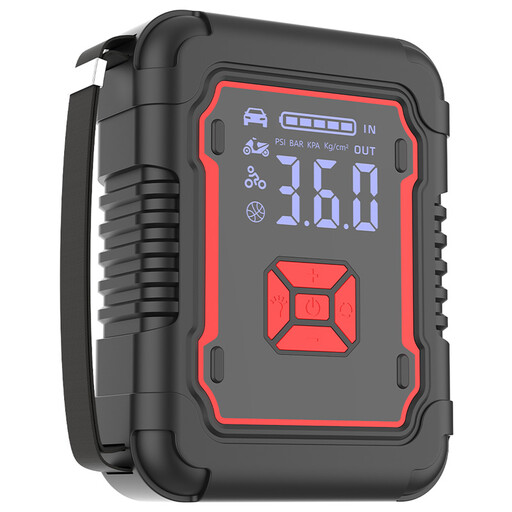
Why it suits this profile: A compact choice for commuters and drivers who want one device for jump-starting, inflating tyres, charging devices and lighting.
The product specifications state a 3,000A peak current, 150 PSI, automatic shut-off and a digital pressure function. Be sure to check the stated limits for your engine.
Stated battery capacity of 20,000mAh, QC3.0 18W output, three-mode LED light and a weight of around 800 grams.
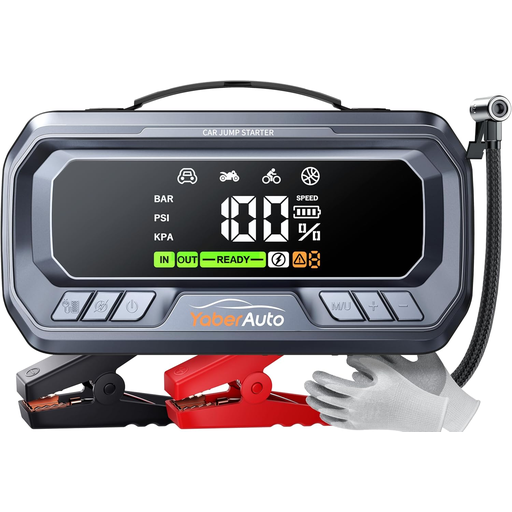
Why it suits this profile: A good fit for drivers who want fast USB-C charging, a clear display and extra 12V functionality as well as a car jump starter.
According to the product specifications, the 3.3-inch display shows the pressure settings and supports automatic shut-off. The compressor is rated at 160 PSI.
Stated peak current of 6500A, 65W bidirectional USB-C-PD, 600-lumen light and a 12–16V/10A DC output.
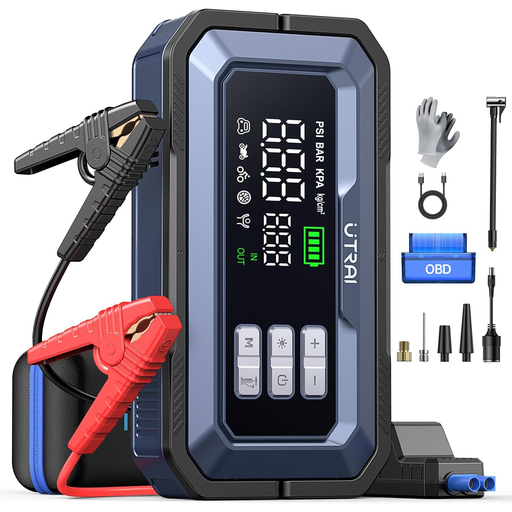
Why it suits this profile: A good option for SUV, van and outdoor enthusiasts looking for a more powerful set-up with an extra 12V output and OBD2 adapter.
The specifications list 10 safety features, temperature protection for the pump and five preset pumping modes. Always check your vehicle’s limits.
7000A peak current, support for diesel engines up to 14 litres according to the product information, a 150 PSI compressor and a 160W DC output.
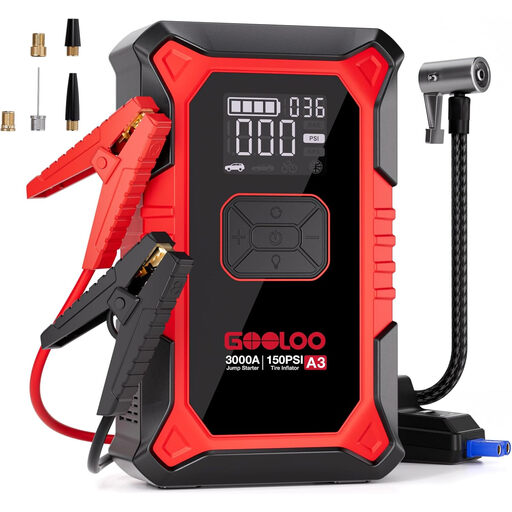
Why it suits this profile: A versatile portable compressor for cars, motorbikes, bicycles and camping gear, with straightforward controls that are easy for beginners to use.
The product page lists five pumping modes, three pressure units, pressure detection and automatic shut-off. This makes it easy to keep the process under control.
3000A peak current, 150 PSI, 35 L/min airflow, USB power bank, LED light and a stated 18-month warranty period.
We’ve put together a complete, up-to-date list of products that meet these strict selection criteria and current European safety requirements.
Switch off the vehicle and first check the positive and negative terminals. Connect the red clamp to + and the black clamp to − or a suitable earth point, as directed in the handbook. Crank the engine briefly, usually for no more than a few seconds at a time. To inflate a tyre, connect the hose securely, set the required pressure and wait for the automatic shut-off to activate.
Its lifespan depends on temperature, storage, charging frequency and use. Many product pages state more than 1,000 charging cycles, but this is a manufacturer’s claim, not a guaranteed lifespan. Recharge the device periodically, avoid leaving it in the heat for long periods and store it with the cables and accessories in the supplied case.
The device mainly uses power when charging and when jump-starting or inflating. The compressor draws relatively high power, so follow the recommended cooling breaks. You can use it as a car power bank to charge phones and other USB devices, but this will reduce the capacity left for a possible jump start. Always check the charge level before setting off.
