
Vandaag of morgen in huis

Kwaliteit gegarandeerd

Welkomstaanbiedingen ontgrendelen: GRATIS bezorging | Tot 80% korting | Gratis 30 dagen JoyPlus-proefperiode
Download de app
A flat battery or soft tyre always seems to happen at the worst possible time. With a car jump starter with compressor, you can often start your vehicle and adjust your tyre pressure yourself. However, many models look similar, even though they can differ considerably in use. A high amp rating or “150 PSI” doesn’t tell the whole story.
A powerful jump starter is often advertised as delivering 2,000, 3,000 or even 8,000 amps. This usually refers to the stated peak current; it doesn’t automatically mean that this current is available for an extended period. So, check which engine type and capacity the product description says the device is suitable for.
A 12V jump starter for a small petrol car has different requirements from an emergency starter for a diesel SUV, van or motorhome.
A compressor with a maximum pressure of 150 PSI may be suitable for car tyres, but this figure mainly indicates the maximum pressure. For practical use, airflow, maximum run time, an automatic shut-off and the included valve adapters are also important. For example, a 35 l/min compressor works differently from a 45 l/min model.
A car battery booster is only useful if its internal battery still has enough charge. Heat inside a parked car, long-term storage and a low charge level can all affect its readiness for use. Check whether the manufacturer recommends charging it periodically, and store the device somewhere dry, out of direct sunlight and preferably in the supplied bag.
Choose a model that’s suitable for a 12V battery system. A 24V system for heavy goods vehicles or certain buses is different. Also check the maximum engine capacity:
Always follow the instructions for your specific vehicle and jump starter.
Smart clamps can include features such as reverse polarity protection, short-circuit protection, overcurrent protection and temperature monitoring. These features reduce the risk of connecting the clamps incorrectly, but they don’t replace careful checking.
The usual procedure is:
Don’t try to start a car with a damaged, leaking or frozen battery.
For a jump starter with an air compressor, these specifications are useful to consider:
A car tyre inflator with these features is particularly useful for adjusting tyre pressure or topping up a slowly deflating tyre. A jump starter won’t repair a puncture.

Why it suits this profile: A compact option for drivers who mainly want to be able to start a 12V car, and would also find a power bank and light useful.
The product details clearly state limits of up to 8.0 litres for petrol engines and 6.0 litres for diesel engines, rather than giving just a standalone amp rating.
2000A peak current, two USB ports, a 400-lumen LED light and a weight of around 545 grams, according to the product information.
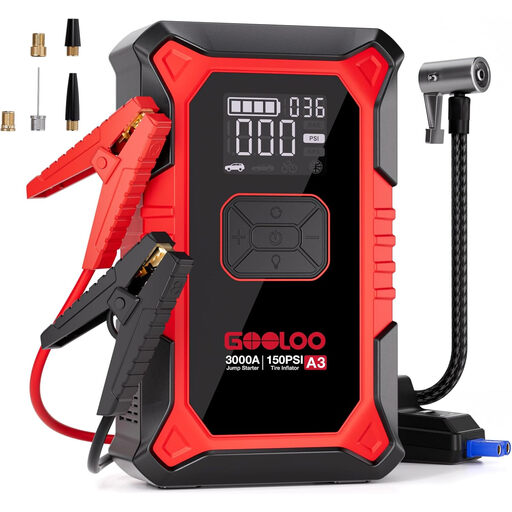
Why it suits this profile: A good choice if you want one device for jump-starting, inflating tyres, providing light and charging USB devices.
The compressor has a digital pressure gauge, automatic shut-off, five modes and three measurement units. That means the maximum 150 PSI isn’t the only specification worth considering.
3000A peak current, 150 PSI, 35 l/min airflow, support for engines up to 9.0 litres for petrol and 6.5 litres for diesel, plus an 18-month warranty according to the offer.
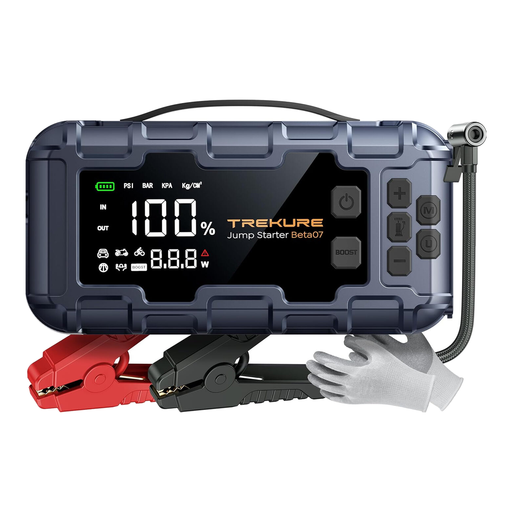
Why it suits this profile: A good option for motorhome, SUV and outdoor users who value extra capacity, a larger display and fast charging.
The stated airflow of 45 l/min, five pressure modes and automatic pressure display provide more context than the 160 PSI figure alone.
6000A peak current, a 45 l/min compressor, 45W USB-C PD, 600-lumen lighting and support for vehicles up to 12 litres, according to the product description.
We’ve put together a complete, up-to-date list of products that meet these strict selection criteria and comply with the applicable European safety regulations.
Not in every car. Check that the vehicle has a 12V system and compare the stated limits for petrol and diesel engines. A 12V device isn’t automatically suitable for 24V vehicles. Also check your car’s manual before connecting the clamps.
Its lifespan depends on the battery type, temperature, charging habits and storage. Some suppliers state a certain number of charging cycles or a standby period; these are manufacturer specifications, not a guarantee for every use case. Recharge the device after use and check it every few months.
There are no fuel costs as there would be with an engine-driven compressor. However, the compressor uses the internal battery, so you’ll need to recharge the device afterwards. Frequent inflation can increase wear and affect run time and charging time. Use the compressor at the stated intervals and let it cool down if the casing gets noticeably warm.
