
Vandaag of morgen in huis

Kwaliteit gegarandeerd

Welkomstaanbiedingen ontgrendelen: GRATIS bezorging | Tot 80% korting | Gratis 30 dagen JoyPlus-proefperiode
Download de app
A flat battery or a soft tyre always seems to happen at the worst possible time. With a car jump starter with compressor, you have portable starting power, an inflator and a light close at hand. However, many models look similar, even though they can differ considerably in starting power, battery capacity and ease of use.
Look out for these three common pitfalls:
A 12V portable jump starter is designed for vehicles with a 12V system. Next, check the stated engine limit. A compact model for a small petrol car isn’t automatically suitable as a jump starter for an SUV or truck.
Check the following:
For example, according to the product description, the BuTure BC02 supports 12V vehicles with engines up to 9.0 litres for petrol and 8.0 litres for diesel. The smaller EAFC model specifies a limit of 4.0 litres for petrol and 2.0 litres for diesel. Use specifications like these to help you choose, rather than relying on the name “car jump starter” alone.
A battery booster with air compressor is handy for a tyre that’s slowly losing air. Look for:
A 150 PSI tyre inflator can also be used for bicycle tyres, balls and other inflatables, but maximum pressure isn’t the same as the speed at which it inflates a car tyre. According to the product information for several models, the compressor needs to cool down after extended use. So don’t use it continuously without a break.
A lithium jump starter combines a battery pack with jump leads and often a USB output. A higher capacity can be useful if you want to charge your phone while you’re out and about, but it doesn’t tell you by itself how many starts you can get.
Look for practical safety features such as:
Temperature limits and charging instructions vary by model. Store the device in a dry place and recharge it according to the instructions. Some products specify a charging interval of two to three months; always follow the product-specific guidance.
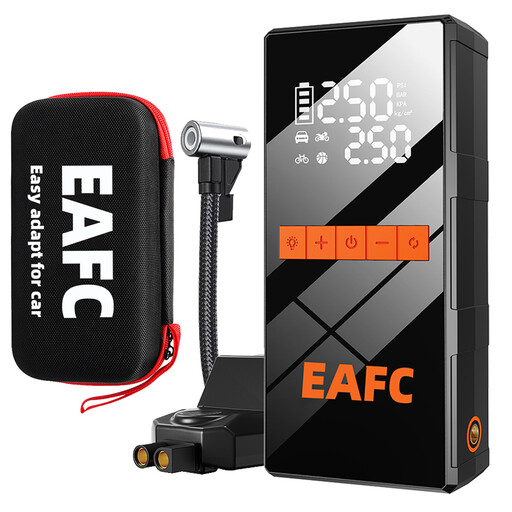
Why it suits this user type: This compact 4-in-1 model is designed for everyday use with a car, short trips and camping. The product description lists a peak current of 1200A, support for engines up to 4.0 litres for petrol and 2.0 litres for diesel, plus a power bank and LED light.
The product specifications give specific engine limits, rather than just a general starting power figure. The compressor has automatic shut-off and several pressure units.
150 PSI maximum compressor pressure, LCD display, LED modes and USB output in a portable design.
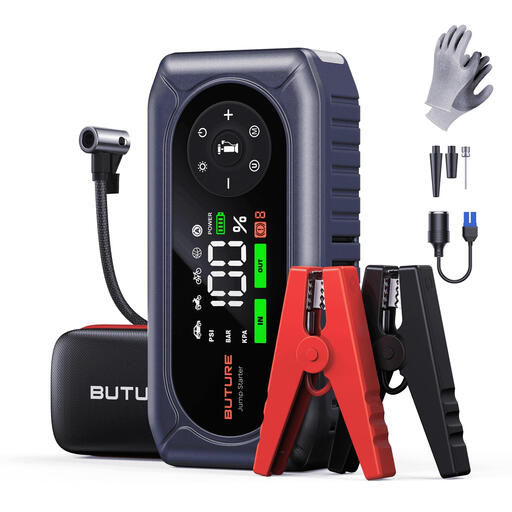
Why it suits this user type: According to the product description, this model is designed for cars, SUVs, trucks and motorcycles. Its stated limits are up to 9.0 litres for petrol and 8.0 litres for diesel, making it suitable for larger vehicles.
The description lists ten safety features, temperature control and a warning not to run the compressor continuously for more than ten minutes.
4500A peak current according to the product specifications, 150 PSI compressor, LCD screen, four nozzles and a 500-lumen LED light.
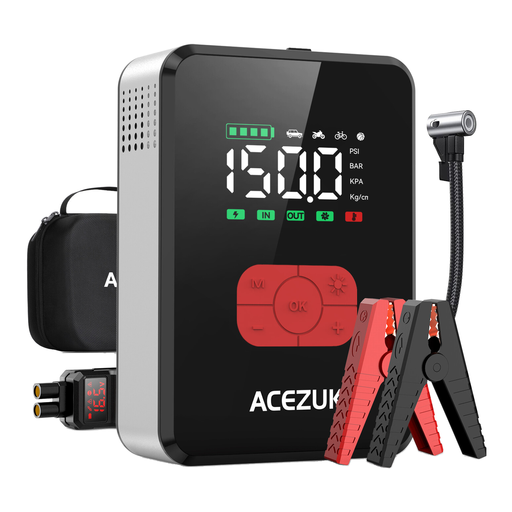
Why it suits this user type: According to the product description, this model is designed for larger vehicles and more intensive use, supporting petrol and diesel engines up to 12 litres. The built-in power bank is handy for long journeys and outdoor use.
The product specifications list a 3.3-inch screen, automatic shut-off and four adjustable modes. This lets you check the set tyre pressure instead of inflating for a set amount of time.
7000A peak current according to the product information, 26800mAh capacity, USB outputs, LED modes and smart safety clamps with a warning system.
We’ve put together a comprehensive, up-to-date list of products that meet these strict selection criteria and the applicable European safety regulations.
Read the instructions and fully charge the car battery booster before use. Switch off the vehicle, check the positive and negative terminals, and connect the red clamp to the positive terminal. Connect the black clamp as instructed for the device. Don’t try to start a vehicle with a damaged, leaking or frozen battery.
When inflating a tyre, first set the desired pressure. Then check the tyre pressure with a reliable gauge. A jump starter compressor is intended for emergencies and topping up, not necessarily for prolonged professional use.
No. Most models are designed for 12V vehicles, but the permitted engine capacity and fuel type vary. Always check the product’s limits for petrol and diesel engines. A model suitable for a small car may not be suitable for a heavy SUV or truck.
That depends on the battery capacity, storage temperature, use and charging habits. Fully charge the device before first use and check its charge level regularly. Some product descriptions recommend recharging every two to three months. If a jump starter is stored flat for a long time, it may not provide enough power when you need it.
The device draws power from its internal lithium battery. Energy use depends on the number of starts, how long you spend inflating tyres and whether you charge other devices using the power bank. The compressor uses a relatively large amount of energy, so let it cool down after extended use and then recharge the jump starter.
