
Vandaag of morgen in huis

Kwaliteit gegarandeerd

Welkomstaanbiedingen ontgrendelen: GRATIS bezorging | Tot 80% korting | Gratis 30 dagen JoyPlus-proefperiode
Download de app
A flat battery or a soft tyre usually strikes at the worst possible time: on the motorway, in a dark car park or just before you set off. A car jump starter with compressor combines an emergency starter for a 12V battery with a portable tyre inflator. Some models also work as a power bank for your car and have a jump starter with LED light for use in the dark.
However, not every combination is suitable for every vehicle. A high amp rating on the packaging, for example, doesn’t tell you everything about diesel compatibility, battery capacity or how well the compressor works in practice. So, watch out for these common pitfalls.
A powerful car jump starter may quote a high peak current, but always check which engine sizes and fuel types the model is designed for. A booster for a compact petrol car isn’t automatically suitable as a jump starter for an SUV or diesel vehicle.
Check for:
A 24V lorry or an electric car’s high-voltage battery falls outside the usual intended use of these products. If in doubt, check your vehicle’s specifications and manual.
A 150 PSI tyre inflator may quote a maximum pressure, but that doesn’t mean a car tyre should be inflated to 150 PSI. The recommended tyre pressure for passenger cars is usually much lower and can be found on the sticker inside the door frame, on the fuel flap or in your car’s manual.
More important than the maximum pressure alone are:
Always follow the vehicle manufacturer’s recommended tyre pressure. A compressor with a high maximum pressure is useful as a technical margin, not as a target pressure.
A jump starter is still a lithium battery with a powerful current output. Protection against reverse polarity, short circuits, overheating and overcharging is therefore important. These features reduce the risk of incorrect use, but they don’t replace the manual.
Pay attention to storage, too. Don’t leave a jump starter in a hot, enclosed car for long periods, and recharge it after use. Many manufacturers recommend topping up the battery periodically, even if you haven’t used the booster. Its actual lifespan depends on storage temperature, charging habits and how intensively it’s used.
A compact model may be enough for a small petrol car. For an SUV, diesel car or van, it’s sensible to allow more headroom. Don’t just look at the “A” rating; check the engine size explicitly stated in the product information, too.
According to the product information, the GOOLOO A3 is suitable for 12V vehicles, with petrol engines up to 9,0 litres and diesel engines up to 6,5 litres. The manufacturer also lists a BOOST function for very low battery voltage, but this won’t necessarily restore a completely faulty or damaged battery.
A jump starter with an air compressor is handy for a slow puncture, motorbike tyre, bicycle tyre or ball. Check whether the device has a digital pressure gauge and automatic shut-off. This lets you set the required pressure in advance, so you don’t have to check it manually as often.
A compressor can get hot during use. Follow the maximum run time in the manual and let the device cool down when instructed. A powerful tyre inflator with jump starter isn’t designed to replace a fixed garage compressor for inflating lots of tyres in a row.
A larger capacity can be useful for multiple starting attempts or charging phones, but a bigger device also takes up more space. Check:
A display showing battery level, tyre pressure and error messages makes the device easier to use. Do check that the cables and accessories supplied are suitable for your needs.
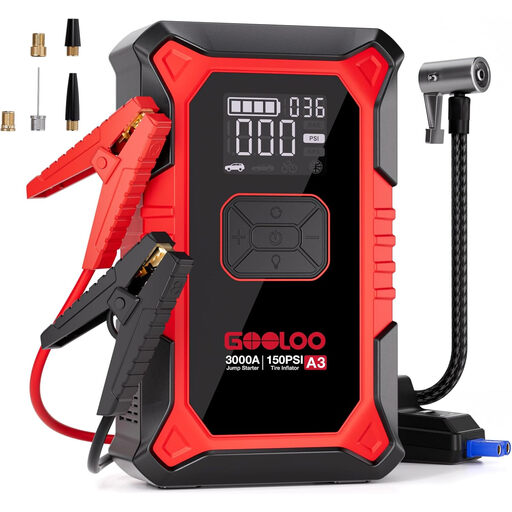
Why it suits this profile: This model combines a 12V emergency starter, compressor, LED light and power bank in one portable device. According to the product information, it supports petrol engines up to 9,0 litres and diesel engines up to 6,5 litres.
The specifications list both engine size and fuel type. The compressor has a display, automatic shut-off and five inflation modes.
3000A peak current, 150 PSI maximum pressure, 35 l/min airflow and ten listed safety features.
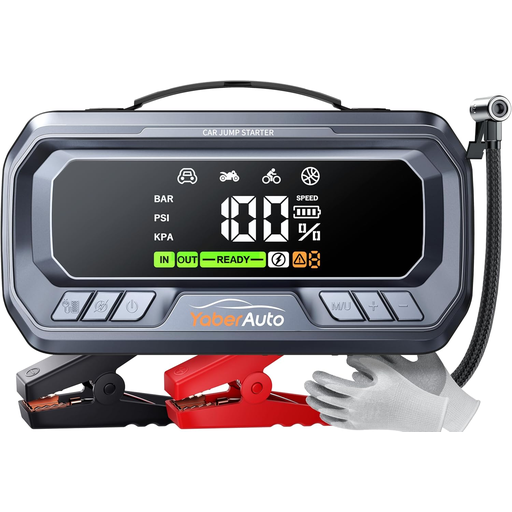
Why it suits this profile: The YA90 is designed for drivers who want to charge laptops, tablets or other devices as well as jump-starting and inflating tyres. The product information lists USB-C PD up to 65W, a 160 PSI compressor and a 3,3-inch LCD screen.
The screen shows both set and current readings. The manufacturer also lists temperature monitoring and a forced-start function for emergencies.
6500A listed peak current, 16.000mAh battery, 600 lumen light and 12–16V/10A DC output.
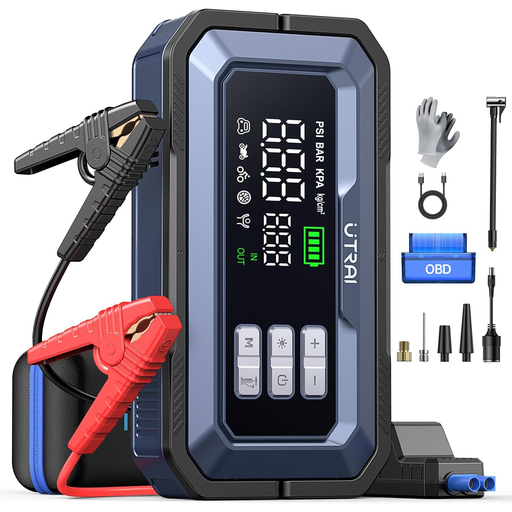
Why it suits this profile: According to the product information, this model is designed for 12V cars, SUVs, diesel vehicles up to 14 litres and hybrid models. The 160W DC output may be suitable for certain 12V devices.
The stated limits for use are clearly listed. The compressor has temperature protection, automatic shut-off and four pressure units.
7000A listed peak current, 150 PSI maximum pressure, 2000 lumen light and OBD2 adaptor included.
We’ve put together a complete, up-to-date list of products that meet these strict selection criteria and the applicable European safety regulations.
No. Check that your car has a 12V system and compare its engine size and fuel type with the product specifications. Don’t use a 12V booster with a 24V system. Hybrid vehicles may have additional requirements, so always follow the car and jump starter manuals.
Park the car safely and check the recommended tyre pressure. Connect the hose securely, choose the correct unit and set the target pressure on the display. Let the automatic shut-off do its job if the feature is available. Don’t touch the hose or connector straight after prolonged inflation, as they may be hot.
Lifespan varies depending on the battery type, storage temperature and charging frequency. Recharge the device after use and check it every few months. Store it somewhere dry and out of direct sunlight. A jump starter isn’t a permanent battery charger: if your car battery keeps going flat, it’s a good idea to have a garage check it.
