
Vandaag of morgen in huis

Kwaliteit gegarandeerd

Welkomstaanbiedingen ontgrendelen: GRATIS bezorging | Tot 80% korting | Gratis 30 dagen JoyPlus-proefperiode
Download de app
A flat car battery or a soft tyre rarely happens at a convenient time. With a car jump starter with compressor, you can often start a 12V vehicle yourself and adjust your tyre pressure. It’s a practical option for car drivers, SUV and lorry owners, motorcyclists, caravan owners, and anyone who travels frequently or ventures beyond built-up areas.
However, not every portable car battery jump starter is suitable for every vehicle. Marketing claims such as a high peak amperage, 150 PSI or ‘suitable for all vehicles’ only tell you so much unless you also check the specifications behind them.
Manufacturers often quote a high peak current, such as 3000A, 6500A or 7000A. However, peak current isn’t always the same as the current the device can deliver during a normal start. So check the stated starting current, vehicle compatibility and maximum engine capacity too.
Pay particular attention to the difference between petrol and diesel engines. A diesel engine generally needs more starting power. If you’re looking for a jump starter for a diesel car, SUV or commercial vehicle, it’s best not to base your decision solely on the highest amperage in the product title.
A 150 PSI tyre inflator or a battery booster with a 160 PSI air compressor sounds powerful. But PSI mainly tells you the maximum pressure, not how quickly a car tyre will inflate. Check the airflow, hose length, automatic shut-off and recommended operating time too.
A high maximum pressure is useful for different applications, but for a car, setting the correct tyre pressure accurately matters more than simply choosing the highest figure.
A jump starter power bank is only useful when its internal battery has enough charge. Lithium batteries slowly lose charge and may perform less well in low temperatures. Check the charge level every two to three months and recharge the device according to the instructions.
Don’t leave a car emergency starter in direct sunlight or in a very hot, enclosed car for extended periods. Also check whether the supplied cables, clamps, air nozzles and storage bag are included.
A 12V jump starter is designed for vehicles with a 12V electrical system. Also check the maximum engine capacity for petrol and diesel engines. A compact model is often enough for a small city car. For an SUV, campervan, pick-up or lorry, a higher stated capacity makes more sense.
Don’t use a jump starter on a visibly damaged, leaking or frozen battery. A jump starter also won’t fix a faulty battery or a vehicle charging problem.
At a minimum, look for protection against reverse polarity, short circuits, overheating and overloading. Smart clamps may warn you if they aren’t connected correctly, but always check the positive and negative terminals yourself.
The red clamp should go on the positive terminal (+), and the black clamp on the negative terminal (-) or a suitable earth point, depending on the instructions. Don’t let the clamps touch each other away from the battery. Use forced-start mode only when you’re certain the clamps are connected correctly and the normal starting procedure doesn’t work.
A jump starter with an LCD display can show the charge level, set tyre pressure or an error message. An automatic shut-off prevents the compressor from continuing to run once it reaches the set pressure. A built-in light with a white beam, flashing mode or SOS function can be useful if you break down in the dark.
A USB-A or USB-C port also makes the device useful as a portable power source. If you want fast charging, check the output ratings: according to their product specifications, some models support USB-C PD up to 65W, while others only offer a standard USB output.
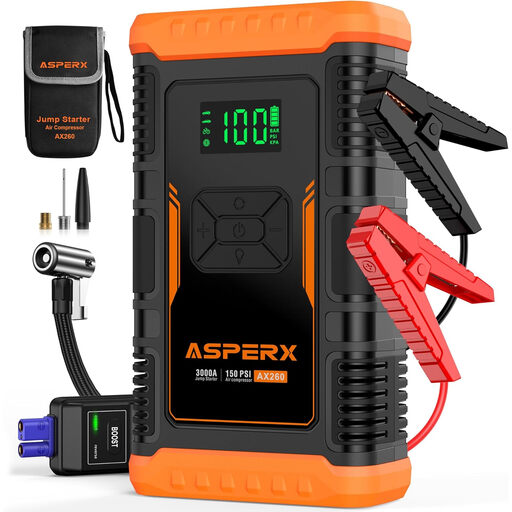
Why it suits this profile: This model combines a car jump starter, air compressor, power bank and light in one portable device. According to the product information, it’s suitable for 12V vehicles and engines up to the stated petrol and diesel capacity.
The LCD display, pre-set pressure and automatic shut-off make it easier to use than a compressor without a pressure display.
3000A stated peak current, compressor up to 150 PSI, LCD display, LED light and USB charging function, according to the product description.
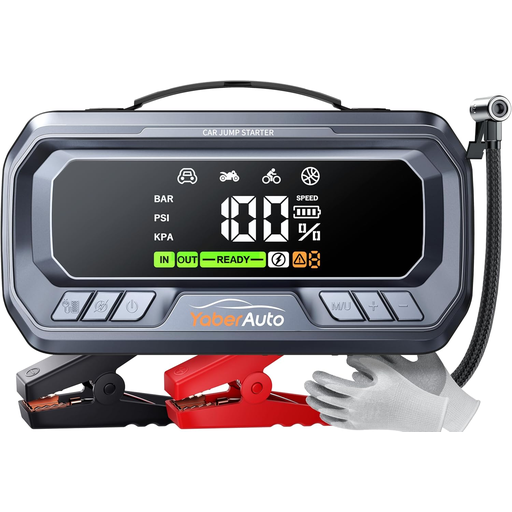
Why it suits this profile: The product specifications list a 160 PSI compressor, 3.3-inch LCD screen, 65W USB-C PD and support for larger vehicles. It’s a good fit for drivers who want to inflate tyres and power mobile devices as well as start their vehicle.
Before buying, check the stated starting and peak currents: the title and technical table give different figures. That way, you won’t rely on ‘6500A’ alone.
160 PSI compressor, automatic pressure shut-off, 65W USB-C PD, 600-lumen light according to the product information, and a storage bag included.
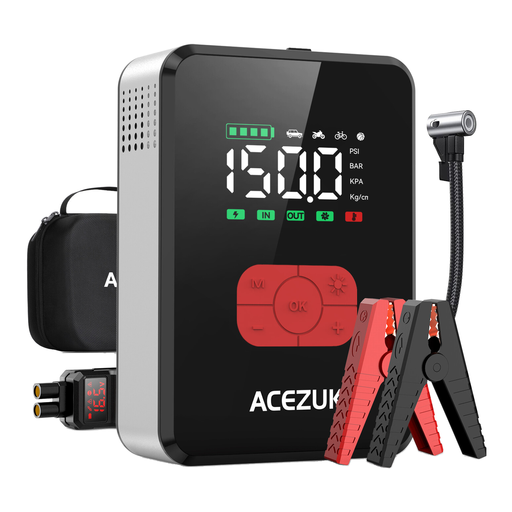
Why it suits this profile: According to the product information, this model is designed for larger petrol and diesel engines and extended use on the road. The combination of compressor, display, light and storage bag makes it a good match for SUV, campervan and commercial vehicle owners.
The pressure setting, automatic shut-off and safety warnings help reduce the need for prolonged checking and prevent incorrect connections.
7000A stated peak current, 26800mAh capacity, 150 PSI compressor, 3.3-inch screen and three light modes, according to the product description.
We’ve put together a complete, up-to-date list of products that meet these strict selection criteria and current European safety regulations.
Only use the forced-start function when the connections are correct, and only if normal mode doesn’t work. For some models, the manufacturer gives an operating and storage temperature of around -20 °C to 60 °C; check the instructions for your specific device.
No. Check that your vehicle has a 12V system and compare the stated petrol and diesel engine capacities with your car. A model for a small petrol engine won’t necessarily be suitable for a diesel SUV or lorry.
Its lifespan depends on charging cycles, storage temperature, how long it’s used for and how well it’s maintained. Don’t run the compressor continuously for longer than necessary, recharge the jump starter periodically, and store it somewhere dry and out of direct sunlight.
The direct electricity cost is usually limited to charging the internal battery. The cost depends on the battery capacity, how often you charge it and the price of electricity. A model with USB ports can also charge phones or other devices, combining several functions in one device.
