
Vandaag of morgen in huis

Kwaliteit gegarandeerd

Welkomstaanbiedingen ontgrendelen: GRATIS bezorging | Tot 80% korting | Gratis 30 dagen JoyPlus-proefperiode
Download de app
A flat battery or soft tyre always seems to happen at the worst time: on your way to work, during a holiday or in a dark car park. A car jump starter with compressor combines a portable car battery booster with a tyre inflator, power bank and often LED emergency lighting.
However, not every model is suitable for every car. High amp ratings and a pressure of 150 PSI may sound impressive, but they don’t tell you everything about ease of use, vehicle compatibility or lifespan. Keep these points in mind to avoid making the wrong choice.
A rating such as 3,000A, 5,500A or 7,000A usually refers to the maximum peak current, not the current the device supplies continuously. Whether it’s suitable also depends on engine size, fuel type, battery condition and the quality of the jump leads.
So always check:
A 12V jump starter is not suitable for 24V lorries. You mustn’t try to start an electric car’s high-voltage battery with a conventional car jump starter either.
A 150 PSI tyre inflator may have a high maximum pressure rating, but that doesn’t mean you should inflate your car tyre to 150 PSI. Always use the tyre pressure specified in your owner’s manual, on the sticker inside the door frame or by the fuel filler flap.
Pay particular attention to:
For regular use, airflow is often more practical than maximum pressure alone. A car tyre compressor with an airflow of around 35 litres per minute, for example, is designed for relatively quick top-ups, while a smaller model may take longer.
A portable car battery booster only works if its internal battery has enough charge. If a device sits unused in your car for months, it may be less useful when you need it.
Good habits to follow:
Choose a car battery starter to suit your own vehicle. A model rated for engines up to 4 or 5 litres may be enough for a small petrol car. For an SUV, van or diesel car, it’s sensible to allow more headroom.
Be aware of the difference between:
These figures are claims made by the brands. Check the manual and your car’s specifications before ordering. Don’t use a jump starter with a damaged, leaking or frozen battery.
A jump starter with an air pump is particularly useful for adjusting tyre pressure on the road. Automatic shut-off means you don’t have to stand beside the tyre throughout, but once you’ve finished inflating it, check the pressure against the figure specified for your vehicle.
A digital display is useful if it shows all of the following:
Look for reverse polarity protection, short-circuit protection, overheat protection and overcharge protection. These features reduce the risk of damage if the clamps are connected incorrectly, but the red clamp should still go on the positive terminal and the black clamp on the negative terminal or a suitable earth point.
A car power bank, USB ports and LED emergency lighting are useful extras. However, they don’t replace a warning triangle or other legally required safety equipment.
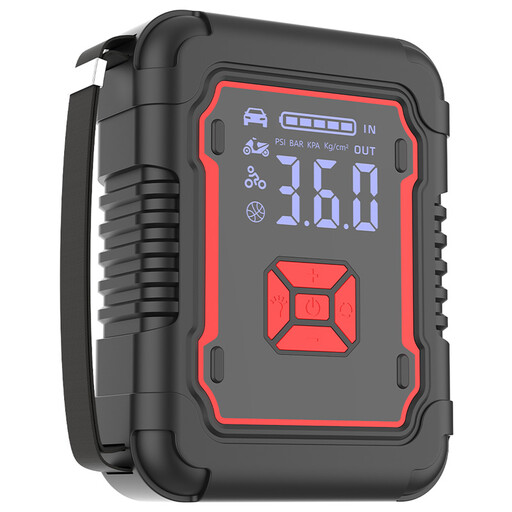
Why it suits this type of user: A compact combination for motorists looking for a basic solution for 12V cars, tyres and mobile devices.
The product information lists a 3,000A peak current, a 150 PSI compressor, automatic shut-off and an LCD pressure display. Make sure your engine size is within the stated limits.
Stated battery capacity of 20,000mAh, QC3.0 output, three-mode LED lighting and support for 12V petrol and diesel vehicles.
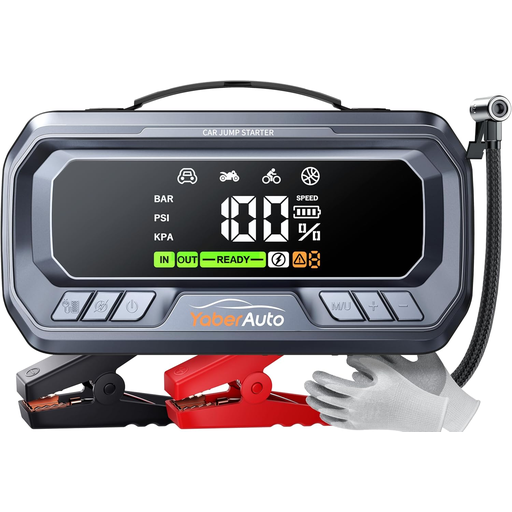
Why it suits this type of user: Designed for drivers who value a fast power supply and an extensive display, as well as jump-starting and inflation.
The product information lists a 160 PSI pump with automatic shut-off, a 3.3-inch screen and a forced-start function for emergencies. Use this function only when the connections are correct.
Peak current of 6500A according to the product information, 65W USB-C PD, a 160 PSI compressor and multi-mode LED lighting.
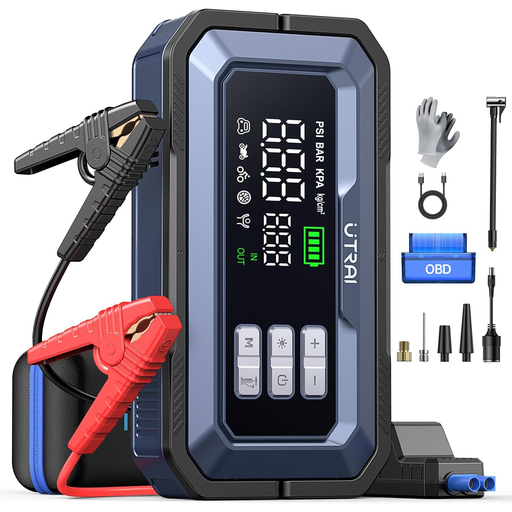
Why it suits this type of user: A good option for SUV, van and diesel drivers who want extra 12V functionality and powerful emergency lighting.
The specifications list temperature protection for the pump, five inflation modes and four pressure units. The relatively extensive kit does require more storage space.
Peak current of 7000A, support for diesel engines up to 14 litres according to the product information, a 150 PSI pump, 160W DC output and 2,000-lumen LED lighting.
We’ve put together a complete, up-to-date list of products that meet these strict selection criteria and the applicable European safety regulations.
Turn off the car and switch off all electrical equipment. Connect the red clamp to the positive terminal and the black clamp to the negative terminal or a suitable earth point. Check the indicators on the cable, then follow the instructions in the manual. Don’t try to start the engine for more than a few seconds at a time. Once the engine has started, remove the cables in the reverse order specified.
It depends on battery capacity, charging cycles, storage temperature and maintenance. The charging cycles quoted by brands are specifications from their product information, not a guarantee for every use. Regular charging, dry storage and avoiding heat help keep the lithium battery in good working order.
For occasional use, the electricity required to charge it is usually modest. The compressor does use noticeably more energy than the USB output. The exact cost depends on the battery capacity, charging losses and how often you inflate tyres. So don’t look at mAh alone: check the stated Wh capacity, charging time and operating time too.
