
Vandaag of morgen in huis

Kwaliteit gegarandeerd

Welkomstaanbiedingen ontgrendelen: GRATIS bezorging | Tot 80% korting | Gratis 30 dagen JoyPlus-proefperiode
Download de app
A flat battery and a soft tyre often strike at an inconvenient moment: on the motorway, at a campsite or just before you leave for work. A car jump starter with compressor can tackle two practical problems at once: provide support for a 12V battery and top up your tyres. Some models also work as a power bank for your car, offer LED emergency lighting and even read OBD2 fault codes.
However, a high amp rating or the word “multifunctional” on the box doesn’t tell you everything. Before you order, look out for these common pitfalls.
A rating such as 3000A, 4500A or 7000A sounds impressive, but suitability also depends on the 12V application, engine capacity, battery condition and cables. Always check which petrol and diesel engines the manufacturer says the product is suitable for.
A diesel jump starter generally needs more starting power than a model for a small petrol engine. For an SUV, van or campervan, the stated maximum engine capacity is more relevant than the peak current alone.
150 PSI is the maximum pressure a compressor can reach according to the product specifications. It doesn’t automatically mean it will inflate a car tyre quickly. The actual speed depends on factors including airflow, hose, battery level and heat build-up.
Also check whether the pump has a digital tyre pressure gauge, an automatic stop function and a suitable valve connection. A small air pump for balls or bicycle tyres is not the same as a portable air compressor for car tyres.
A hybrid car jump starter is generally intended for the 12V battery, not the high-voltage system. Always follow the car manufacturer’s instructions. Don’t use a jump starter on connections that aren’t designed for 12V, and don’t try to force a faulty or frozen battery to start.
Look for three details:
A powerful car battery starter for an SUV or diesel van needs to suit the vehicle you actually drive. If in doubt, a model with a wider stated compatibility range may be more practical, but bear in mind that these claims come from the brand’s product information.
Ideally, a good car air pump has:
Don’t run a compressor continuously without a break. Some models specify a maximum running time or recommend cooling breaks. This is important when inflating several tyres, large SUV tyres or campervan tyres.
Look for protection against reverse polarity, short circuits, overheating, overcharging and overloads. An LED light with an SOS or flashing mode can be useful if you break down in the dark. A USB-C connection means you can also use the device as a power bank.
A built-in OBD2 fault code reader can read fault codes, but it won’t fix a technical problem by itself. Check what a code means in your vehicle documentation or ask a garage to assess it.
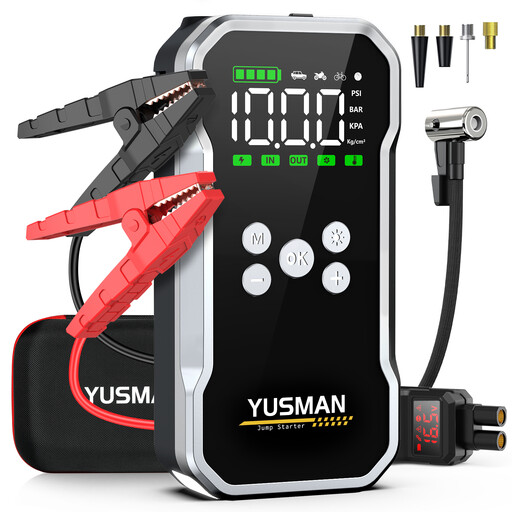
Why it suits this profile: This 4-in-1 model combines a jump starter, compressor, LED light and power bank for everyday use and longer journeys. According to the product description, it is suitable for petrol and diesel engines up to 7 litres.
The stated vehicle limit, 150 PSI compressor and LCD display make the key selection details clear. Check the current product specifications and running time before buying.
7000A peak current according to the product information, 150 PSI air pump, LCD display and storage case.
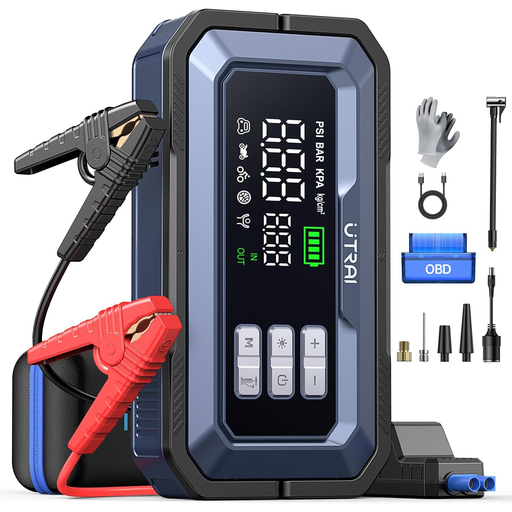
Why it suits this profile: The JS-30 is designed for motorists with a diesel, SUV, hybrid car or several 12V devices. According to UTRAI’s own information, the model supports diesel engines up to 14 litres and has a 160W DC output.
The specifications include a 150 PSI compressor, pressure settings with automatic shut-off, temperature protection and several safety features. This makes it easy to check the relevant functions.
OBD2 adapter, 2000 lumen LED panel, 18W USB-C PD and 160W 12V output according to the product description.

Why it suits this profile: According to the product specifications, this model is designed for 12V cars, SUVs, trucks and motorbikes. Its stated limits are petrol engines up to 9 litres and diesel engines up to 8 litres.
The BC02 offers five inflation modes, three pressure units and automatic shut-off. The manufacturer also recommends letting the compressor cool down after a maximum of 10 minutes.
4500A peak current, 150 PSI compressor, LCD screen, 500 lumen light and a stated temperature range of approximately -20 to 60 °C.
We’ve put together a complete, up-to-date list of products that meet these strict selection criteria and the applicable European safety requirements.
Fully charge your car jump starter before putting it in the car. Store it somewhere dry and out of direct sunlight for long periods. Check the battery level every few months, especially before a long journey or camping trip.
When jump-starting:
Before inflating your tyres, check the recommended tyre pressure on the door pillar, fuel flap or in the car’s manual. The figure on the side of the tyre isn’t always the recommended everyday pressure. Let the compressor cool down when the manual advises you to do so.
No. A 12V jump starter is designed for vehicles with a 12V starting system, but the suitable engine capacity and diesel limit vary between models. Check the condition of the battery too. A jump starter won’t replace a faulty battery or fix a problem with the electrical system.
Its lifespan depends on charging cycles, storage temperature, frequency of use and heat exposure. Charge the device as instructed in the manual, avoid deep discharge and don’t run the compressor for longer than permitted. A model with temperature protection may offer extra protection, but it doesn’t guarantee a particular lifespan.
The electricity costs are usually low because the compressor runs for a short time. With a built-in battery, you mainly pay to recharge the device. A 12V model powered by the car uses energy from the vehicle battery. Only leave the engine running if it’s safe and necessary according to the vehicle and product manuals.
