
Vandaag of morgen in huis

Kwaliteit gegarandeerd

Welkomstaanbiedingen ontgrendelen: GRATIS bezorging | Tot 80% korting | Gratis 30 dagen JoyPlus-proefperiode
Download de app
A flat battery or soft tyre rarely comes at a convenient time. With a car jump starter with compressor, you can often get back on the road by yourself, without waiting for breakdown assistance or another driver with jump leads. This type of device is a useful option for car drivers, motorcyclists, caravan and motorhome owners, and anyone who often drives outside the city.
However, not all models are equally suitable. A high current rating on the packaging, for example, doesn’t tell you everything about how useful a device will be. Nor does a compressor rated at 150 PSI automatically mean it’s suitable for extended use. So, pay particular attention to these common pitfalls.
The peak current, for example 1500A, 3000A or 4500A, indicates the starting capacity under certain conditions. Whether a device is actually suitable also depends on:
A model described as suitable for diesel engines up to 8.0 litres won’t necessarily be able to start every lorry battery. Always check the stated vehicle compatibility.
A built-in compressor is intended for emergencies and small tyre pressure adjustments. The maximum pressure of 150 PSI doesn’t tell you how quickly it will inflate a car tyre. Also check the airflow, for example in litres per minute, the maximum operating time and whether it has an automatic shut-off.
For example, the BuTure BC02 is listed with an airflow of 35 litres per minute, five preset modes and automatic shut-off. The manufacturer states that the compressor should not be used continuously for more than 10 minutes. Let the device cool down afterwards.
A cheap emergency starter without clear cable protection can be awkward to use when you’re working in the dark or under stress. Look for reverse polarity protection, short-circuit protection, a spark-free connection and overheat protection.
Also check exactly what’s included. A storage bag, USB-C cable, air hose, adaptor nozzles and clear instructions can make a difference in everyday use. For example, a jump starter power bank without a suitable charging cable may be less practical than you expect.
For a small petrol car or motorbike, a car battery jump starter with a lower stated peak current may be sufficient. For an SUV, motorhome, van or diesel car, it’s sensible to have more power in reserve. The models below, for example, are listed as supporting 12V vehicles.
Bear in mind that “12V” doesn’t mean a device is suitable for every vehicle. Check your car’s handbook and compare the maximum engine size in the product description with your vehicle.
A digital pressure reading is useful for tyres. Models with PSI, BAR and KPA units are better suited to different handbooks and tyre pressure gauges. A preset pressure and automatic stop help you avoid having to check the pressure manually throughout inflation.
Use the compressor in a safe place, park the car and follow the tyre pressure recommended by the car manufacturer. The figure on the side of the tyre is usually not the recommended pressure for driving.
A portable jump starter can also act as a power bank for a phone, tablet or sat nav. However, capacity alone doesn’t tell you how many times you’ll be able to start a car. Store the device somewhere dry, away from direct sunlight, and don’t leave it in a very hot car for long periods.
Recharge the jump starter after use. If you don’t use it for months, it’s a good idea to top it up periodically. GOOLOO’s product information recommends charging the GP4000 every two to three months.

Why it suits this type of user: This model combines a 12V jump starter with a tyre inflator rated up to 150 PSI, an LCD screen and four attachments. It’s a practical choice if you want to keep one device in your boot.
The product information lists automatic shut-off, several pressure settings and ten safety features. Before buying, check the stated maximum operating time for the compressor.
4500A peak current according to the product information, 150 PSI compressor, LCD display and four-mode LED emergency light.
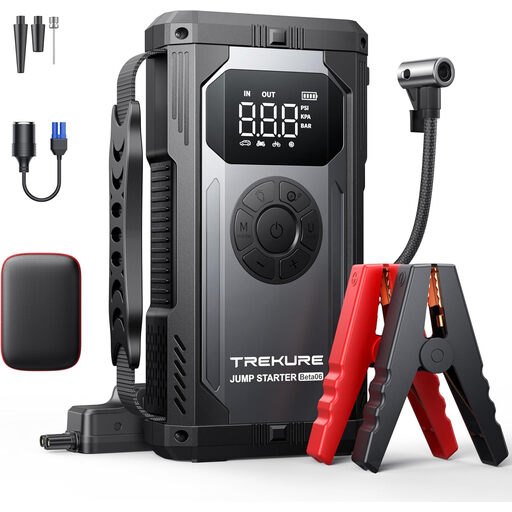
Why it suits this type of user: The combination of a 150 PSI compressor, LCD display, 12V output and several charging ports makes it a good fit for motorhome owners, SUV drivers and anyone who takes longer journeys.
The product information lists a pressure display, automatic stop and ten safety features. Use only the smart cables supplied and follow the instructions.
5500A peak current according to the product information, support for petrol and diesel engines up to 10.0 litres, plus USB-A, USB-C and 12V output.
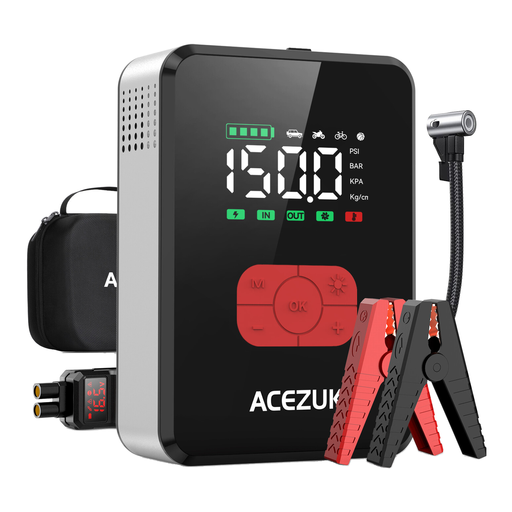
Why it suits this type of user: According to the product information, this model is designed for vehicles with larger engines. It combines a 150 PSI compressor with a 3.3-inch screen and a capacity of 26800 mAh.
According to the product description, the display shows the battery status and tyre pressure. This is useful when you’re on the road, but check in advance that the stated engine limit is suitable for your vehicle.
7000A peak current according to the product information, suitable for petrol and diesel engines up to the stated limits, with three LED modes and four compressor settings.
We’ve put together a complete, up-to-date list of products that meet these strict selection criteria and the applicable European safety requirements.
An LED emergency light with an SOS or flashing function can help you stay visible if you break down at the roadside. Also put out a warning triangle and wear a high-visibility vest if you need to work outside the car.
No. Check that your vehicle has a 12V battery and compare the stated maximum engine size and fuel type with your car. A jump starter for petrol and diesel engines may have different limits. If you’re unsure, consult your vehicle and product handbooks.
Its lifespan depends on charging cycles, storage temperature, use and maintenance. Recharge the device after use and check it regularly if you keep it in the car for long periods. Don’t store a lithium battery in extreme heat for an extended time.
Yes, according to the product specifications, a compressor with a maximum pressure of 150 PSI can be suitable for car tyres. However, also check its airflow and maximum operating time. Set the recommended tyre pressure and let the pump stop automatically if that function is available.
