
Vandaag of morgen in huis

Kwaliteit gegarandeerd

Welkomstaanbiedingen ontgrendelen: GRATIS bezorging | Tot 80% korting | Gratis 30 dagen JoyPlus-proefperiode
Download de app
A flat battery or soft tyre rarely happens at a convenient time. With a car jump starter with compressor, you can often get back on the road without having to wait for roadside assistance. But not every model is right for every car. A compact starter for a small petrol car needs different specifications from a powerful car jump starter for an SUV, van or motorhome.
Watch out for these three common pitfalls before you buy:
Most portable models in this category are designed for 12V vehicles. These usually include cars, motorbikes, SUVs and some vans. A 24V system for heavy goods vehicles or buses isn’t automatically compatible.
Next, compare the maximum engine capacity:
A higher peak current can provide extra headroom, but check the quality of the clamps, cables and safety features too. Product descriptions often list protection against reverse polarity, short circuits, overheating and overcurrent. Treat these as useful safety features, not a substitute for connecting the unit correctly.
A built-in tyre inflator with compressor is handy for a slow puncture, bicycle tyre or ball. As well as the maximum pressure, look for:
So, a 150 PSI tyre inflator isn’t necessarily faster. A model with a higher airflow may be better suited to car tyres in practice. Always use the tyre pressure recommended for your vehicle, which is usually shown on a sticker inside the door frame or in the handbook.
A car battery starter needs to be easy to reach when you need it. Check its weight, dimensions, storage case and cable length. A larger model with a compressor may offer more capacity, but it’ll also take up more space in the boot.
The car power bank function is useful for charging a phone, tablet or sat nav. An LED light with an SOS or flashing mode can help when checking your car at the roadside. Check the connections, though: USB-A, USB-C, USB-C PD and a 12V output don’t all offer the same charging options.
Read the instructions before use. In general, connect the red clamp to the positive terminal and the black clamp to the negative terminal or a suitable unpainted metal earth point. Crank the engine briefly, usually for no more than a few seconds at a time, and let the unit cool down between attempts.
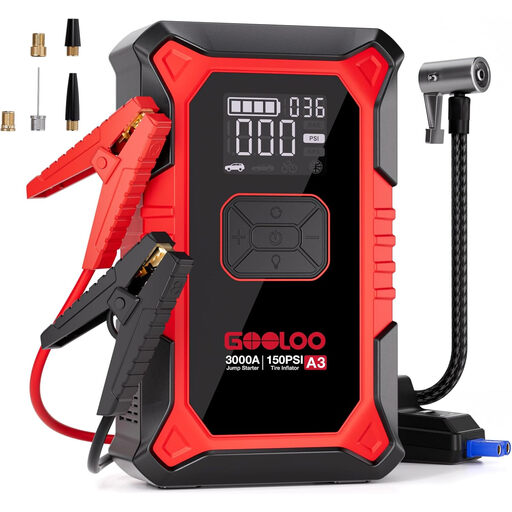
Why it suits this type of user: The A3 combines jump starting, inflation, lighting and charging in one device. Its specifications list 3000 A, 150 PSI, 35 litres per minute and support for engines up to 9,0 litres petrol or 6,5 litres diesel.
The product lists not only the maximum pressure, but also the airflow, five inflation modes, three pressure units and automatic shut-off.
3000 A peak current, 150 PSI compressor, digital pressure display, USB function and LED lighting.
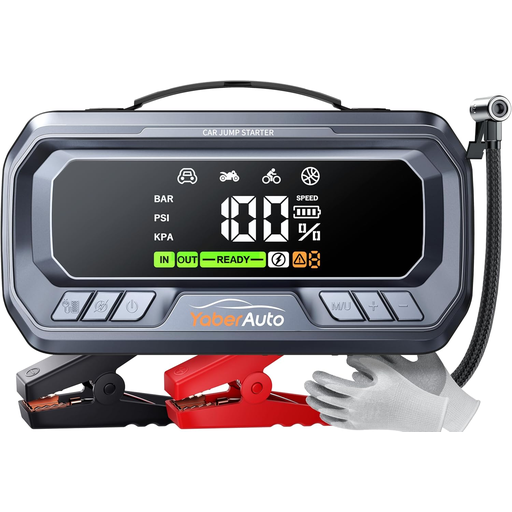
Why it suits this type of user: This model is designed for drivers who use several devices on the go. The product description lists a 6500 A peak current, a 160 PSI air pump, 65 W USB-C PD and a 3,3-inch LCD screen.
The product information gives separate details for charging power, compressor, screen, temperature monitoring and forced starting. Check compatibility with your car before buying.
65 W two-way charging, 160 PSI compressor, automatic shut-off and multi-mode lighting.

Why it suits this type of user: The BC02 is designed for larger vehicles and regular use on the go. According to the product specifications, it supports petrol engines up to 9,0 litres and diesel engines up to 8,0 litres.
As well as 150 PSI, the product page lists five inflation modes, four nozzles, three pressure units and a recommended cooling break after use.
4500 A peak current, LCD screen, automatic compressor shut-off, 500 lumen light and a stated two-year warranty.
We’ve put together a complete, up-to-date list of products that meet these strict selection criteria and current European safety requirements.
Yes, but prolonged exposure to heat isn’t good for a lithium battery. Ideally, keep the device in its supplied case, out of direct sunlight and not for long periods in a very hot, enclosed car. Check the charge level regularly and top up the car emergency jump starter as instructed in the manual.
Its lifespan depends on charging cycles, storage temperature and maintenance. Fully charge the device before first use and check it after a few months in storage. Don’t use a model with a damaged casing, loose cables, swelling or a leaking battery. Any stated lifespan or number of charging cycles comes from the brand’s product information and isn’t a guarantee for every use case.
The compressor runs on the jump starter’s internal battery. There are normally no additional running costs, but you’ll need to recharge the battery after use. The overall costs are therefore mainly the purchase price, the electricity used for charging and any replacement needed in the longer term. Also check whether a hose, nozzles and charging cables are included; buying accessories separately can increase the total cost.
