
Vandaag of morgen in huis

Kwaliteit gegarandeerd

Welkomstaanbiedingen ontgrendelen: GRATIS bezorging | Tot 80% korting | Gratis 30 dagen JoyPlus-proefperiode
Download de app
A flat battery or soft tyre is rarely convenient. A car jump starter with compressor combines a car jump starter, tyre inflator and power bank in one device. It’s a practical choice for drivers, SUV and van owners, motorcyclists, campers and travellers.
However, not every portable jump starter is suitable for every car. Big numbers on the packaging don’t tell the whole story. Before you buy, make sure you avoid the pitfalls below.
A rating such as 5,500A or 8,000A sounds impressive, but peak current isn’t the only measure of everyday performance. Check which engine sizes and engine types the car jump starter is designed for. Petrol and diesel engines don’t always need the same starting capacity.
Also check whether your vehicle uses a 12V system. A 12V jump starter isn’t designed for heavy 24V lorries or high-voltage electric vehicle batteries.
A 150 PSI tyre inflator may have a high maximum pressure rating, but that doesn’t tell you how quickly it will inflate a car tyre. Airflow, often listed in litres per minute, is just as relevant. In practice, a compressor with a flow rate of 35 L/min performs differently from one with a lower flow rate.
An automatic shut-off function and a clear display are more useful than a high PSI figure alone. Set the desired pressure, then always check the tyre pressure against your vehicle’s specifications or with a separate gauge.
Capacity in mAh tells you how much energy the internal battery can store, but actual performance also depends on temperature, age, charge level and the condition of your car battery. A completely damaged, leaking or frozen battery can’t simply be fixed with a car emergency starter.
So check whether the manufacturer specifies a minimum remaining charge. Many models recommend charging the jump starter sufficiently before use and topping it up regularly, even when it’s kept in the car.
Check these three things:
A high peak current is particularly relevant for larger engines, vans and SUVs. A lower-rated model may be sufficient for a compact petrol car. Use the product specifications as a guide, and follow the instructions in your vehicle and product manuals.
A car jump starter with air compressor is especially practical if it:
If the manual says to let a portable car tyre compressor cool down between uses, make sure you do so. Continuous use can cause it to heat up. Also, the maximum pressure isn’t necessarily the recommended tyre pressure for your car.
Look for reverse polarity, short-circuit, overheating, overload and overcharge protection. These features reduce the risk of damage if the device is used incorrectly, but they don’t replace the need to connect it properly.
As a general rule, connect the red clamp to the positive terminal and the black clamp to the negative terminal or a suitable unpainted metal earth point, following the manual. Never let the clamps touch each other. Don’t store a lithium battery in a very hot car for long periods, and recharge the jump starter regularly.
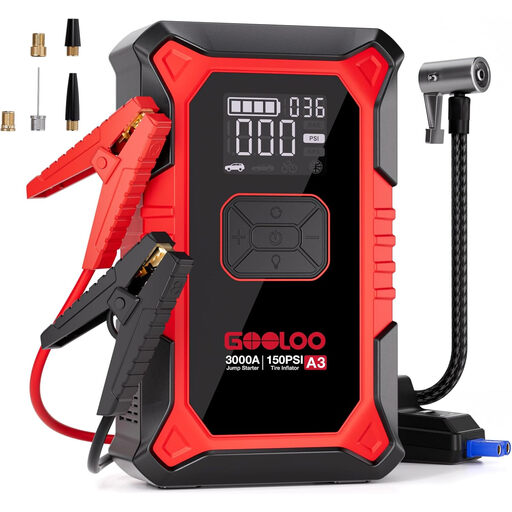
Why it suits this profile: This model combines jump starting, inflation and portable power in one compact device. According to the product description, it supports petrol engines up to 9.0 litres and diesel engines up to 6.5 litres.
The stated 150 PSI, 35 L/min and automatic shut-off tell you more than the maximum pressure alone. The LED display shows the set and measured tyre pressure.
Five inflation modes, three pressure units, USB charging and a stated battery life of up to 45 minutes of cordless inflation.
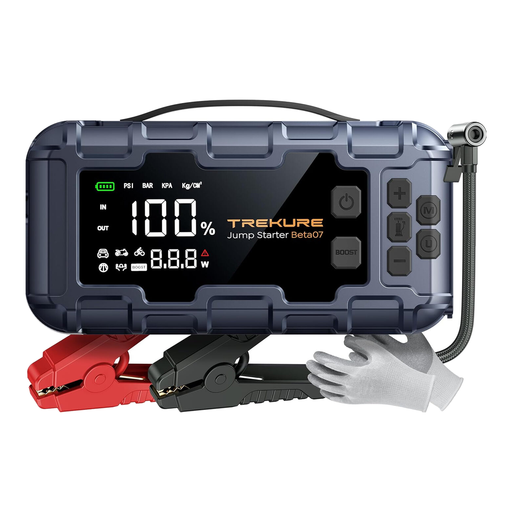
Why it suits this profile: The combination of 6,000A peak current, 160 PSI and a 3.3-inch display makes this a good fit for larger vehicles and for anyone who values extra charging options on the go.
As well as peak current, the product information lists an airflow of 45 L/min, five pressure settings and automatic shut-off at the set pressure.
45W USB-C PD, two USB-A ports, 600-lumen LED lighting and insulated gloves included.
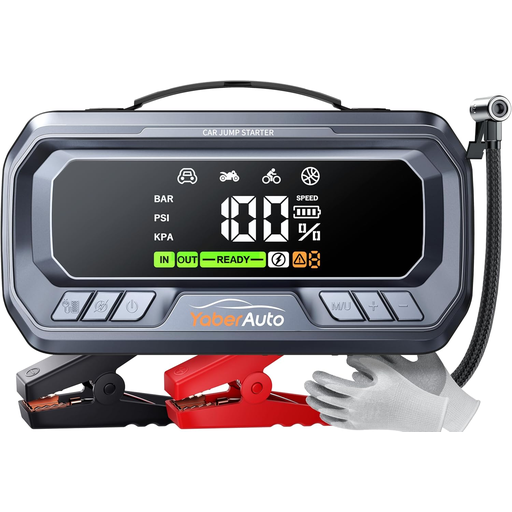
Why it suits this profile: Ideal for drivers who want to combine a car jump starter, portable compressor and portable power supply for long journeys, camping or use with extra 12V equipment.
Alongside a 6,500A peak current, the specifications list a 160 PSI compressor, 22-cylinder pump, pressure display and automatic shut-off. This lets you compare the features that matter individually.
65W bidirectional USB-C PD, 12–16V/10A DC output, 16,000mAh battery and four lighting modes with 600 lumens.
We’ve put together a complete, up-to-date list of products that meet these strict selection criteria and current European safety regulations.
No. Always check 12V compatibility, fuel type and maximum engine capacity. A model designed for petrol engines up to 10 litres isn’t automatically suitable for a diesel engine of the same capacity. Don’t use a jump starter with 24V systems or high-voltage electric vehicle batteries unless the manufacturer explicitly says it’s suitable.
Its lifespan depends on charging cycles, storage temperature and maintenance. Charge the device according to the manual and check its charge level before you set off. If you’re storing it for a long time, it’s a good idea to top it up periodically. Don’t leave it in direct sunlight or a hot car for months on end.
The compressor runs on the jump starter’s internal battery, so it doesn’t use fuel. However, inflating tyres uses a relatively large amount of power, especially if you’re inflating several tyres or using it for a long time. Recharge the battery booster with power bank after use. Also check that the hose and adapters are securely attached to avoid wasting energy.
