
Vandaag of morgen in huis

Kwaliteit gegarandeerd

Welkomstaanbiedingen ontgrendelen: GRATIS bezorging | Tot 80% korting | Gratis 30 dagen JoyPlus-proefperiode
Download de app
A flat 12V battery, a soft tyre or a dark roadside: with a car jump starter with compressor, you can deal with several problems yourself while you’re on the road. But not every device with “3000A” or “150 PSI” on the packaging is right for your car or the way you plan to use it.
For car drivers, motorcyclists, SUV owners and van drivers, the combination of starting power, compressor, safety and maintenance is particularly important. Read on to find out what to check before buying a portable car jump starter.
A peak current of 1500A, 3000A or 7000A sounds impressive, but it doesn’t tell you everything about how useful the device will be day to day. Check the following too:
A larger diesel engine may need more current to start. For example, a manufacturer might state that the device supports engines up to 9.0 litres for petrol and 6.5 litres for diesel. That’s no guarantee it will work with every battery condition or vehicle. So check the manual alongside your vehicle specifications.
A 150 PSI tyre inflator rating tells you the compressor’s maximum pressure, not the pressure you should inflate a car tyre to. You can usually find the recommended tyre pressure on the door frame, fuel flap or in the car’s manual.
Also look for:
A jump starter with an air pump is useful for topping up tyres and dealing with emergencies, but it’s no substitute for a professional check of a punctured or damaged tyre.
A car battery booster contains a powerful lithium or other type of battery. So choose a model with clear protection against short circuits, reverse polarity, overheating and overcharging. Also check whether the smart jump leads warn you if they’re connected incorrectly.
Store the device somewhere dry and don’t leave it in full sun for long periods. Check its charge regularly. Product information for various models recommends recharging every three to six months; some manufacturers even advise recharging every two to three months if the device is rarely used.
A 12V jump starter is designed for vehicles with a 12V battery system, such as many cars, motorbikes, SUVs and vans. A vehicle with a 24V system, such as some heavy commercial vehicles, isn’t automatically compatible.
Don’t just look at the peak current. Check:
A completely dead, damaged or frozen battery can’t always be helped by a car emergency starter. Some models have a boost function that can support a very low voltage, but that’s no guarantee either.
An automatic stop function is useful for tyres: set the pressure you want and the compressor stops when it reaches that level. Check that the units match the ones you use: PSI, bar or kPa.
Extra nozzles make a jump starter with air compressor suitable for bicycle tyres, balls and other inflatables. That’s useful for campers and outdoor enthusiasts, but check how long it can be used for. A compressor can get hot, so follow the maximum continuous running time in the manual.
A jump starter can also work as a mobile car power bank, charging a smartphone, tablet or sat nav. Check the number of USB ports and the charging standard, such as USB-C or QC3.0. An LED light with steady, flashing and SOS modes can be useful if you break down in the dark.
Think of these features as extras. Your main priorities should still be suitable starting capacity, safe cables and a compressor that meets your needs.
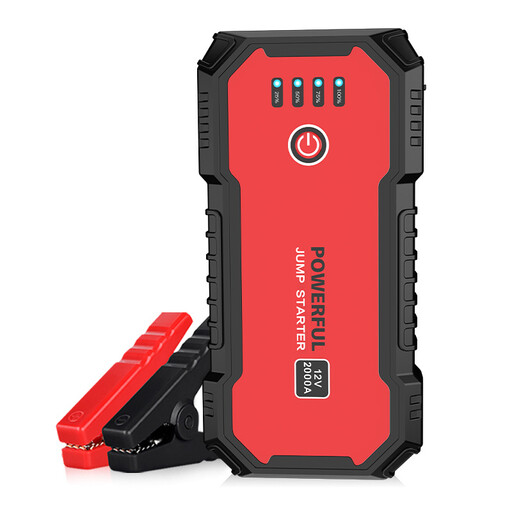
Why it suits this type of user: This compact model is designed for drivers who want to keep a simple car jump starter, power bank and LED light in their car. The product information states that it supports 12V petrol and diesel vehicles.
The LCD display shows the remaining charge, so you’re less likely to set off with a flat device. Be sure to check the recommended engine capacity yourself.
1500A peak current according to the product listing, USB charging, three light modes and a weight of around 430 grams.

Why it suits this type of user: This model combines a higher stated peak current with a digital compressor, LCD screen and several safety features. It’s a good fit for drivers who want one versatile device.
The listing mentions 10 layers of protection, automatic shut-off and a pressure display. Use the compressor as recommended to help prevent overheating.
4500A peak current, compressor up to 150 PSI, five inflation modes, four nozzles and support for up to 9.0 litres petrol or 8.0 litres diesel according to the product specifications.
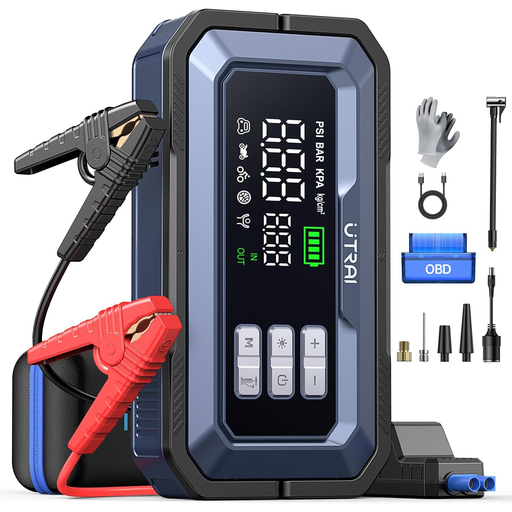
Why it suits this type of user: This larger device is designed for anyone who wants more than just jump-starting and inflation. It also offers a 160W DC output, OBD2 adapter and extensive lighting for trips or outdoor activities.
The product information specifies temperature protection for the battery and compressor, a display and several safety features. Check in advance that it will fit in your storage space.
7000A peak current, compressor up to 150 PSI, 160W DC output, OBD2 diagnostic adapter and a stated light output of 2000 lumens.
We’ve put together a complete, up-to-date list of products that meet these strict selection criteria and current European safety regulations.
You can if the product information lists both fuel types and your engine capacity. A 12V jump starter isn’t automatically suitable for 24V systems. Check your vehicle’s manual too.
Its lifespan depends on storage temperature, how often it’s charged and how it’s used. Recharge the device periodically, even if you don’t use it. For some models, manufacturers state that they can withstand hundreds or more than a thousand charging cycles, but this is a stated product specification, not a guarantee for every use case.
A maximum rating of 150 PSI means the compressor can reach that upper limit. Always set the tyre pressure recommended by the car manufacturer. Automatic shut-off and a digital pressure gauge make topping up easier, but check the tyre for damage or leaks afterwards.
