
Vandaag of morgen in huis

Kwaliteit gegarandeerd

Welkomstaanbiedingen ontgrendelen: GRATIS bezorging | Tot 80% korting | Gratis 30 dagen JoyPlus-proefperiode
Download de app
A flat battery or underinflated tyre rarely happens at a convenient time. A car jump starter with compressor combines a car battery booster with a portable tyre inflator, power bank and emergency light. This gives you more options on the road than jump leads or a separate air compressor for car tyres.
However, not every jump starter is suitable for every vehicle. High amp ratings on the packaging, a maximum pressure of 150 or 160 PSI and terms such as “intelligent protection” only mean something if the underlying specifications suit your intended use.
A high peak current sounds appealing, but the suitability for your engine also depends on the type of vehicle, engine capacity, battery voltage and battery condition. A model for a small petrol car is not automatically suitable as a jump starter for an SUV or truck.
Therefore, always check:
A jump starter cannot guarantee that a damaged, frozen or leaking battery will start. Do not use the device in such circumstances.
PSI indicates the maximum pressure, not how quickly a tyre is inflated. For passenger cars, the recommended tyre pressure is usually much lower; check the sticker on the door pillar, fuel flap or in the owner’s manual.
In addition to the maximum pressure, look for:
A compressor can become hot during inflation and for a short while afterwards. Do not touch the hose immediately and follow the maximum operating time stated in the manual.
Reverse polarity, short circuits, overheating and overloading are risks that many models offer protection against. According to the product information provided by the relevant brands, some models feature several layers of protection. This does not remove the need to connect the device correctly.
When using a car jump starter, connect the red clamp to the positive terminal and the black clamp to the negative terminal or a suitable unpainted metal earth point, depending on the manual. Never allow the clamps to touch each other. Use only the supplied jump leads and check the connection before attempting to start the engine.
Look at the combination of peak current, starting current and engine limit. The stated peak current is a short-term maximum; the regular starting current may be lower. For a compact petrol car, 1,500 A may be sufficient according to the product specification, while a larger diesel engine may require a model with broader stated compatibility.
A 12V jump starter is not suitable for a 24V system. Also check whether your vehicle is a hybrid and which 12V battery it uses. Electric vehicles with a high-voltage battery are not covered by the compatibility stated for these products.
A 150 PSI tyre inflator or 160 PSI model offers a generous maximum pressure, but this does not directly indicate how practical it is for everyday use. An LCD screen, preset pressure and automatic shut-off make inflation easier to monitor. Check that the pressure is shown in the correct unit: PSI, bar or kPa.
A car jump starter with compressor is primarily an emergency solution for an underinflated tyre or a small loss of pressure. If you have a flat tyre, have the problem inspected. The compressor cannot repair a damaged tyre.
Capacity is often stated in mAh or Wh. A larger battery can provide more starts or longer power delivery, but it will usually also make the device heavier. Consider the balance between size, weight and intended use.
Useful connections include:
A jump starter is a power bank for cars, not a permanent car battery charger. Recharge the device after use and check its charge level every few months, even if it is kept in the boot.
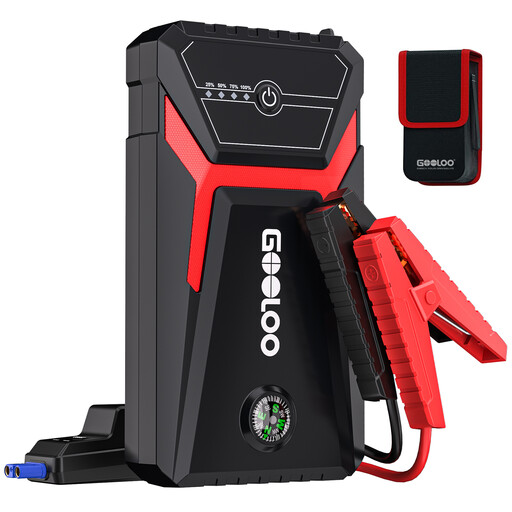
Why it suits this profile: This compact model is designed for 12V vehicles and, according to the product information, supports petrol engines up to 6.0 litres and diesel engines up to 4.0 litres. It is suitable for drivers who are mainly looking for a straightforward car battery booster.
The product specification states vehicle and engine limits, so you do not have to rely solely on the amp rating. According to GOOLOO, the smart cable features several safety functions.
1,500 A peak current, USB outputs, 400-lumen LED lighting and a stated weight of 0.878 kg.
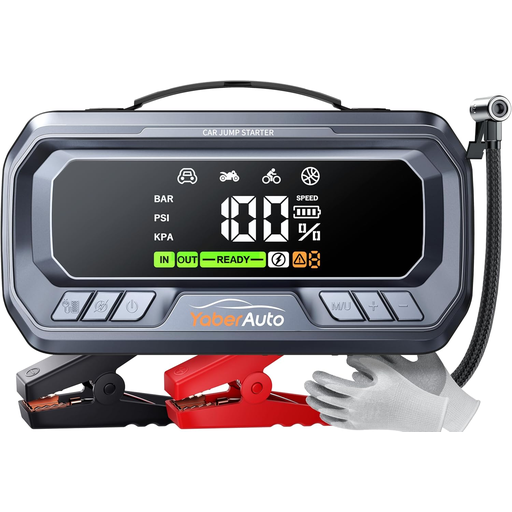
Why it suits this profile: The combination of a stated 160 PSI compressor, 3.3-inch LCD screen and 65W USB-C PD is ideal for anyone who wants to keep one comprehensive emergency device in the car.
The pressure is adjustable and, according to the product information, the pump stops automatically. When buying, however, check the stated starting current and vehicle limit, as the product description lists different current ratings.
16,000 mAh, USB-C 65W bidirectional charging, 600-lumen lighting and a carry case.

Why it suits this profile: According to the product information, this model is designed for 12V cars, SUVs, trucks and motorbikes, supporting petrol engines up to 9.0 litres and diesel engines up to 8.0 litres.
According to the product specifications, the LCD displays the battery status and tyre pressure. The compressor has an automatic shut-off, and the manual recommends taking breaks after a maximum of 10 minutes of use.
4,500 A peak current, 150 PSI, five pressure modes, four valves, 500-lumen LED and ten stated safety features.
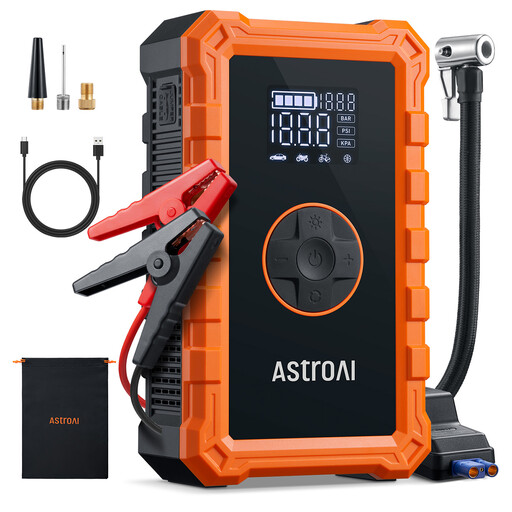
Why it suits this profile: This model combines a 12V starting function with a compact compressor and digital controls. According to the product information, it is intended for petrol engines up to 6.0 litres and diesel engines up to 3.0 litres.
The digital gauge, five preset modes and automatic shut-off reduce the need for manual checks. However, the stated rest period after using the compressor remains important.
1,500 A peak current, 150 PSI, 25 litres per minute according to the product information and a 2.4-inch screen.
We have put together a complete, up-to-date list of products that fully meet these strict selection criteria and the applicable European safety regulations.
Usually not in the same way as a traditional battery charger. A jump starter provides temporary starting power. For slow charging and maintenance, you need a suitable car battery charger.
Its service life depends on charging cycles, storage temperature and maintenance. Do not leave the device in a hot car for long periods. Recharge it every few months as instructed in the manual and check the cables, clamps and casing before use.
Yes, the maximum pressure will generally provide sufficient range for car tyres. Always set the tyre pressure recommended by the vehicle manufacturer. Also consider the inflation speed, automatic shut-off and maximum operating time; 150 PSI alone does not determine how practical the compressor is.
