
Vandaag of morgen in huis

Kwaliteit gegarandeerd

Welkomstaanbiedingen ontgrendelen: GRATIS bezorging | Tot 80% korting | Gratis 30 dagen JoyPlus-proefperiode
Download de app
A flat car battery or soft tyre usually happens at the worst possible time: on the way to work, during a weekend trip or in a dark car park. A car jump starter with compressor combines a car battery booster with a portable air compressor for car tyres. This means you can try to start a 12V vehicle and top up a tyre without having to rely immediately on breakdown assistance.
However, not every model is suitable for every car. High amp ratings, 150 PSI on the packaging and a long list of features do not tell the whole story. Pay particular attention to the connection, the actual vehicle compatibility and how the compressor may be used.
A figure such as 3000A, 5000A or 7000A immediately stands out. However, this is the maximum peak current, not necessarily the current the device can deliver for an extended period. So also check which type of engine the model is designed for:
A diesel jump starter for a large van generally requires higher specifications than a compact petrol jump starter for a small city car.
A 150 PSI tyre inflator may indicate a high maximum pressure, but that does not tell you how quickly a car tyre will inflate. Also look at the airflow, for example in litres per minute, the hose length and the maximum operating time.
A compressor that stops automatically at the set pressure is convenient. However, check whether the pressure can be set in PSI, bar or kPa. In the Netherlands, bar is often the unit shown on the sticker in the door pillar or in the car’s manual.
A built-in car power bank, USB-C connection or LED emergency light can be useful, but only if the essentials are properly covered. Before buying, check:
According to product information published by various brands, safety features such as reverse-polarity protection, overheat protection and short-circuit protection can help prevent problems when the device is used incorrectly. However, they do not replace the manual or a correct connection.
Start by choosing based on your vehicle. For a standard car, motorbike or small van, a model for 12V vehicles is usually the starting point. If you have a diesel engine, SUV or larger van, explicitly check the maximum diesel engine capacity.
For example, the TREKURE Beta07 product information states that it supports 12V petrol and diesel vehicles up to 12 litres. According to the listed specifications, the TREKURE Beta06 is designed for petrol engines up to 10 litres and diesel engines up to 10 litres. These are the manufacturer’s product specifications and do not guarantee that every flat battery will start.
Pay attention to three areas:
A compressor is intended for topping up tyres or getting you through an emergency. Afterwards, check the tyre at a petrol station or garage using a suitable tyre inflator. Allow the compressor to cool down according to the manual. Some models may operate continuously for a maximum of ten minutes.
A larger battery can provide more charging options, but it also often makes the jump starter heavier. As well as mAh, look at the weight, dimensions and storage temperature. Do not store the device in a hot car or damp conditions for long periods.
Recharge a portable jump starter after use and check the charge level every few months. A model left unused in the boot can still be flat when you need it.
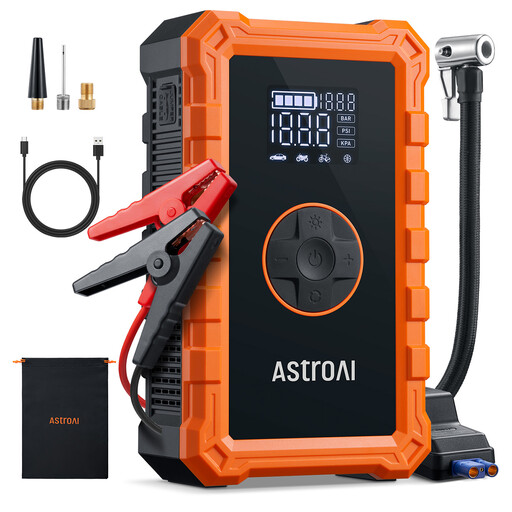
Why it suits this profile: This compact model combines a 12V car battery booster, tyre inflator and power bank in one device for everyday use.
The digital gauge shows the set and current pressure. According to the product information, the compressor stops automatically at the selected value.
150 PSI, 25 L/min airflow, five pressure modes and support for petrol engines up to 6 litres and diesel engines up to 3 litres, according to the product listing.
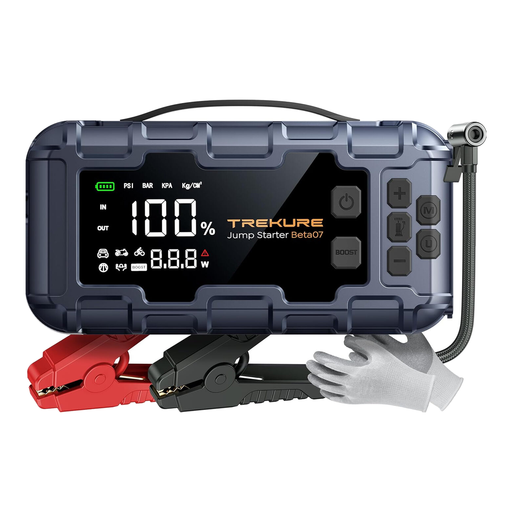
Why it suits this profile: The combination of a high stated peak current, fast USB-C charging and a large display is ideal for drivers looking for several functions in one device.
The specifications state 45 L/min and automatic pressure modes, so you can see not only the maximum PSI but also the airflow.
6000A peak current, 160 PSI, 3.3-inch display, 45W USB-C PD and 600-lumen LED lighting, according to the product information.

Why it suits this profile: A suitable choice for drivers of SUVs, lorries, motorbikes or boats who need more starting power and straightforward controls.
The product listing states a maximum compressor run time of ten minutes and recommends allowing it to cool between uses.
4500A peak current, support for up to 9-litre petrol and 8-litre diesel engines, 150 PSI and four lighting modes, according to the product specifications.
We have put together a complete, up-to-date list of products that fully meet these strict selection criteria and the applicable European safety regulations.
Read the manual before connecting the emergency car battery starter. Put the car in park or neutral and switch off the lights, radio and other equipment. Connect the red clamp to the positive terminal and the black clamp to the negative terminal or a suitable earth point, as specified by the manufacturer.
Use only the supplied cables when required. Stop using the device if you notice damaged cables, a leaking battery, smoke or unusual heat. A CE mark is the manufacturer’s declaration of conformity with applicable EU rules; also check that the seller provides clear safety information and responsible contact details.
No. Check that the device is suitable for 12V and that the maximum engine capacity matches your petrol or diesel engine. A jump starter is not designed for 24V lorries or the high-voltage battery of an electric car.
This depends on the battery type, storage temperature, use and maintenance. Recharge the device after use and check the charge level every few months. Follow the stated storage temperature and do not leave the lithium battery in a hot car for long periods.
The compressor uses the internal battery. The precise operating time varies according to the model, tyre pressure, tyre size and temperature. Therefore, check the airflow, battery capacity and maximum continuous operating time. After inflating a tyre, recharge the jump starter, especially before setting off on a longer journey.
