
Vandaag of morgen in huis

Kwaliteit gegarandeerd

Welkomstaanbiedingen ontgrendelen: GRATIS bezorging | Tot 80% korting | Gratis 30 dagen JoyPlus-proefperiode
Download de app
A flat battery, soft tyre or phone with no charge usually happens at the worst possible time. A car jump starter with compressor combines several functions in one device: starting a 12V vehicle, inflating tyres and charging devices. This makes it practical for motorists, SUV and van owners, motorcyclists, campers and outdoor enthusiasts.
However, a high amp rating does not tell you everything. Usability also depends on vehicle compatibility, the compressor, the cables and how you maintain the device.
A product may state 3000A, 4500A or even 7000A, for example. This is a peak rating, not a constant starting current. Above all, check the engine size and fuel type for which the model is specified. A 12V jump starter for a compact petrol car is not automatically suitable for a large diesel engine.
Also pay attention to the difference between a car, SUV, van and lorry. Many models are designed for 12V systems and not for 24V vehicles.
A mobile car compressor with only a pressure gauge requires constant supervision. You then run the risk of inflating for too long. A tyre inflator with automatic stop switches off at the set pressure. This makes it easier to use, but you should still check the tyre pressure with your car’s gauge or a separate tyre pressure gauge.
The maximum pressure, such as 150 PSI, also does not indicate how quickly a tyre will inflate. Look at the airflow, hose length, connections and recommended operating time as well.
A car jump starter is an emergency aid, not a device you can leave in the boot without checking it. Lithium batteries gradually lose charge during storage. Check the battery level regularly and recharge the device according to the instructions. Store it in a dry place and do not leave it in extreme heat for long periods.
First check whether your vehicle has a 12V battery system. Then look at the maximum engine size specified for petrol and diesel. A car battery booster with a higher stated capacity does not automatically offer greater peace of mind if the clamps, cables or safety instructions are not suitable for your vehicle.
A model for diesel and petrol jump starting should clearly state the applicable limits. Hybrid vehicles require extra care: only use a product whose manufacturer explicitly confirms compatibility, and follow the vehicle handbook.
A digital pressure setting is useful for tyres. Look out for:
A compressor can become hot during use. Allow the device to cool down whenever instructed in the manual. Do not use the car tyre inflator for applications that the manufacturer does not support.
A portable car power bank is more useful when it has several connections, such as USB-A, USB-C or a 12V output. Check the maximum power output if you want to charge a tablet, dashcam, cool box or laptop.
Also look for protection against reverse polarity, short circuits, overheating, overcharging and sparking. CE marking is relevant for products offered on the European market, but you should also read the manual and check that the supplied cables are suitable for your vehicle.
A jump starter is different from a car battery charger. A jump starter provides a short burst of power to start the vehicle. A battery charger is designed to charge and sometimes maintain a battery via mains electricity or a suitable charging programme.
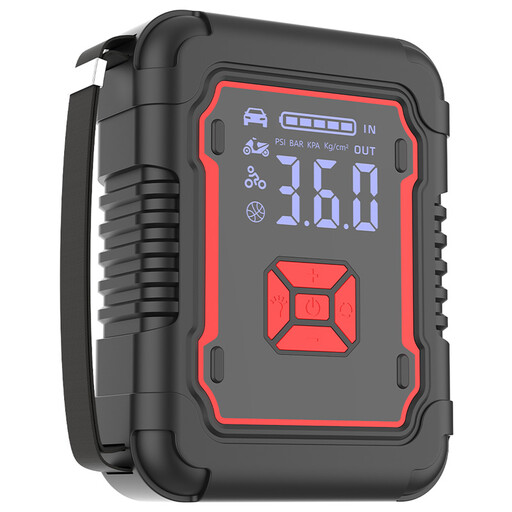
Why it suits this profile: This model combines a 3000A peak current, compressor and power bank in a relatively compact device for 12V petrol and diesel vehicles.
The product specifications state that the compressor has an automatic stop, allowing you to set a target pressure rather than relying on timing alone.
150 PSI compressor, QC3.0 charging output, LED light and support for vehicles within the specified 12V engine limits.
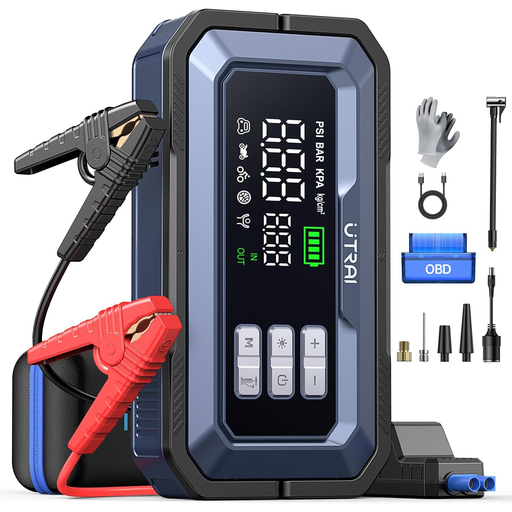
Why it suits this profile: The stated features are aimed at larger vehicles, camping and situations where additional power outputs are useful.
The manufacturer specifies 12V use for petrol vehicles, diesel engines up to 14 litres and hybrid models. Nevertheless, check the exact vehicle requirements before buying.
150 PSI compressor with automatic pressure setting, 160W 12V output, 18W USB-C PD and a stated 2000-lumen lamp.

Why it suits this profile: Suitable for drivers who want a digital compressor, compatibility with different vehicles and clear safety features in one device.
The product specifications list five inflation modes, automatic shut-off and a maximum continuous operating time of ten minutes.
4500A peak current, 150 PSI compressor, LCD screen and stated support for petrol engines up to 9.0 litres and diesel engines up to 8.0 litres.
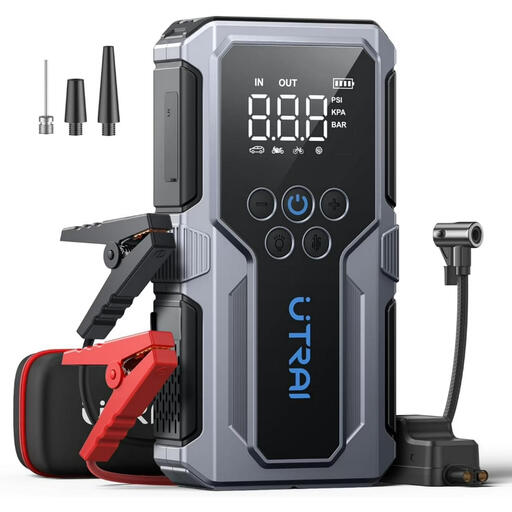
Why it suits this profile: Its size and combination of compressor, power bank and lighting are well suited to use on the road, camping and motorbike trips.
The LCD screen displays the pressure, while the product specifications state that it has an automatic stop and ten safety features.
3000A peak current, 150 PSI compressor, 15,000mAh battery, USB and USB-C connections, and a weight of approximately 0.72 kg according to the product information.
We have put together a complete, up-to-date list of products that fully meet these strict selection criteria and the applicable European safety regulations.
Not automatically. Check that your car has a 12V system and compare the specified maximum engine size for petrol and diesel. A 24V lorry, a damaged battery or a vehicle outside the stated limits may be unsuitable.
Its lifespan depends on charging cycles, storage temperature, frequency of use and maintenance. Store the device in a dry place, avoid prolonged exposure to heat and recharge it according to the manual. A stated number of charging cycles or warranty period is not a guarantee of a fixed lifespan.
Yes, you need to recharge the internal battery regularly. Power consumption generally remains limited when you only use the device in emergencies. A compressor uses more energy while inflating; how often you use it for tyres or devices determines the total consumption.
