
Vandaag of morgen in huis

Kwaliteit gegarandeerd

Welkomstaanbiedingen ontgrendelen: GRATIS bezorging | Tot 80% korting | Gratis 30 dagen JoyPlus-proefperiode
Download de app
A dead battery always happens unexpectedly and at the worst possible moment. In the middle of winter, when you're rushing to an appointment, or in a deserted parking lot. Waiting for roadside assistance is time-consuming, and a tow service is expensive. A jump starter, also known as a booster pack, seems like the perfect solution: a compact device that brings your car back to life instantly.
However, the market is flooded with models that promise the world. Before you invest in this convenient emergency tool, it's crucial to recognise the common pitfalls that lead to a poor purchase.
Pitfall 1: The Peak Current Myth Manufacturers advertise with sky-high peak currents of 3000A or even 4000A. This sounds impressive, but for most passenger cars, it's overkill. The peak current is only available for a fraction of a second. What really counts is the continuous starting current. You're paying extra for a number that adds little practical value.
Pitfall 2: Unrealistic Battery Capacity A high capacity (mAh) is useless if the battery cells are low-quality. Budget-friendly jump starters often use inferior cells that lose their charge quickly, especially in the cold. After a few months in your trunk, there's a high chance the emergency starter itself will be dead when you need it.
Pitfall 3: Missing Safety Features The cheapest models often cut corners on essential safety protections. The lack of protection against reverse polarity (connecting the clamps incorrectly) or short circuits can not only destroy the jump starter but also permanently damage your car's sensitive electronics.
To choose a reliable car battery starter, focus on the specifications that truly matter. Don't get distracted by marketing buzzwords.
The most important specification is the starting current, not the peak current. This value determines whether the jump starter has enough power for your engine.
Always check the engine displacement (in litres) specified by the manufacturer and compare it with your vehicle.
A good jump starter with a power bank is a multifunctional lifesaver.
You should be able to use a reliable car emergency starter with complete peace of mind.
Not everyone has the same needs. Below, we highlight a product that offers a great balance of power, safety, and functionality for the average driver.
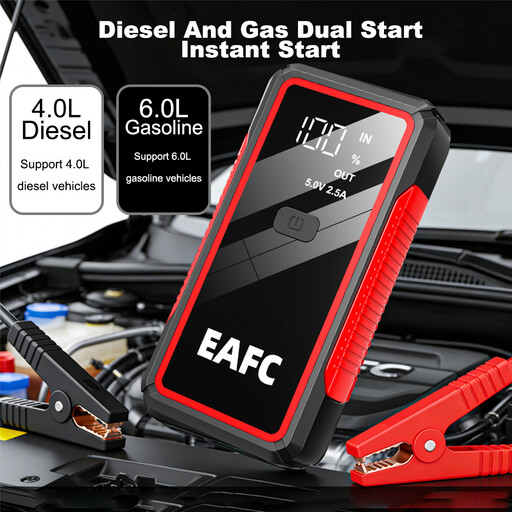
Why This Fits Their Persona: This model is a practical choice for drivers of the most common cars, SUVs, and vans. It provides ample power for both gasoline and diesel engines, combined with the features you truly need in an emergency.
With a 2000A peak and 10000mAh capacity, this model offers realistic specifications that match its claimed engine compatibility (up to 6.0L gasoline / 4.0L diesel). It comes with smart clamps that protect against incorrect connections.
According to the manufacturer, the device is functional across a wide temperature range (-10°C to +85°C), making it reliable in both cold winters and hot summers. The 3-in-1 LED light and power bank function make it a versatile emergency kit.
We have compiled a complete, up-to-date list of products that meet these strict selection criteria and current safety standards.
1. How often should I charge a jump starter? It is advisable to fully charge a jump starter every 3 to 6 months, even if you haven't used it. This keeps the internal lithium battery in good condition and ensures it's ready for use when you need it. Most modern models have low self-discharge and hold their charge for a long time.
2. Is a jump starter safe for my modern car's electronics? Yes, provided you choose a model with "smart clamps" or "intelligent jumper cables." These are equipped with built-in safety mechanisms that protect against short circuits, reverse polarity (connecting them the wrong way), over-voltage, and overheating. This prevents damage to both the jump starter and your car's sensitive onboard computer.
3. Can I use any jump starter for my diesel car? Not always. Diesel engines require a significantly higher starting current than gasoline engines due to their higher compression ratio. Therefore, always check that the manufacturer explicitly states the jump starter is suitable for diesel engines and up to what engine size (e.g., up to 4.0L). A jump starter that is too weak will not be able to start a diesel engine.
