
Vandaag of morgen in huis

Kwaliteit gegarandeerd

Welkomstaanbiedingen ontgrendelen: GRATIS bezorging | Tot 80% korting | Gratis 30 dagen JoyPlus-proefperiode
Download de app
A flat car battery often strikes at the worst possible time: just before you set off, at the roadside or at a campsite with no mains socket. With a car jump starter, you can try to start a 12V vehicle without needing another car and jump leads. However, not every model is suitable for every petrol or diesel engine.
Marketing copy often focuses on a high peak current. That figure doesn’t tell the whole story. Before you buy, also check vehicle compatibility, safety features, battery capacity and practical accessories.
A figure such as 2000A or 6000A sounds impressive, but similar products may list different values for starting current and peak current. The stated peak current doesn’t guarantee that every vehicle will start. Check the recommended engine capacity for petrol and diesel, and make sure your vehicle uses a 12V system.
A 24V lorry or heavy commercial vehicle isn’t automatically suitable for a car jump starter. A completely faulty battery may also be outside the intended scope of use.
A lithium jump starter with, for example, 20.000 mAh may seem to offer plenty of capacity. However, manufacturers may list both nominal and rated capacity. For example, the Porbi S901 is listed with a battery capacity of 20.000 mAh and a rated capacity of 10.000 mAh. For the Porbi S903, the figures are 20.000 mAh and 16.000 mAh respectively.
Use mAh mainly to compare models within the same product range. When it comes to starting your vehicle, the stated starting current, compatible engine capacity and instructions are just as important.
Incorrectly connected clamps can cause damage. Features such as reverse polarity protection, short-circuit protection, overheating protection and spark-proof technology can reduce the risk during use, but they don’t replace the instructions.
A jump starter also needs to stay charged. Check the charge level before you set off and recharge the device regularly as instructed. Don’t store a lithium battery for long periods in a very hot car, a damp place or direct sunlight.
A 12V car jump starter is designed for vehicles with a 12V electrical system, such as cars, many motorbikes, motorhomes, boats and light commercial vehicles. Always check:
The stated limits come from the manufacturer’s product information. According to CAROSS’s product description, the 800A model is generally suitable for petrol engines up to 4,0 litres and diesel engines up to 3,0 litres. Check your vehicle’s manual and exact vehicle classification to make sure it’s suitable.
A car battery booster needs to supply enough current to the starter motor. A higher stated current may be useful for larger engines, in cold conditions or for vehicles with higher starting demands. It isn’t, on its own, proof of quality.
A Boost function can help when the battery voltage is low. Some models require you to activate this function manually. Follow the connection sequence and safety instructions carefully. Don’t use a car jump starter as a substitute for a battery that is worn out or damaged.
As well as the electrical specifications, look for:
A compact portable jump starter fits easily in a glove compartment. A more powerful model may be larger and heavier, but it can offer compatibility with a wider range of engines or extra outputs for 12V accessories.
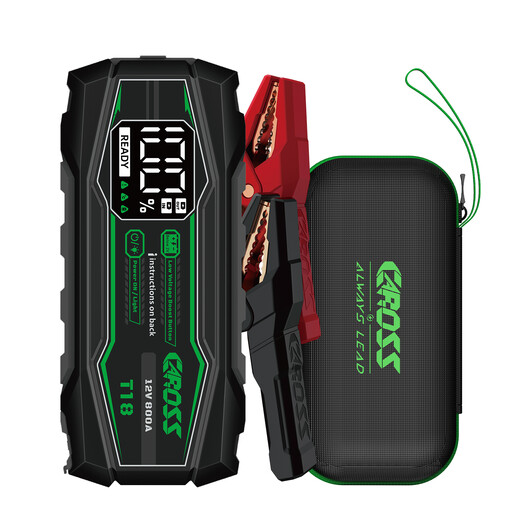
Why it suits this type of user: This model combines a 10.000mAh lithium battery with a Boost function, 2,3-inch screen, QC 18W charging and a protective case for use with a standard car.
The product information lists more than just an 800A peak current: it also specifies 12V use, a Boost function and safety features such as a spark-proof design and reverse polarity protection.
10.000mAh lithium battery, 18W fast charging, digital display and protective case included.
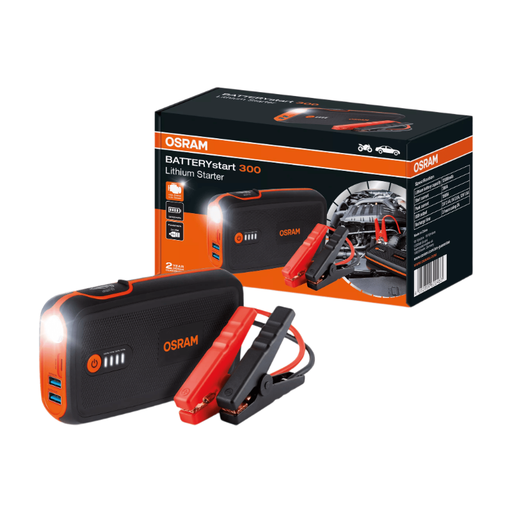
Why it suits this type of user: According to OSRAM’s product information, this 12V lithium jump starter is designed for engines up to 8 litres petrol and 4 litres diesel. It’s a good option for drivers with a larger car, light van or extra 12V equipment.
The manufacturer gives separate limits for petrol and diesel engines rather than making a general claim about vehicle compatibility. Even so, check these limits against your vehicle’s manual.
2000A peak output, dual USB power bank, 12V output and LED light; weight according to the product information: 1174 grams.
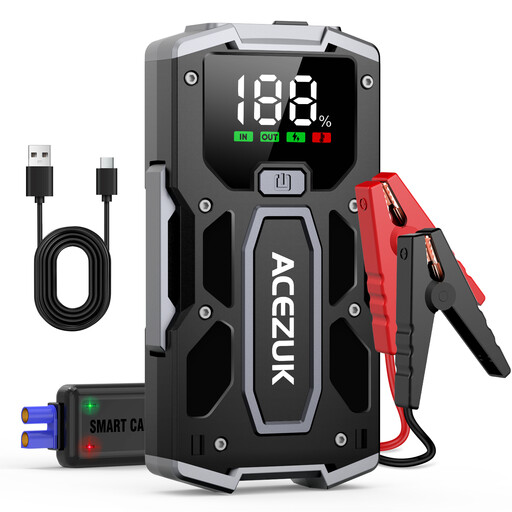
Why it suits this type of user: The manufacturer states that it supports 12V vehicles with petrol engines up to 7,0 litres and diesel engines up to 5,5 litres. It also has an LCD, temperature warning and smart clamps.
According to the product description, the LCD shows the charge level and temperature. The eight listed safety features include protection against reverse polarity, short circuits, overheating and overcurrent.
Suitable for larger engines according to the manufacturer, with a 2,5-inch display, 400-lumen LED light and USB-C cable included.
We’ve put together a complete, up-to-date list of products that meet these strict selection criteria and the applicable European safety regulations.
Only use the device with the specified voltage and vehicle type. If the battery is damaged, leaking or has loose connections, or if you’re unsure what to do, calling for roadside assistance is a sensible option.
It depends on the model and the remaining battery voltage. Some models have a Boost function for low voltage. However, an emergency car jump starter can’t reliably restore a battery with internal damage or a completely faulty cell.
Its lifespan depends on storage, temperature, charging frequency and the quality of the lithium battery. Recharge the device regularly, even if you don’t use it often. Follow the manufacturer’s maintenance schedule and check the charge level before a long journey.
Yes. Several models have USB ports for phones, tablets, cameras or sat navs. Check the output, such as QC3.0 18W, and bear in mind that charging via USB reduces the capacity left for starting your vehicle.
