
Vandaag of morgen in huis

Kwaliteit gegarandeerd

Welkomstaanbiedingen ontgrendelen: GRATIS bezorging | Tot 80% korting | Gratis 30 dagen JoyPlus-proefperiode
Download de app
A flat car battery often happens at the worst possible time: in a car park, during a camping trip or while travelling in a van. In certain situations, a car jump starter can help you start a vehicle with a flat 12V battery independently. However, not every model is suitable for every vehicle. A high amp rating on the packaging does not tell you everything either.
As a Joybuy Product Recommendation Officer, I focus mainly on verifiable information: engine compatibility, battery voltage, safety features, charging options and usage instructions. This helps you avoid buying a compact portable jump starter that does not provide enough capacity in real-world use.
Manufacturers often state a peak current, such as 1500 A, 4000 A or 8000 A. This is a quoted peak value, not a guarantee that every vehicle will start in all conditions. Engine size, fuel type, temperature, battery condition and the jump starter’s charge level also play a role.
Always check the stated combination, such as 6.0-litre petrol and 4.0-litre diesel. A 12V jump starter for a small car is not automatically suitable for a motorhome, SUV or diesel van.
A lithium jump starter supplies power temporarily to start the engine. It does not charge a flat battery in the same way as a 12V battery charger. If your main aim is to maintain a vehicle over a longer period, you will need a separate trickle charger or intelligent battery charger.
A jump starter with a power bank is useful for phones, tablets and other USB devices. This extra function makes the device more versatile, but does not change how it works as an emergency starter.
Incorrectly connected jump leads can cause damage. Look out for features such as reverse-polarity, short-circuit, overheating, overload and overcurrent protection. Also check that the clamps are sturdy and that the cables are long enough for your engine bay.
Safety protection is not a substitute for careful use. Always follow the instructions for your chosen model and your vehicle.
Most models in this category are designed for 12V lead-acid batteries in cars, motorbikes, motorhomes, SUVs, tractors and some vans. Check your vehicle handbook before buying. Do not use a 12V jump starter with a vehicle that has a different battery voltage.
Also look at:
Peak current indicates the temporary starting assistance available. The stated capacity in mAh or Wh says more about the energy reserve for repeated use and charging devices. These values are not directly interchangeable.
For an ordinary car, a model in the 1500 A class may be suitable based on the product specifications. For larger diesel engines or more intensive use, a model with a higher quoted peak current is likely to be more appropriate. Do not choose a larger model than necessary without also considering its weight, size and price.
A useful emergency starter needs to be sufficiently charged when kept in your car. Check:
For long-term storage, some brands recommend charging the device periodically. According to GOOLOO product information, a charging interval of two to three months is recommended for various models; always follow the instructions for your specific version.
The selection below is based on the stated specifications and features. Claims about starting power and temperature use come from the product information provided by the respective brands.
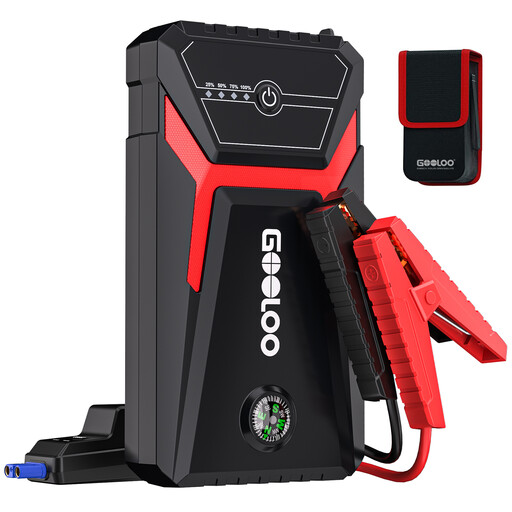
Why it suits this profile: The GE1500 is designed for 12V vehicles and combines emergency starting assistance with USB outputs and an LED light. It is well suited to motorists who want to keep a relatively compact emergency device in their car.
The product information specifically states 1500 A, 6.0-litre petrol and 4.0-litre diesel compatibility. It also lists ten protection features and a weight of approximately 0.878 kg.
Two USB outputs, a 400-lumen LED light with three modes, smart jump leads and a storage bag.
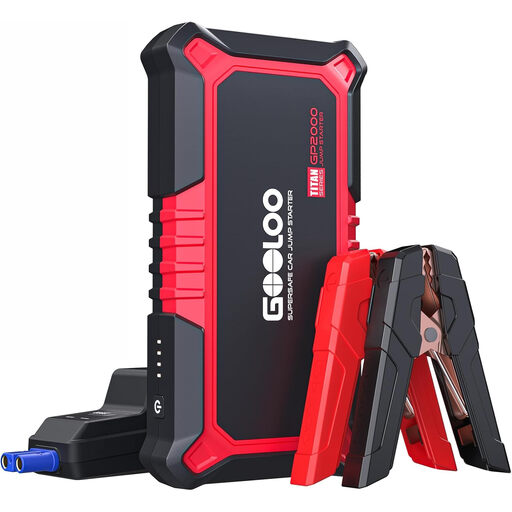
Why it suits this profile: According to GOOLOO, the GP2000 provides a peak current of 2000 A and is rated for petrol engines up to 8.0 litres and diesel engines up to 6.0 litres. This makes it an interesting option for larger cars, SUVs and light commercial vehicles.
Compatibility is linked to engine size and fuel type. According to the product description, the smart cable includes ten safety protections, including short-circuit and reverse-polarity protection.
400-lumen LED light, two USB outputs and a quoted standby time of up to 24 months.
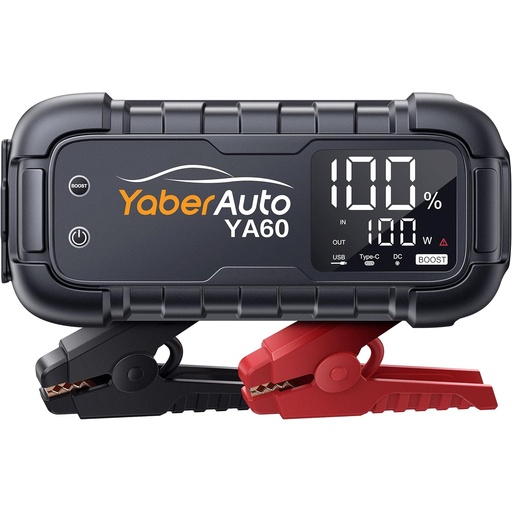
Why it suits this profile: This model is aimed at users with larger vehicles, motorhomes or multiple power needs while travelling. According to YaberAuto, it is designed for 12V petrol engines and diesel engines up to 12.0 litres.
Alongside the stated 8000 A, the product information lists the engine limit, 10 safety functions, 8AWG cables and a charge-level indicator. Check these details against your vehicle handbook nonetheless.
65W USB-C charging, two USB-A outputs, a 150W DC output and a 600-lumen light with three modes.
We have put together a complete, up-to-date list of products that fully meet these strict selection criteria and the applicable European safety regulations.
Do not use the emergency starter with a damaged, leaking or swollen battery. If in doubt, contact a breakdown service or garage.
No. Check the voltage, fuel type and maximum engine size stated by the manufacturer. A model for a 12V petrol engine is not automatically suitable for a heavy diesel engine. A faulty battery, an electrical problem or extreme cold can also prevent the engine from starting.
This depends on storage, temperature, charge level and use. Store the device in a dry place and follow the charging interval in the manual. Some product descriptions state a standby time, but this is a quoted product specification, not a fixed service life. Recharge the jump starter before a long journey.
No. Car jump leads connect the flat battery to a second vehicle. A jump starter contains its own battery and can therefore provide starting current independently. With both methods, the correct polarity, secure connections and the manufacturer’s instructions are important.
