
Vandaag of morgen in huis

Kwaliteit gegarandeerd

Welkomstaanbiedingen ontgrendelen: GRATIS bezorging | Tot 80% korting | Gratis 30 dagen JoyPlus-proefperiode
Download de app
A flat car battery never happens at a convenient time. Whether you’re on your way to work in the morning, heading to the campsite or starting your car after a long period parked up, a car jump starter can get you moving again. However, many models look similar, while the differences in starting current, vehicle compatibility and ease of use can be significant.
As a Joybuy Product Recommendation Officer, I filter the most important product specifications and practical considerations, so you can assess marketing claims more effectively. Pay particular attention to these three common pitfalls:
First, check whether the car battery booster is suitable for your vehicle. Look at:
A 12V rating does not mean that every model is suitable for every 12V vehicle. A motorhome, van, boat, motorbike or hybrid vehicle may have different requirements. Always check the manual and your vehicle specifications. Claims such as “suitable for all vehicles” should be considered alongside the specific limits listed in the product specifications.
Capacity is often stated in mAh. A higher capacity may mean that the jump starter power bank can provide more starting attempts or more USB charges, but actual performance also depends on cell technology, temperature and maintenance.
Look out for:
A car battery booster should not be left permanently in a hot car. Store the device somewhere dry and follow the manufacturer’s temperature limits. Fully charge it before first use and check its status several times a year.
A good car emergency jump starter should include clear connection instructions. Useful features include protection against reverse polarity, short circuits, overloading and overheating. According to the product descriptions of some brands, smart clamps detect incorrect connections; always check whether this is also stated for the model you choose.
With a jump starter with air compressor, a digital pressure gauge, automatic shut-off and different valve adapters are practical features. Also check the maximum operating time. The UTRAI JS-9 and BuTure BC02, for example, state that the compressor should not be used continuously for more than 10 minutes. Allow the device to cool down afterwards.
A jump starter is not a replacement for a proper maintenance charger and cannot fix a damaged, leaking or frozen battery. Do not use a car jump starter when the battery is visibly damaged. Follow the manual: red to the positive terminal, black to the negative terminal or a suitable earthing point, depending on the vehicle and jump starter instructions.
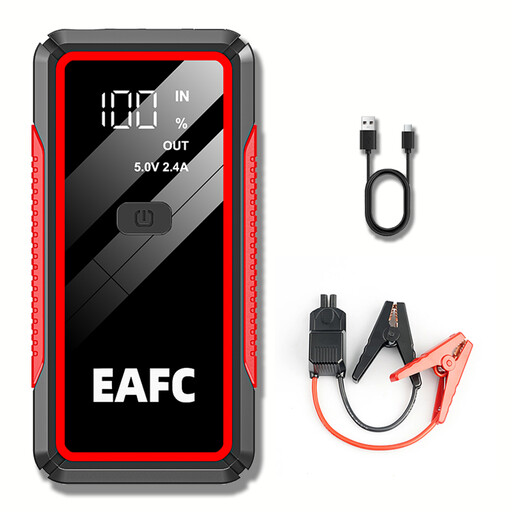
Why it suits this profile: A compact basic solution for motorists who mainly need a car jump starter and a simple power bank function.
The product description states specific limits: up to 6.0 litres for petrol and 4.0 litres for diesel. This makes it easier to compare compatibility with your vehicle specifications.
2,000A peak current, 10,000mAh capacity, USB output and an LED torch with three modes.
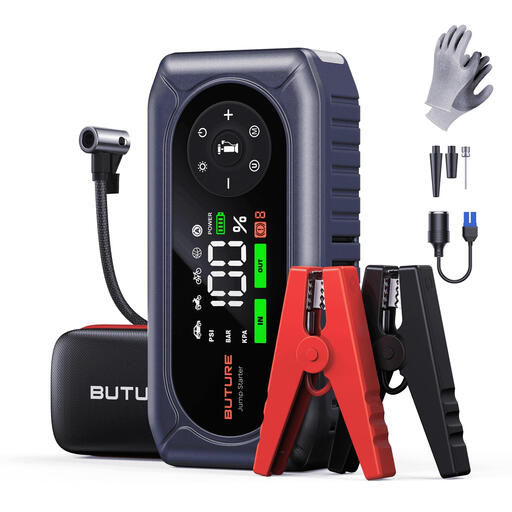
Why it suits this profile: Suitable for drivers who want to top up their tyres as well as start their vehicle, and who appreciate clear information on a display.
The specifications state vehicle limits, a maximum compressor operating period of 10 minutes, five inflation modes and automatic shut-off.
4,500A peak current, compressor up to 150 PSI, four light modes and a two-year warranty according to the product information.
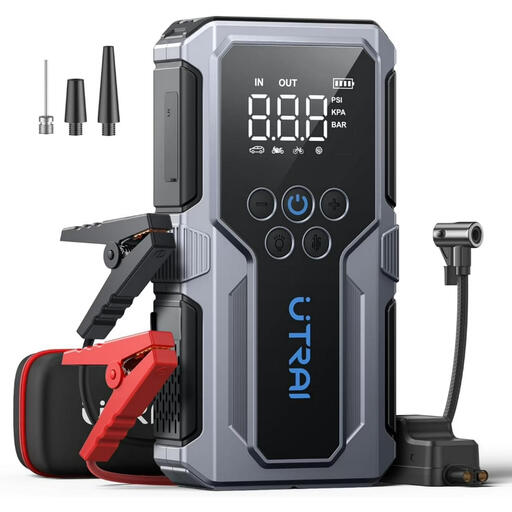
Why it suits this profile: A multifunctional model for SUVs, motorhomes, boats, motorbikes and outdoor trips where starting, inflating and charging all come together.
The product information states 12V compatibility, engine limits, an LCD pressure gauge and a warning not to pump continuously for more than 10 minutes.
3,000A peak current, 15,000mAh power bank, compressor up to 150 PSI, USB and USB-C ports and three light modes.
We’ve put together a complete, up-to-date list of products that fully meet these strict selection criteria and the applicable European safety regulations.
Car jump leads remain a useful alternative, but they require a second vehicle and a correct connection. A portable jump starter takes up less space and can also function as a power bank or LED torch.
This depends on the condition of the battery, the temperature, the engine capacity and the jump starter’s capacity. A deeply discharged or damaged battery may not be safe to start. Check the vehicle limits and follow the manual.
Its lifespan depends on charging cycles, storage temperature and maintenance. Recharge the device regularly according to the manufacturer’s instructions, even when it is not being used. Do not store it for long periods in extreme heat or cold.
The device runs on its built-in battery and does not require mains power during use. There are therefore no separate running costs, but you will need to recharge the jump starter afterwards. Frequent pumping may drain the battery more quickly; also allow the compressor to cool down as instructed.
