
Vandaag of morgen in huis

Kwaliteit gegarandeerd

Welkomstaanbiedingen ontgrendelen: GRATIS bezorging | Tot 80% korting | Gratis 30 dagen JoyPlus-proefperiode
Download de app
A flat battery usually happens at the worst possible time: in a car park, during a camping trip or just before leaving for work. With a car jump starter, you can often try to start a 12V battery yourself, without needing another car and jump leads. However, not every model is suitable for every vehicle.
As a Joybuy Product Recommendation Officer, I focus primarily on verifiable specifications. High amp figures, large capacities and extra features may sound appealing, but they only tell you something when they match your engine, usage situation and maintenance routine.
A figure such as 2000A or 5000A is generally a stated peak current, not a continuous starting current. Manufacturers use different testing methods. Therefore, also compare the stated engine compatibility, battery type and any available starting current rating.
A small petrol engine has different requirements from a diesel engine, SUV, motorhome or van. Also check that your vehicle actually uses a 12V lead-acid battery. A jump starter is not a universal solution for electrical systems with a different voltage.
A jump starter power bank with a high mAh rating is useful for phones and other devices, but high capacity does not automatically mean the device is more powerful at starting an engine. Look separately at:
A product can therefore be a good portable battery charger without being suitable for a large diesel engine.
Incorrectly connected clamps can cause damage. Therefore, look for reverse-polarity, short-circuit, overheating and overcharge protection. A smart cable with clear indicators makes operation easier to understand, but always read the manual.
Lithium batteries do not like being left in a hot car. Ideally, store a car jump starter somewhere dry and out of direct sunlight. Check the charge level before a long journey and recharge the device periodically according to the instructions.
Choose a 12V jump starter based on your vehicle. For a compact petrol car, a model rated for up to 6.0-litre petrol and 3.0- or 4.0-litre diesel engines may be sufficient according to the product description. For large SUVs, motorhomes or lorries, models with a higher stated engine limit are more appropriate.
Please note: stated compatibility is a manufacturer or seller specification, not a guarantee that every completely failed battery will start. You must not attempt to activate a damaged, leaking or frozen battery with a jump starter.
Check that the cables are long enough to reach the battery terminals safely. Metal clamps, robust insulation and a clear Ready or Boost indicator are practical features. Only use the supplied smart jump leads when the manual specifies this.
The usual procedure is:
A jump starter with compressor can be useful when a tyre is under-inflated, but a maximum pressure of 150 PSI does not tell you how much air is delivered per minute. For car tyres, automatic shut-off, an easy-to-read display and the correct pressure setting are more important than the maximum PSI figure alone.
An LED light with a standard setting, SOS and flashing mode is useful if you break down in the dark. USB-C, USB-A and a DC output make the device more versatile for phones, tablets, GPS devices or a small 12V accessory.
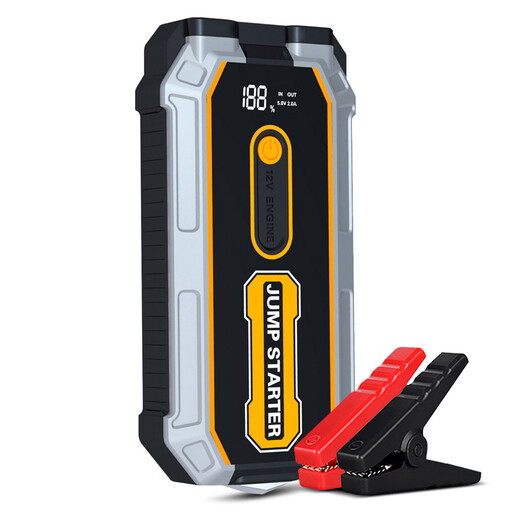
Why it suits this profile: Weighing around 330 grams, its compact housing and LCD display make it an easy-to-use choice for motorists who want to keep a simple emergency car starter in the boot.
The product details state both a 1200A peak current and 600A starting current, along with clear compatibility with 12V petrol and diesel vehicles.
Stated capacity of 12800mAh, a 10W USB output, LCD status display and three LED modes. According to the product description, a limited one-year warranty is included.
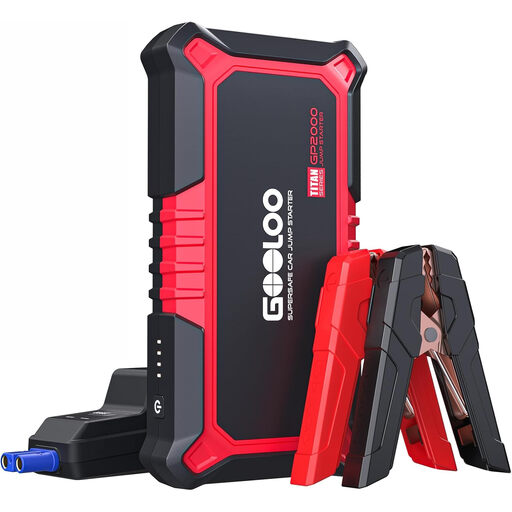
Why it suits this profile: This model is aimed at drivers of larger vehicles who value USB charging and robust storage as well as jump-starting capability.
The stated limit is 8.0 litres for petrol and 6.0 litres for diesel. The product information also mentions ten protection functions and a Ready indicator.
Stated peak current of 2000A, two USB outputs, a 400-lumen light and a stated operating temperature of -20°C to 60°C.
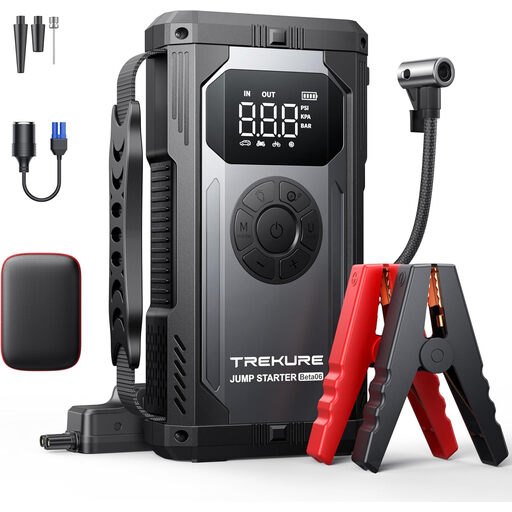
Why it suits this profile: Motorhome owners, SUV drivers and outdoor enthusiasts may find the combination of a car jump starter and tyre inflator practical on longer journeys.
Alongside a 5500A peak current, the product description states that the compressor reaches up to 150 PSI, with automatic shut-off and an LCD display showing the set pressure.
Stated battery capacity of 23800mAh, two USB outputs, a 12V output and three light modes. The stated dimensions are 20,70 × 11,20 × 5,20 cm and the weight is approximately 0,89 kg.
We have put together a complete, up-to-date list of products that fully meet these strict selection criteria and the applicable European safety regulations.
A car jump starter only works if its internal battery has sufficient charge. Do not leave it loose in the boot among metal objects, and store the clamps in their designated place. Check the charge level every few months, even when you are not using the device.
Also bear the following points in mind:
For a motorbike, boat or motorhome, physical storage is particularly important: splash resistance is not the same as being submersible. An IP rating, where stated, should be understood as a technical protection classification, not permission to use the device in water.
No. Check the 12V compatibility, fuel type and maximum engine capacity in the product details. A model for a small petrol engine is not automatically suitable for a large diesel engine. Do not use the device with a damaged or leaking battery.
This varies by model. Some product descriptions recommend charging every two to three months, while others state six months for long-term storage. Follow the instructions for your model and recharge the device after use. Store it somewhere dry and away from prolonged heat.
That depends on how you intend to use it. If you only want to deal with emergencies involving a flat battery, a compact car jump starter may be sufficient. If you often take long journeys, go camping or want to replace a tyre inflator in your car, a jump starter with compressor may be more practical. Alongside PSI, compare airflow, automatic shut-off, hose length and cooling time.
