
Vandaag of morgen in huis

Kwaliteit gegarandeerd

Welkomstaanbiedingen ontgrendelen: GRATIS bezorging | Tot 80% korting | Gratis 30 dagen JoyPlus-proefperiode
Download de app
A flat battery often happens at the worst possible moment: on a cold morning, during a weekend away or in a remote car park. With a car jump starter, you can sometimes start a 12V vehicle yourself, without waiting for another car or roadside assistance. However, not every model is suitable for every engine.
A high amp rating on the packaging does not tell you everything. A large battery capacity, compressor or strikingly low price can also create the wrong impression. In this guide, you’ll learn what to look for when choosing a jump starter for a car, SUV, motorbike, motorhome or boat.
Brands often state a peak current of, for example, 1,500A, 3,000A or even 8,000A. This is a short-term maximum value, not a guarantee that every engine will start immediately. Suitability also depends on:
Always check that the stated compatibility matches your vehicle. A 12V jump starter for a small petrol engine is not automatically suitable for a large diesel engine.
A jump starter power bank with a high mAh rating is useful for phones and other devices, but high capacity does not automatically mean a powerful starting function. As well as capacity, check the stated peak current and starting current. Product information does not always use the same measurement method for these figures, making direct comparison difficult.
For a compact car, a model rated at 1,200A or 1,500A may be sufficient according to the product specifications. For a larger SUV, motorhome or diesel engine, having extra headroom is sensible. Use the stated engine limit as your starting point, rather than looking only at the largest number on the box.
A portable jump starter works with high current. Features such as reverse-polarity protection, short-circuit protection, overheat protection and spark protection reduce the risk of incorrect connection. However, they do not replace reading the instructions or checking the clamps.
A car jump starter will also slowly lose charge when left unused in the car. According to the product information, many models need charging every two to six months. Check the charge level before a long journey and do not leave the device in a hot car for extended periods.
First, check whether your vehicle uses a 12V battery. A jump starter for a car is not intended for 24V systems unless this is explicitly stated. Then check the maximum engine capacity for petrol and diesel engines. Diesel engines generally need more starting power, particularly in low temperatures.
Only use the starting aid with a battery that is not visibly damaged, leaking or frozen. If in doubt, professional roadside assistance is the safer option.
Starting current gives a more useful indication of the current supplied during starting than peak current alone. Not every brand states both values. Also pay attention to the length and thickness of the cables, the sturdiness of the clamps and whether a smart cable module is included.
Follow the instructions when using the device. A common procedure is:
The exact procedure varies by model.
A jump starter with compressor can be useful if a tyre is under-inflated. Check the maximum pressure in psi, airflow rate, included nozzles and automatic shut-off. A stated pressure of 150 psi does not mean that every tyre will inflate at the same speed.
A USB output makes the device suitable as a portable car battery charger for smartphones, tablets or navigation equipment. An LED light with SOS or flashing mode can provide extra visibility at the roadside. Treat these features as useful additions; they do not automatically make a model suitable for your engine.
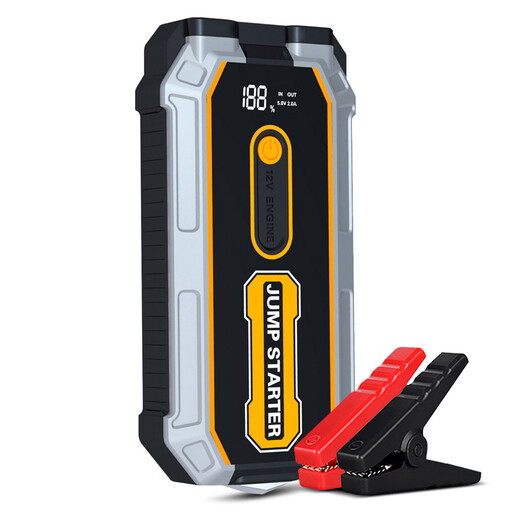
Why it suits this profile: According to the product information, this is a compact car battery booster weighing approximately 330 grams, suitable for 12V petrol and diesel vehicles. This makes it practical for everyday use in a small car or motorbike.
The specifications state both a 1,200A peak current and a 600A starting current. The LCD screen also shows the remaining charge level.
Stated capacity of 12800mAh, 10W USB output, three LED modes and dimensions of 165 × 84 × 30 mm.
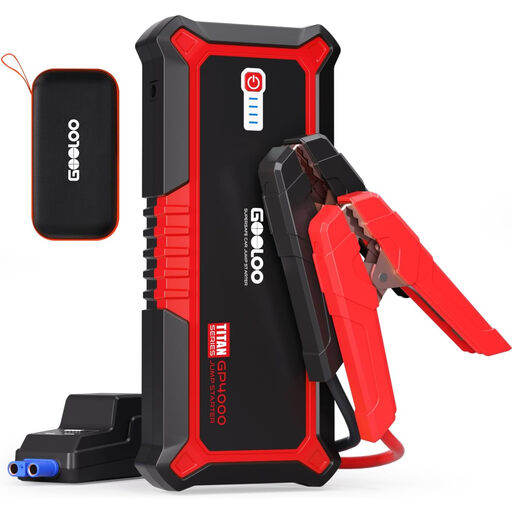
Why it suits this profile: According to GOOLOO, this model is designed for 12V vehicles, all petrol engines and diesel engines up to 10.0 litres. The USB ports and sturdy housing make it suitable for regular travel by car, motorhome or boat.
The product information lists ten safety protections and recommends charging every two to three months. This helps ensure that maintenance is not forgotten.
Stated peak current of 4,000A, two USB outputs, USB-C input, LED light and included storage case.
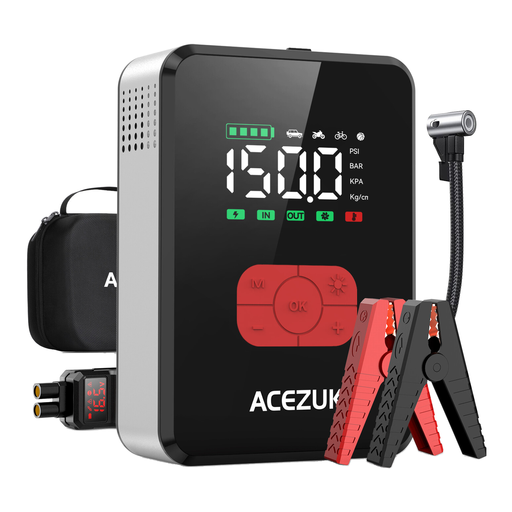
Why it suits this profile: If you want to inflate tyres as well as jump-start your vehicle, the product information states that this model includes a 150 PSI compressor, LCD screen and selectable modes for cars, motorbikes, bicycles and balls.
The integrated pressure gauge and automatic shut-off mean you do not have to rely solely on a marketing claim about compressor power.
Stated peak current of 7,000A, 26.800mAh capacity, 150 PSI compressor and LCD status screen.
We have put together a complete, up-to-date list of products that fully meet these strict selection criteria and the applicable European safety regulations.
First, check that the jump starter and car both use 12V. Connect the red clamp to the positive terminal and the black clamp to the negative terminal or a suitable earth point. Wait for the ready signal from the smart cable and start the engine briefly. Always consult the instructions for your model.
This depends on the lithium battery, storage temperature and maintenance. Recharge the device periodically in accordance with the product instructions. For many models, the interval is between two and six months. Store the starting aid in a dry place away from direct sunlight. Check the charge level before use.
The electricity used for charging is generally limited. The main costs are the purchase price and any replacement required when the internal battery wears out. A model with a compressor, extra ports or higher capacity will usually cost more, but may combine several separate emergency tools. Choose features that suit your vehicle and how you use it, so you do not pay for functions you rarely need.
