
Vandaag of morgen in huis

Kwaliteit gegarandeerd

Welkomstaanbiedingen ontgrendelen: GRATIS bezorging | Tot 80% korting | Gratis 30 dagen JoyPlus-proefperiode
Download de app
A flat car battery often happens at the worst possible moment: on a cold morning, after a weekend away or in a car park with no help nearby. A car jump starter can get you moving again, but not every model is suitable for every vehicle. If you only look at the highest amp rating, you could end up buying a device that is too large, inconvenient or not powerful enough for your engine.
In this buying guide, we explain what to look for in a portable jump starter, which marketing claims to treat with caution and which models suit different situations.
A model rated at 4,000 or 8,000 A may automatically seem more powerful than one rated at 1,500 A. However, peak currents are not always directly comparable: brands use different testing methods and conditions. So also check the stated engine capacity, fuel type and recommended vehicle voltage.
For an ordinary passenger car, a 12V jump starter with a suitable compatibility specification is often more practical than a heavier model designed mainly for large diesel engines.
Diesel engines generally require more starting power than petrol engines. Check whether the product description states separate limits, such as up to 6.0 litres for petrol and 4.0 litres for diesel. A jump starter for petrol and diesel engines is only suitable within the limits specified by the manufacturer.
Claims about the number of possible starts or performance in extreme temperatures come from the brand’s product information. Do not treat them as a guarantee for every car, battery or weather condition.
A car battery booster must be connected correctly. Protection against reverse polarity, short circuits, overheating and overloading can reduce the risk of incorrect use, but it does not replace the instruction manual. Do not use a jump starter with a damaged, leaking or frozen battery.
Also consider storage. Lithium batteries lose charge over time. Many manufacturers recommend charging the device every two to six months when it is not being used.
Choose a model for 12V vehicles and compare the stated engine capacity with that of your car, campervan, motorbike, SUV or van. For a small passenger car, 1,200 to 2,000 A may be sufficient according to the product specifications. For campervans, large SUVs and diesel vans, a model with a higher stated capacity may be more suitable.
Also check whether your vehicle uses a conventional 12V lead-acid battery. A jump starter is not intended for the high-voltage system of an electric car.
Practical points to consider include:
A jump starter with compressor combines starting assistance with a portable tyre inflator. Check the maximum pressure, airflow, automatic shut-off and maximum operating time. A compressor rated at 150 psi does not mean it will inflate every tyre at the same speed. After prolonged use, the device often needs time to cool down.
If you only need to get a flat battery started, a compressor mainly adds extra weight and cost. For road trips, campervans and outdoor activities, however, the combination can be very practical.

Why it suits this profile: According to the product information, this compact model weighs approximately 330 grams and is suitable for 12V petrol and diesel vehicles. This makes it easy to store in a glove compartment or emergency bag.
The product description states both a peak current of 1,200 A and separate support for petrol and diesel engines. An LCD display shows the remaining charge level.
12800 mAh according to the product specification, 10 W USB output, LCD indicator and LED light with three settings.
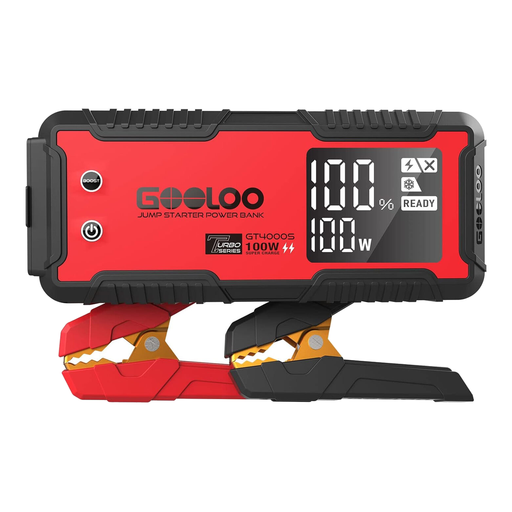
Why it suits this profile: For drivers of larger vehicles, the manufacturer states that this model supports petrol engines up to 12.0 litres and diesel engines up to 10.0 litres.
The product information lists a display, ten safety features and a 100W charging function. Always check that these specifications are suitable for your vehicle.
4000 A peak current according to the product specification, USB-C and USB-A ports, 15V/10A output and an LED lamp with three settings.
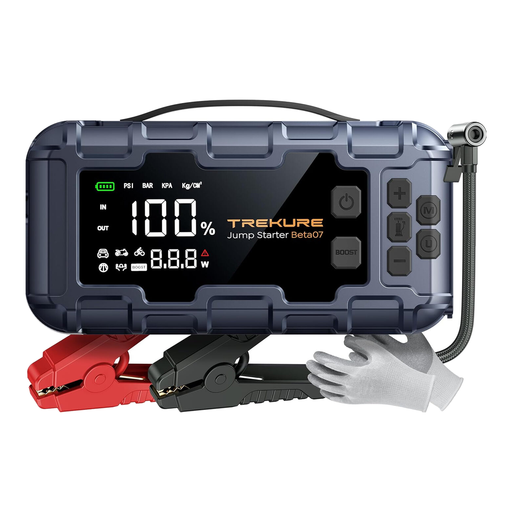
Why it suits this profile: According to the product description, this model combines jump-starting assistance with a compressor, display, power bank and LED lighting. That makes it suitable for campervans, SUVs and high-mileage drivers.
The stated 160 psi compressor has five pre-set pressure modes. Use the compressor within the recommended limits and allow it to cool down when necessary.
6000 A peak current, 45W USB-C PD, two 18W USB-A ports, 600 lumen LED light and a stated airflow of 45 litres per minute.
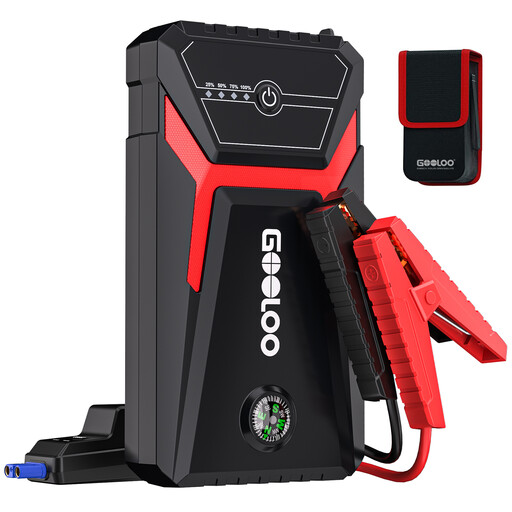
Why it suits this profile: According to the product information, the GE1500 is designed for 12V cars, motorbikes, campervans and other vehicles, and weighs approximately 0.878 kg.
The manufacturer lists ten protection features, including reverse-polarity, short-circuit and overheating protection. Always follow the supplied instructions when using the device.
1500 A peak current, support for up to 6.0 litres of petrol and 4.0 litres of diesel, two USB outputs and a 400 lumen lamp with three settings.
We have put together a complete, up-to-date list of products that fully meet these strict selection criteria and the applicable European safety regulations.
Do not use a standard set of car jump leads and a jump starter interchangeably without following the instructions. Also check whether the battery itself is faulty; a jump starter will not permanently resolve a worn or damaged battery.
Its lifespan depends on storage temperature, charging frequency and usage. Recharge the device regularly, store it somewhere dry and cool, and avoid leaving it in a hot car for extended periods. The stated warranty varies by product and is shown on the product page.
Yes, provided the product description explicitly mentions diesel engines and your engine falls within the stated capacity. A model that only mentions petrol engines is not automatically suitable as a car battery booster for diesel vehicles.
Most models use a built-in rechargeable lithium battery. Electricity consumption mainly comes from charging via USB-C or an adapter. A compressor uses more energy than a short jump-starting session alone. Recharge the device after use and check the battery level regularly before setting off.
