
Vandaag of morgen in huis

Kwaliteit gegarandeerd

Welkomstaanbiedingen ontgrendelen: GRATIS bezorging | Tot 80% korting | Gratis 30 dagen JoyPlus-proefperiode
Download de app
A flat car battery often happens at the worst possible time: before setting off for work, during a camping trip or while travelling in a motorhome. With a car jump starter, you can attempt to start a 12V vehicle independently, without needing a second car and jump leads.
However, not every portable jump starter is suitable for your vehicle. High amperage ratings on the packaging do not tell the whole story. You should also consider engine size, battery type, cables, storage conditions and how you use the device.
A peak current rating, such as 1500A or 4000A, does not guarantee that every vehicle can be started. The stated compatibility with petrol and diesel engines is just as important. A compact 12V jump starter for a small petrol car may not be powerful enough for a large diesel engine, van or motorhome.
Therefore, always check:
A jump starter is not intended for the high-voltage system of an electric car. If in doubt, consult your vehicle’s manual.
Connecting the cables incorrectly can cause damage. Check whether the supplied smart jump leads provide protection against reverse polarity, short circuits, overheating and overcurrent, among other things. These are features that may be listed in the brand’s or seller’s product description; always check the manual for correct use.
An alert, display or status light is useful. It allows you to see more quickly whether the clamps are connected correctly or whether the jump starter does not have enough charge.
Lithium batteries gradually lose charge during storage. A portable battery booster that has not been charged for a long time will not help when you break down. Check the charge level regularly and follow the manufacturer’s maintenance schedule. Many models recommend charging the jump starter every two to six months.
You should also avoid storing the device for long periods in damp conditions, direct sunlight or extreme heat. A car interior can become much hotter in summer than the recommended storage temperature.
The peak current indicates how much power the car battery booster can deliver for a short time. For everyday use with a compact petrol car, a model rated at around 1200A to 1500A may be suitable, provided the manufacturer supports your engine size. For larger SUVs, motorhomes, pick-ups or diesel engines, a more powerful model is the more sensible choice.
Pay attention to the difference between peak current and starting current. If both values are listed, focus on the full technical specifications rather than just the largest figure in the title.
Capacity is often stated in mAh, but this figure is not always directly comparable. Voltage and the stated usable capacity also play a part. A jump starter power bank can also charge phones, tablets, cameras or laptops.
Check for:
A portable car starting aid needs to fit in your vehicle and be easy to access. A lightweight model weighing around 330 grams is easy to carry, while heavier models often offer more connections or additional functions.
Also check the length and thickness of the cables, the quality of the clamps and whether a storage bag is included. A sturdy bag prevents cables and connectors from rolling around loose in the boot.

Why it suits this profile: According to the product description, this compact model is suitable for 12V petrol and diesel vehicles, motorbikes, boats and snowmobiles. Weighing around 330 grams, it is easy to carry.
The specifications state both a 1200A peak current and a 600A starting current. According to the description, the LCD display shows the remaining charge.
A 12800mAh battery according to the product information, a 10W USB output and an LED light with continuous, flashing and SOS modes.
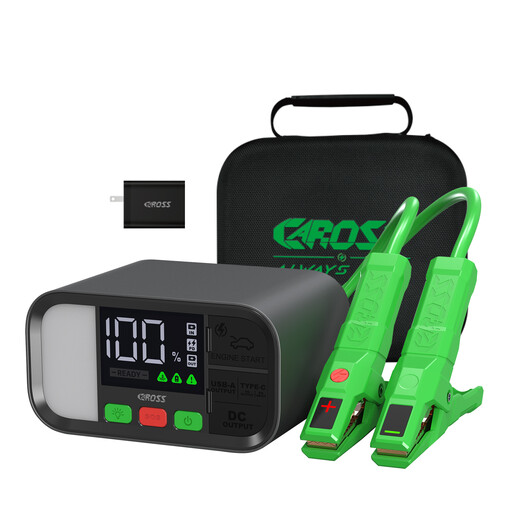
Why it suits this profile: According to the product specifications, this model combines a 1600A peak current with a 16000mAh lithium-ion battery, a 3-inch screen and a 65W Power Delivery output.
The screen displays the product status, while the supplied Smart Connect clamps are described as non-polarised. Check compatibility and instructions before use.
65W USB-PD output, an aluminium housing according to the product description and a protective case with a 65W charger.
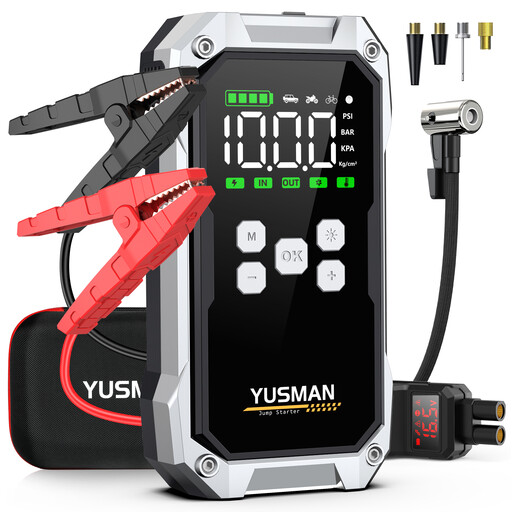
Why it suits this profile: For SUV and van owners, motorhome users and outdoor enthusiasts, combining a car starting aid with a tyre inflator can be highly practical.
The product information lists an LCD screen, smart clamps and protection against short circuits, overheating and reverse polarity, among other hazards.
According to the product specifications, 5000A peak current, 21800mAh capacity and an integrated compressor with a stated maximum of 150 PSI.
We have put together a complete, up-to-date list of products that fully meet these strict selection criteria and the applicable European safety regulations.
Before using it for the first time, read the manual and fully charge the portable jump starter. Then follow these basic steps:
Do not use a car emergency starter with a damaged, leaking or frozen battery. If the car does not start after several attempts, there may be a more serious problem than a flat battery.
No. Check the battery type, system voltage and maximum engine size. A product suitable for 12V cars is not automatically suitable for 24V lorries or the high-voltage systems of electric vehicles.
Its lifespan depends on charging cycles, storage temperature and maintenance. Charge the device according to the manual, store it in a dry place and check the charge level regularly. A model with a display makes this easier. Damaged or swollen batteries must no longer be used.
Jump leads are usually simpler and cheaper, but you need a second vehicle. A portable battery booster works independently and can also serve as a power bank or emergency light. When choosing, focus on the purchase price, charging frequency, included accessories and the vehicles for which the model is suitable.
