
Vandaag of morgen in huis

Kwaliteit gegarandeerd

Welkomstaanbiedingen ontgrendelen: GRATIS bezorging | Tot 80% korting | Gratis 30 dagen JoyPlus-proefperiode
Download de app
A flat battery often strikes at the worst possible time: in a dark car park, on the motorway or just before setting off on a camping trip. A car jump starter can be a practical emergency solution, without having to wait for breakdown assistance or another motorist with jump leads.
However, not every car battery jump starter is suitable for every vehicle. Marketing often focuses on high amp ratings, extra features and large capacities. The key question remains: is the device right for your vehicle and the way you plan to use it?
A figure such as 2,000A, 4,500A or 7,000A sounds impressive, but it doesn’t tell you everything about day-to-day performance. Check which engine size and fuel type the device is designed for, too. A jump starter for a compact petrol car has different requirements from one for a large diesel engine, van or motorhome.
Also check the voltage. The models discussed here are designed for 12V vehicles. Don’t use them with a vehicle that has a different electrical system.
A jump starter with a compressor is handy for inflating a soft car or bicycle tyre, or an airbed. The stated pressure, such as 150 PSI, is the maximum pressure; it doesn’t automatically tell you how quickly a car tyre will inflate. Check the airflow as well, such as 35 litres per minute, along with the hose length and automatic shut-off.
A built-in compressor is intended for emergencies and topping up on the go. If you’re inflating several large tyres in a row, the device may need time to cool down.
A portable jump starter contains a lithium battery, so protection against reverse polarity, short circuits, overheating and overcharging is important. Check whether smart jump leads are included and whether the display or warning signal alerts you to an incorrect connection.
Don’t leave a jump starter in a hot car permanently, and recharge it regularly according to the instructions. Some models are recommended for a top-up charge every two to three months after extended storage.
Choose a battery booster to suit your vehicle:
The GOOLOO GP2000 lists a peak current of 2,000A and supports petrol engines up to 8.0 litres and diesel engines up to 6.0 litres. The GOOLOO GE1500 is rated for petrol engines up to 6.0 litres and diesel engines up to 4.0 litres. Always check your vehicle’s handbook as well.
If you also want to inflate car tyres, look for:
An LCD screen makes it easier to read pressure values. Check that the unit shown matches your preference: PSI, bar or kPa.
A jump starter is usually kept in the boot, so its weight and whether it comes with a storage bag are practical considerations. Many models also work as a jump starter power bank, with USB ports for a smartphone, tablet or sat nav. An LED light with a steady beam, flashing mode or SOS mode can be useful when checking your vehicle at the roadside.
These extra features are handy, but they shouldn’t come at the expense of suitable starting power and good-quality cables.
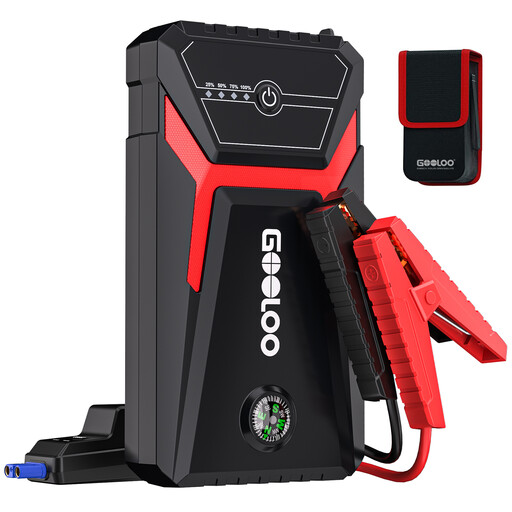
Why it suits this profile: This compact car jump starter is designed for 12V vehicles with petrol engines up to 6.0 litres and diesel engines up to 4.0 litres. That makes it suitable for many cars and motorcycles.
The specifications give separate limits for petrol and diesel engines, so you don’t have to rely solely on the general peak rating of 1,500A.
1,500A peak current, two USB ports, a 400-lumen light and a stated weight of approximately 0.878 kg.
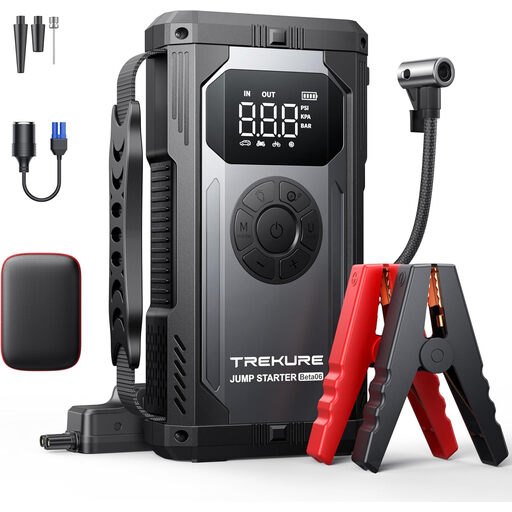
Why it suits this profile: For drivers of SUVs, vans and larger vehicles, this model offers higher stated engine limits and a built-in compressor.
The stated specifications include 5,500A and support for petrol and diesel engines up to 10.0 litres. Always check these limits against your vehicle’s details.
150 PSI compressor, LCD screen, automatic shut-off, 10 listed safety protections and a 12V output.
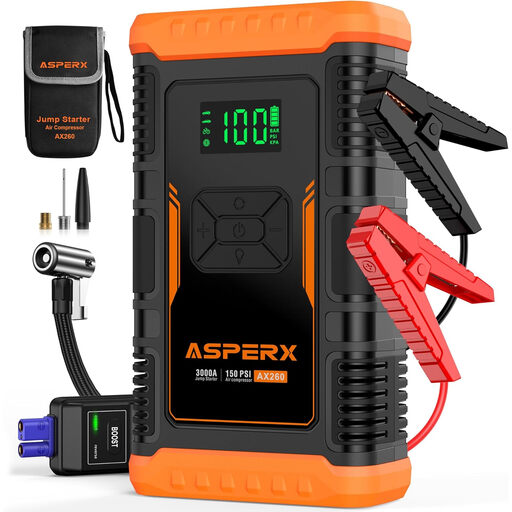
Why it suits this profile: This model combines a 12V battery booster with a compressor. It’s aimed at motorists, motorcyclists and outdoor enthusiasts who want to use several functions on the go.
According to the product information, the compressor has an LCD display, preset modes and automatic shut-off. This makes it easier to monitor while inflating.
3,000A peak current, compressor up to 150 PSI, the ability to charge two devices at once and a multi-mode light.
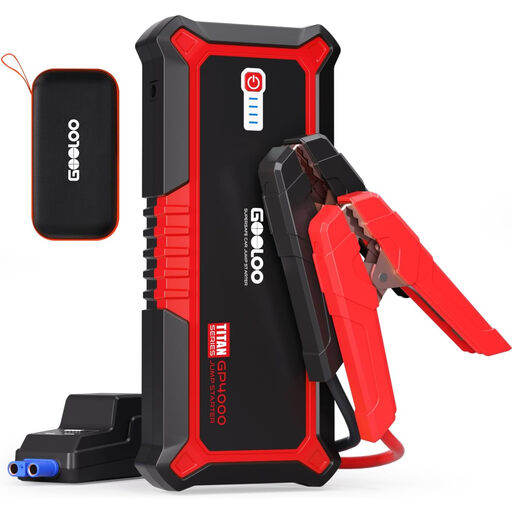
Why it suits this profile: This 12V jump starter is designed for larger petrol and diesel vehicles. It also offers USB and 12V options for use on the go.
The product specifications list support for petrol and diesel engines up to 10.0 litres. The included smart clamps have several safety features.
4,000A peak current, USB ports, a USB-C connection, metal clamps and a robust casing according to the product description.
We’ve put together a complete, up-to-date list of products that meet these strict selection criteria and the applicable European safety regulations.
Always follow the manufacturer’s instructions when using an emergency jump starter. As a general guide:
A jump starter won’t fix a faulty battery. If your car keeps struggling to start, have the battery and charging system checked.
Its lifespan depends on storage temperature, charging habits and how often it’s used. Store the device somewhere cool and dry, avoid leaving it in a hot car for long periods and recharge it regularly. Follow the maintenance intervals in the instructions.
Only if the model has a built-in compressor. Check the maximum pressure, airflow and operating time. A compressor built into a jump starter is mainly intended for topping up tyre pressure on the go, not for prolonged professional use.
No. The battery must be suitable for the jump starter, and the vehicle must be within the stated 12V, engine and temperature limits. An emergency jump starter can’t reliably solve the problem if the battery is damaged, frozen or faulty internally.
