
Vandaag of morgen in huis

Kwaliteit gegarandeerd

Welkomstaanbiedingen ontgrendelen: GRATIS bezorging | Tot 80% korting | Gratis 30 dagen JoyPlus-proefperiode
Download de app
A flat battery often strikes at the worst time: on a cold morning, during a camping trip or when you’re out and about in a motorbike, SUV or van. A car jump starter can be a practical emergency solution. However, not every model is suitable for every vehicle.
Many buyers focus mainly on the highest amp figure on the packaging. This can be misleading. You should also check engine compatibility, battery type, safety features and how you plan to use the device. Below are the main things to consider, along with some suitable options for different situations.
A figure such as 6000A or 8000A sounds powerful, but it doesn’t tell you on its own what a jump starter can do in practice. Always check the stated petrol and diesel engine capacity. For example, a model may be suitable for a petrol engine up to 9.0 litres, but have a lower limit for diesel engines.
Also note the difference between peak current and normal starting current. Peak current is a short-lived maximum figure. The manufacturer also specifies which vehicles and conditions the product is designed for.
Most cars, motorbikes, motorhomes and many SUVs use a 12V battery system. Heavy commercial vehicles and some lorries use 24V. A 12V jump starter is not automatically suitable for a 24V system. So check your vehicle’s handbook before connecting a car jump starter.
A jump starter is also not a replacement for a standard car battery charger. A jump starter provides temporary power to start the engine; a battery charger recharges the vehicle battery in a controlled way.
A jump starter with a compressor can be useful if your tyres are underinflated, but check the maximum pressure, airflow, hose and supplied valve adapters. A high PSI figure alone doesn’t tell you how quickly a tyre will inflate.
A built-in power bank for your car, torch or laptop output is only useful if the connections are compatible with your devices. Check, for example, whether it has USB-A, USB-C, the right PD wattage and any 12V or 15V outputs.
Choose a model that exceeds your vehicle’s requirements. According to the product information, a 1200A to 2000A model may be sufficient for a small petrol car. For a large diesel engine, motorhome, boat or work vehicle, a more powerful car battery booster makes more sense.
Examples from the range:
These limits don’t guarantee that every vehicle will start in all conditions. If the battery is damaged or leaking, or there’s another electrical problem, contact breakdown assistance or a garage.
A suitable car jump starter should ideally have protection against reverse polarity, short circuits, overheating and overcurrent. Smart clamps can warn you if the connection is incorrect, but always check the terminals yourself.
The usual procedure is:
Only use a boost or forced-start function if the manual allows it and you’ve checked the polarity carefully.
A higher battery capacity can allow more starting attempts and charge more devices, but it often also means a larger or heavier unit. So check the weight if you plan to carry the jump starter on a motorbike, in a small car or in a rucksack.
Lithium batteries don’t hold their charge indefinitely. Recharge your portable jump starter after use and check it regularly if you keep it in the car. Don’t store it for long periods in extreme heat, such as behind glass in a parked car. Always follow the manufacturer’s temperature and storage instructions.
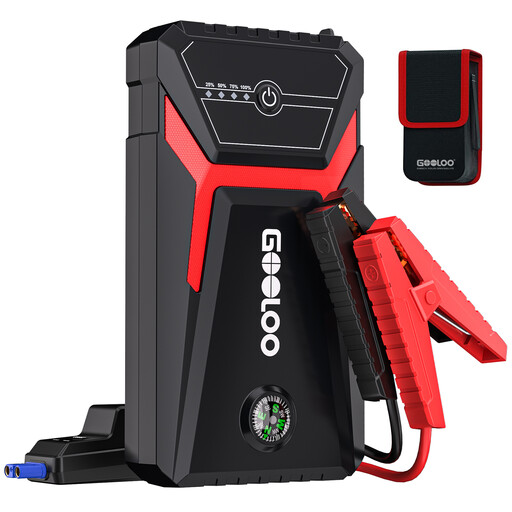
Why it suits this user: A compact option for drivers with a 12V car, motorbike or motorhome who mainly need emergency starting, USB outputs and a light.
The product information states a peak current of 1500A and gives separate limits for petrol and diesel engines, so you can compare compatibility rather than relying on a marketing claim alone.
Specified for 6.0L petrol and 4.0L diesel engines, with two USB outputs, a 400-lumen light and 10 safety features according to the manufacturer.
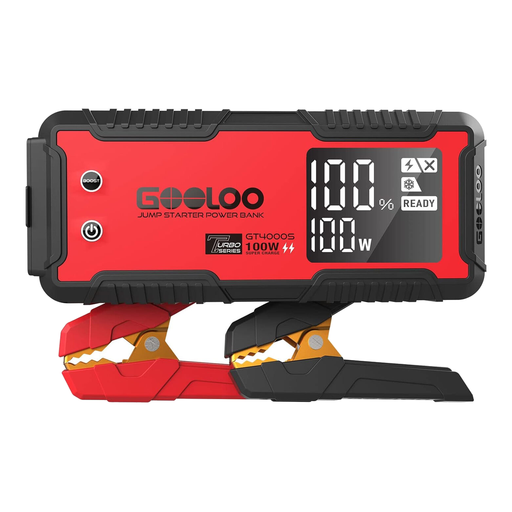
Why it suits this user: Suitable for drivers of larger vehicles, motorhomes, pick-ups and boats who value fast charging options and higher stated engine compatibility.
The specifications state not only a peak current of 4000A, but also the limits of 12.0L for petrol and 10.0L for diesel engines. The 100W Type-C charging function is clearly specified and easy to check.
100W two-way charging, three USB ports, a 400-lumen light and a 15V/10A output according to the product description.
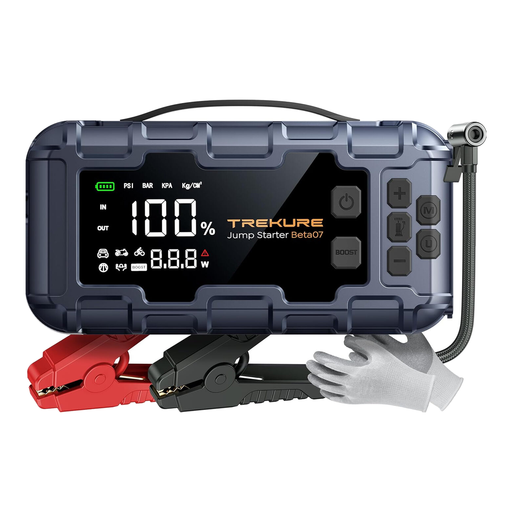
Why it suits this user: A combination for motorhome and SUV drivers, and outdoor enthusiasts who want to inflate tyres, balls and other inflatables on the go as well as jump-start their vehicle.
According to the product information, the compressor has a maximum pressure of 160 PSI, an airflow rate of 45 litres per minute and an automatic stop function. Always check your vehicle’s recommended tyre pressure.
Stated peak current of 6000A, 45W USB-C PD, a 160 PSI compressor, smart display and four light modes.
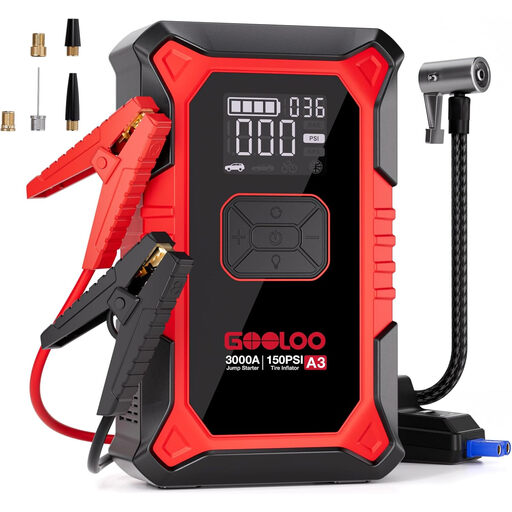
Why it suits this user: Handy if you want one device in the boot for jump-starting, inflating tyres, USB charging and lighting.
The specifications list five inflation modes, digital pressure measurement and automatic shut-off. This gives you more detail about the compressor functions than a high PSI figure alone.
Peak current of 3000A, compressor up to 150 PSI, airflow of 35 l/min, USB power bank and 10 stated safety features according to the product information.
We’ve put together a full, up-to-date list of products that meet these strict selection criteria and the applicable European safety regulations.
No. A 12V jump starter is designed for vehicles with a 12V system, but the permitted engine capacity varies by model. Also check whether your vehicle uses a lead-acid battery and follow the product specifications. Electric vehicles don’t have a conventional high-voltage battery that can be started this way.
That depends on the battery, storage temperature, charging habits and how often you use it. Recharge the device after use and check its charge regularly. Some manufacturers recommend topping up the charge every few months if the device is stored for a long time. Check the manual for your model.
It depends on how you’ll use it. A jump starter with an air compressor is handy if your tyres are underinflated while you’re out and about, but it’s usually larger and heavier. If you only need emergency starting and phone charging, a more compact car jump starter may be enough. So compare the features you’ll actually use, rather than just counting the features listed on the packaging.
