
Vandaag of morgen in huis

Kwaliteit gegarandeerd

Welkomstaanbiedingen ontgrendelen: GRATIS bezorging | Tot 80% korting | Gratis 30 dagen JoyPlus-proefperiode
Download de app
A dead battery. It's one of the most common reasons for a car breakdown. You turn the key and only hear a disappointing click. In the past, this meant waiting for roadside assistance or hoping a helpful neighbour had jumper cables. Today, the solution is more compact and self-reliant: the jump starter. But the market is flooded with models that promise the world. As a Product Recommendation Officer at Joybuy, I'll help you see through the marketing hype and choose a model that won't leave you stranded.
Before you spend your money, watch out for these common pitfalls:
To avoid a bad purchase, it's better to focus on a few concrete specifications. These determine whether a car jump starter will do its job when it matters most.
The peak current (Peak Amps) is the maximum current the booster can deliver for a very short time. More important is the cranking current (Cranking Amps), the continuous current needed to actually turn the engine over.
The capacity, expressed in milliampere-hours (mAh), determines how many times you can start a car or how long you can charge your phone. A higher capacity means more starts per charge.
Many modern jump starters are multifunctional. A power bank with jump starter functionality is standard, but a jump starter with a compressor is a valuable addition. This allows you not only to start your car but also to inflate a flat tire, which is a common problem on the road. A built-in LED light with an SOS function is also a practical extra for breakdowns in the dark.
Based on objective specifications and functionality, we have selected a number of models that suit different user profiles.
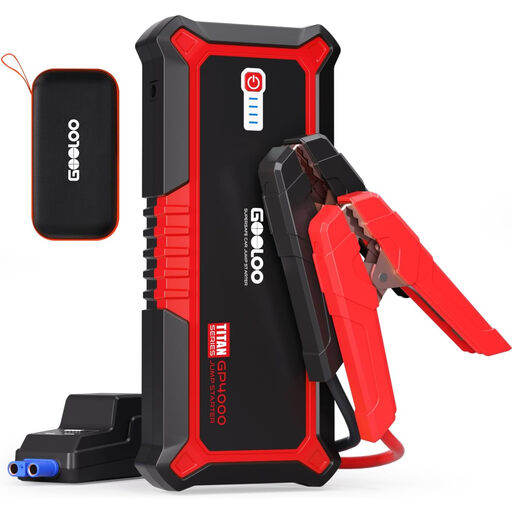
Why This Fits Their Persona: Ideal for those with an RV, van, or a car with a large diesel engine (up to 10.0L). This model is designed for pure starting power and reliability for heavy-duty vehicles, even in low temperatures.
This model bypasses the peak current myth by explicitly specifying its suitability for diesel engines up to 10.0L. The "BOOST" function delivers forced power even when the battery is almost completely dead, offering a concrete solution rather than an empty marketing figure.
Extremely powerful: The 4000A peak is functional here, aimed at starting the heaviest 12V engines. Robust clamps: The all-metal clamps are more durable than plastic-coated versions.
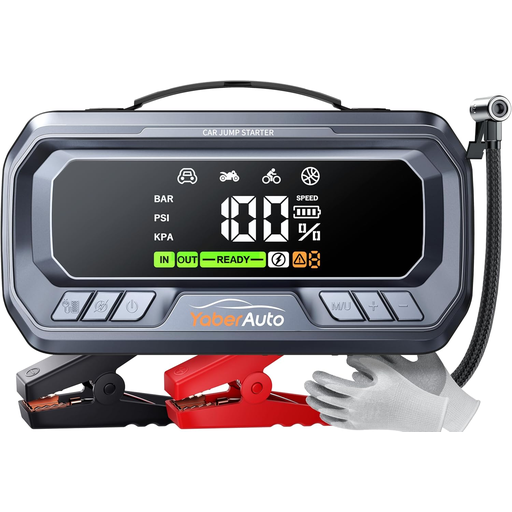
Why This Fits Their Persona: For the driver who wants to be prepared for anything. This is not just a powerful emergency starter, but also a full-fledged compressor and a fast-charging power bank for laptops and phones. Perfect for long trips, camping, or simply for peace of mind.
This model focuses on concrete, useful features rather than just a high Ampere number. The 160 PSI compressor with auto-stop and 65W fast charging are objectively measurable benefits that transcend marketing claims.
65W PD Fast Charging: Not only does it recharge itself quickly, but it can also charge a laptop at high speed. Intelligent Air Pump: The 160 PSI compressor with preset pressure and automatic shut-off makes inflating tires simple and safe.
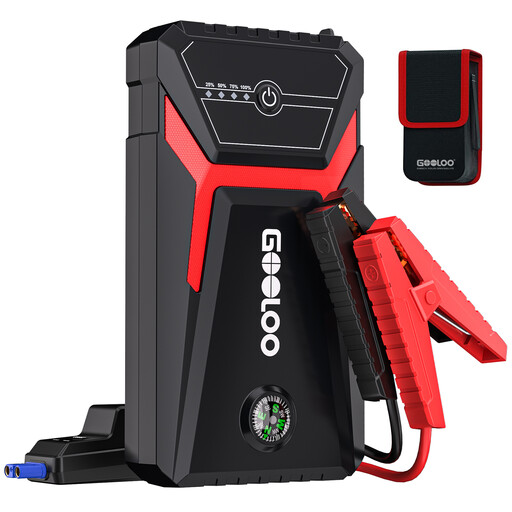
Why This Fits Their Persona: For the driver of an average gasoline or compact diesel car looking for a reliable, no-nonsense solution. This model is small enough for the glove compartment and offers enough power for most passenger cars, without the added cost and bulk of a compressor.
This model tackles the self-discharge trap. According to GOOLOO, it retains its charge for a long time, provided it is recharged every 2-3 months. It focuses on the core task: reliable starting. It's an honest product without unnecessary bells and whistles.
Compact and lightweight: Weighing less than a kilogram and with a small footprint, this is an ideal `car emergency starter` that doesn't get in the way. Complete safety set: Features 10 safety functions, including protection against reverse polarity and sparks.
We have compiled a complete, up-to-date list of products that fully meet these strict selection criteria and safety regulations.
Most manufacturers recommend charging a jump starter every 2 to 3 months, even if you don't use it. Lithium-ion batteries have a low self-discharge rate, but they do lose some charge over time. Regular charging ensures the booster is ready for use when you need it and extends the life of the internal battery.
That depends on your needs. If you often drive long distances, live in a rural area, or go camping, a model with a compressor is an excellent investment. A flat tire is almost as much of an inconvenience as a dead battery. For urban drivers who mainly make short trips and have easy access to a gas station, a more compact model without a compressor might be more practical and cost-effective.
A jump starter is designed to start a vehicle when its battery has insufficient voltage to turn the starter motor. It is a starting aid, not a battery charger or repair tool. If a battery is internally damaged (e.g., due to a shorted cell) or is completely 'dead' and no longer holds any charge, a jump starter can start the car, but it will not repair the battery itself. After starting, the alternator should recharge the battery, but if the battery is faulty, it will still need to be replaced.
