
Vandaag of morgen in huis

Kwaliteit gegarandeerd

Welkomstaanbiedingen ontgrendelen: GRATIS bezorging | Tot 80% korting | Gratis 30 dagen JoyPlus-proefperiode
Download de app
A flat car battery often happens at the worst possible moment: on a cold morning, after a long drive with the lights on or when the car has been left standing for several weeks. A car jump starter can get you moving again without relying on another driver. However, many models look similar, even though there can be significant differences in starting power, safety features and ease of use.
Pay particular attention to these three common pitfalls:
The peak current, measured in amps, indicates how much current the jump starter can deliver for a short period. Starting current is more useful when it comes to starting an engine, but it is not specified for every model. So don’t just compare 1200A, 2000A or 4000A. Check the stated engine capacity as well.
A compact 12V jump starter for a small petrol car has different requirements from a car jump starter for an SUV, motorhome or van. Check:
A jump starter is not intended for the high-voltage battery in an electric car. If in doubt, check your vehicle’s handbook and the product specifications.
A car jump starter should include protection against, among other things:
These features reduce the risk of incorrect connection, but they do not remove the need to use the device carefully. Connect the red clamp to the positive terminal and the black clamp to the negative terminal or a suitable unpainted metal earth point, as stated in the handbook.
Also pay attention to the quality of the clamps and cables. Insulated handles, strong springs and sufficiently thick cables are all practical features. An LCD display can also show whether the jump starter has enough charge or has detected a fault.
A portable jump starter with a power bank can charge phones, tablets or navigation devices. Look for:
Lithium batteries gradually lose charge, particularly when stored in a hot car for long periods. Therefore, don’t leave a jump starter permanently in direct sunlight or somewhere where the temperature can rise significantly. Check the charge level several times a year, even if you have not used the device.
A jump starter with a torch is useful if you break down in the dark. Models with continuous light, flashing light and an SOS signal offer different ways to illuminate your surroundings or attract attention. Treat this as an extra feature, not a replacement for a warning triangle or high-visibility vest.

Why it suits this profile: According to the product information, this model is compact and weighs approximately 330 grams. That means it fits in a glove compartment, rucksack or small emergency kit. The manufacturer states that it supports 12V petrol and diesel vehicles, including cars, SUVs and motorbikes.
The stated 1200A peak current, 600A starting current and LCD display make the key information more specific than a standalone marketing claim about capacity.
Stated capacity of 12800mAh, 10W USB output, USB-C input and an LED lamp with three modes.
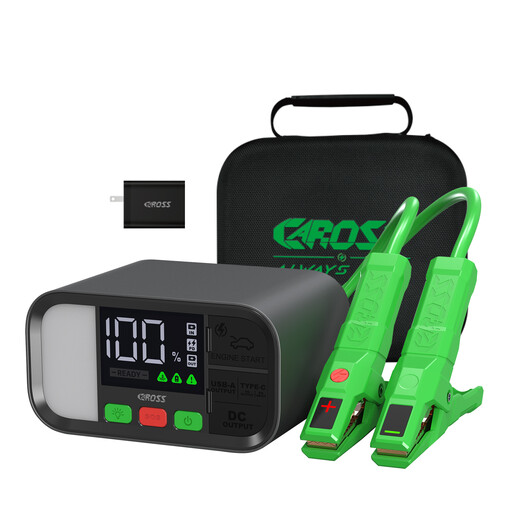
Why it suits this profile: The combination of a 3-inch digital screen, protective case and 65W Power Delivery output is ideal for drivers who also want to charge laptops or other USB-C devices while on the move.
The product specifications state 12V compatibility, a Smart Connect system with non-polarised clamps and protection against reverse polarity.
1600A peak current, 16000mAh lithium battery, 65W PD output and a protective case with charger included.
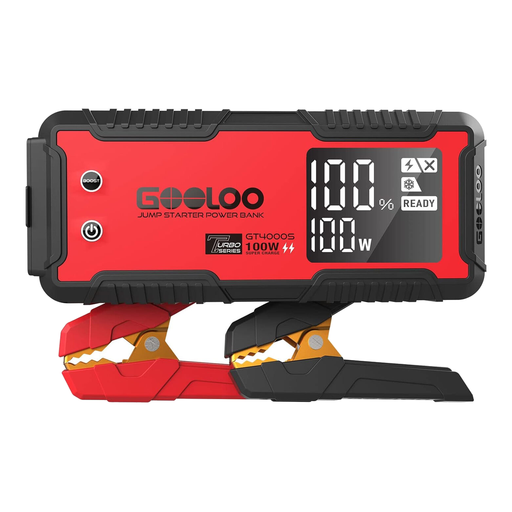
Why it suits this profile: This model is designed for larger vehicles and users who need support for a motorhome, pick-up, SUV or another 12V vehicle. According to the product information, it is intended for petrol engines up to 12.0 litres and diesel engines up to 10.0 litres.
The stated engine limits, 4000A peak current and status display provide more guidance for intensive use than a general term such as “powerful” alone.
100W charging, three USB ports, a 15V/10A connection, LED lamp and car charger included.
We’ve put together a complete, up-to-date list of products that fully meet these strict selection criteria and the applicable European safety regulations.
Read the handbook before using the device for the first time and charge it fully. Then check that the car and jump starter use the same voltage. Switch off all electrical equipment in the car and attach the clamps securely.
Do not attempt to start the engine for longer than the period specified in the handbook, which is often a few seconds per attempt. Wait a moment before trying again. Remove the clamps as soon as the engine is running and recharge the car jump starter after use. Do not use the device with a damaged, leaking or swollen battery.
A jump starter can temporarily help a flat battery start the engine. If the battery quickly goes flat again afterwards, it needs to be inspected or replaced. For heavy commercial vehicles, you should also check whether the vehicle uses a 12V or 24V system.
That depends on the product specifications. Many models are suitable for 12V petrol and diesel vehicles, but the maximum engine capacity varies. Diesel engines generally require more starting power. Always check the stated limits for both engine types.
Standby time varies depending on the model, temperature and storage conditions. Manufacturers may, for example, state a standby period of 18 or 24 months, but this is not a guarantee for every situation. Check the charge level regularly and recharge the device according to the handbook.
Once you have bought one, the direct running costs are limited to recharging the internal battery. Most models charge via USB-C or an included car charger. However, bear in mind that the battery will wear over time, and replace the device when its capacity or starting performance noticeably declines.
