
Vandaag of morgen in huis

Kwaliteit gegarandeerd

Welkomstaanbiedingen ontgrendelen: GRATIS bezorging | Tot 80% korting | Gratis 30 dagen JoyPlus-proefperiode
Download de app
A flat battery rarely happens at a convenient time. For commuters, holidaymakers and DIY enthusiasts, a car jump starter can be a useful addition to the car’s standard equipment. But the range can be more complicated than it first appears. A high amp rating, a built-in compressor and claims such as “safe” only tell you so much: always check the full product specifications.
In this guide, you’ll find out what to look for in a portable jump starter, which marketing claims need closer scrutiny and what type of car battery booster is right for your vehicle.
A figure such as 2.000A, 4.000A or 7.000A usually refers to the stated peak current. This is not the same as a continuous starting current, and figures aren’t always directly comparable across brands. So check the stated engine capacity too:
A compact 12V jump starter for a small petrol car won’t necessarily have enough capacity for a van or diesel SUV.
A jump starter with a compressor can be useful for a slowly deflating tyre, but the maximum pressure in PSI doesn’t tell you how quickly the pump works. Also check the airflow rate, for example in litres per minute, the length of the hose and whether it has an automatic stop at the set tyre pressure.
Use a compressor only to inflate the tyre temporarily. If the tyre is damaged or losing pressure quickly, you’ll need professional help.
Smart jump leads may include features such as reverse-polarity, short-circuit, overheating and overcharge protection. According to the relevant brands’ product information, these are built-in safety features; they don’t remove the need to connect the leads correctly. Always check the positive and negative terminals and follow the instructions.
A jump starter also isn’t a substitute for replacing a worn-out battery or repairing a faulty charging system.
Choose based on your vehicle first, not on how the product looks. For a small car or motorbike, a model rated by the manufacturer for petrol engines up to 6 or 8 litres may offer sufficient capacity. The stated limit is often lower for diesel engines.
If you have more than one vehicle, such as a car and a van, choose a car jump starter that’s compatible with your largest vehicle. Also check that the model is designed for 12V systems. The wrong voltage can cause damage.
Look for:
According to GOOLOO’s own product information, the GP2000 and GP3000 have several safety features. Treat these as verifiable product specifications, not as a guarantee that incorrect use carries no risk.
A jump starter with a power bank can charge phones, tablets and other devices. Check the number of USB ports, the output power and whether a USB-C cable or charger is included. A model with a high stated mAh rating isn’t automatically suitable for every use.
Fully charge the car emergency starter before using it for the first time, and check its charge level regularly. Lithium batteries are less predictable if stored for a long time when completely flat, very hot or very cold. Always follow the manufacturer’s charging and storage advice.
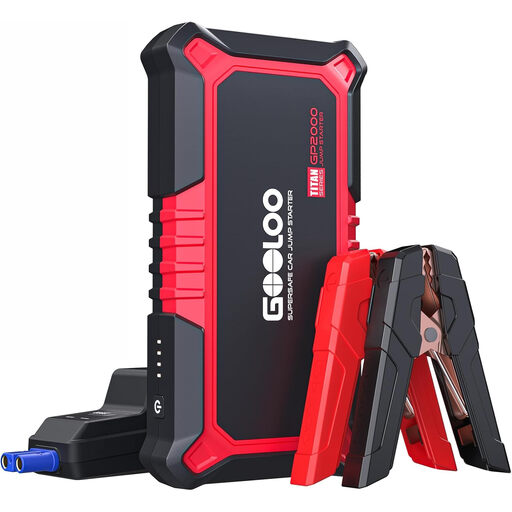
Why it suits this type of user: The GP2000 is compact and weighs around 545 grams, according to the product information. It’s a good choice for drivers who want to keep a straightforward booster in the boot.
The stated compatibility covers 12V vehicles with petrol engines up to 8,0 litres and diesel engines up to 6,0 litres. Even so, check this against your car’s manual.
According to the product description: 2.000A peak current, two USB outputs, a 400-lumen light and a storage case.
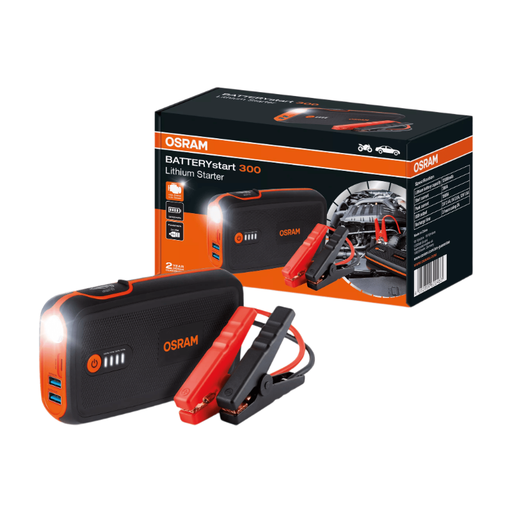
Why it suits this type of user: This model combines a 12V jump-start function with a power bank, 12V output and LED light. It’s a good fit for drivers who want to use several devices or accessories on the go.
The stated limits are clearly listed: up to 8 litres for petrol engines and 4 litres for diesel engines. This makes it easier to compare the product with your vehicle’s specifications.
According to the product details: 2.000A peak power, two USB ports, a 12V socket and a stated weight of 1.174 grams.
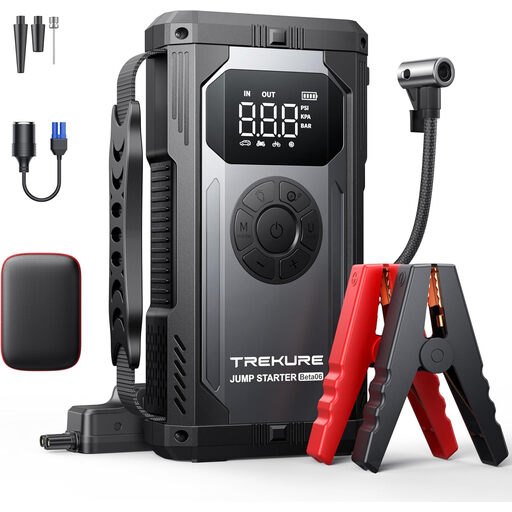
Why it suits this type of user: This model is designed for people who want to inflate tyres as well as jump-start a vehicle. It could be useful on holiday, on long drives or when travelling in a van.
Alongside a maximum pressure of 150 PSI, the product information states an airflow rate of up to 35 L/min and an automatic stop at the set pressure. Before buying, check that these figures suit your needs.
According to TREKURE: 5.500A peak current, support for petrol engines up to 10 litres, an LCD display and several safety features.
We’ve put together a complete, up-to-date list of products that meet these strict selection criteria and the applicable European safety regulations.
Don’t use damaged cables, clamps or casing. Never connect the clamps to each other, and don’t leave a compressor unattended if the manual advises against it.
That depends on the lithium battery, the number of charge cycles, temperature and storage conditions. Recharge the device periodically, even when you’re not using it. Some brands state a standby period, but this is a manufacturer’s figure based on specific conditions, not a guarantee for every real-world situation.
Sometimes, but it depends on the model and vehicle. If the battery voltage is very low, you may need a boost or force-start function. Some brands’ product information states that a dedicated mode is available for this. Always check the manual and first make sure the battery isn’t damaged.
The electricity used to charge one is generally modest, but the overall cost mainly depends on the purchase price, lifespan and maintenance. A model with a power bank, LED light or compressor could replace several separate accessories. Only pay for those features if you’ll actually use them; otherwise, a simpler model is often the more sensible choice.
