
Vandaag of morgen in huis

Kwaliteit gegarandeerd

Welkomstaanbiedingen ontgrendelen: GRATIS bezorging | Tot 80% korting | Gratis 30 dagen JoyPlus-proefperiode
Download de app
A flat 12V battery is rarely convenient: whether you’re on your way to work, facing a cold morning or about to set off in your campervan. With a car jump starter, you can often try to start your vehicle yourself, without needing another car and jump leads.
However, not every portable jump starter is suitable for every vehicle. The large amp ratings on the packaging don’t tell the whole story. A built-in compressor, power bank or torch may also prove less useful in practice than you expect. Read on to find out which specifications to check and which models suit different needs.
A figure such as 4,000A, 6,000A or 8,000A sounds impressive, but this is usually the maximum peak current. Whether a jump starter is suitable also depends on its starting current, cable thickness, battery condition and compatibility with your engine.
A 12V jump starter for a small petrol car requires less power than a jump starter for a large diesel SUV, van or lorry. So always check the stated engine capacity for both petrol and diesel engines.
The battery capacity in mAh gives you an indication of the available energy, but it doesn’t determine on its own whether the car will start. A car power bank, for example, may be handy for charging a smartphone but still not provide enough starting power for a diesel engine.
As well as capacity, check the stated peak current, starting current and vehicle compatibility. Capacity is also not listed in the same way by every brand.
Lithium batteries don’t cope well with prolonged heat. A jump starter left in a locked car in the sun for months may lose capacity more quickly. Check its charge level regularly too. Some manufacturers recommend recharging the device every few months.
Keep your emergency car starter dry, away from children and away from loose metal objects. Don’t use a device that is damaged, swollen or leaking.
Most cars, motorbikes, campervans and vans need a 12V jump starter. Next, check the maximum engine capacity:
A powerful battery booster for a large diesel engine isn’t automatically the most practical choice for a small city car. A compact model may be easier to store and offer sufficient specifications for occasional use.
Peak current is a short-term maximum. Starting current tells you more about the current available when starting the engine, but you should consider this figure in the context of the whole kit too.
Also check:
Connect the red clamp to the positive terminal and the black clamp to the negative terminal or a suitable earthing point, depending on the instructions. Never let the clamps touch each other.
A jump starter with a compressor can be handy if you need to pump up a soft tyre as well as deal with a flat battery. Check the maximum pressure, airflow, hose and automatic shut-off. An LCD display showing the set and current tyre pressure makes it easier to use, but always check the correct tyre pressure for your vehicle.
USB-C, USB-A and a 12V output make the device more versatile. However, don’t expect every output to power a laptop or fridge for long periods. Check the stated power in watts and voltage first.
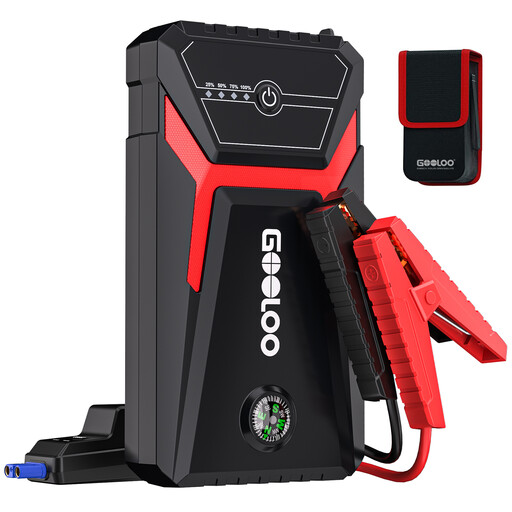
Why it suits this user: This model is compact and designed for 12V vehicles, including cars, motorbikes and campervans. Its stated 1500A peak current makes it a good fit for drivers looking for a practical jump starter for everyday use.
The vehicle limits are clearly stated: up to 6.0 litres for petrol and 4.0 litres for diesel. This makes it easier to compare compatibility than relying on a marketing term alone.
Two USB outputs, a 400-lumen light with three modes and a stated weight of 0.878 kg.
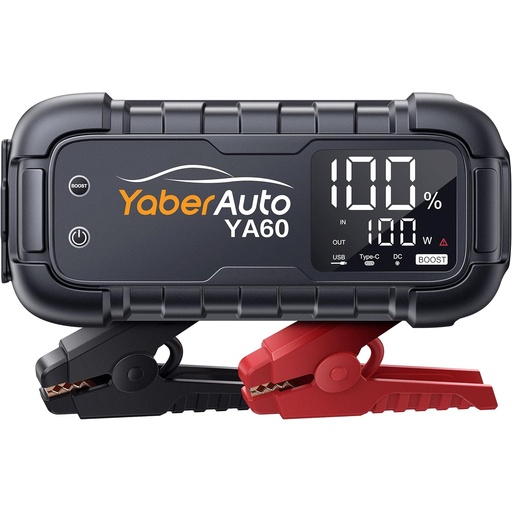
Why it suits this user: A good choice if you value fast charging and extra power options as well as jump-starting capability. According to the product information, this model supports 65W USB-C charging and 150W DC output.
The stated support for 12.0-litre diesel engines and 8,000A peak current give you more information for comparing models for larger vehicles. Always check the instructions for your own model, though.
26800mAh lithium polymer battery, 65W USB-C, two USB-A outputs and a 600-lumen light.
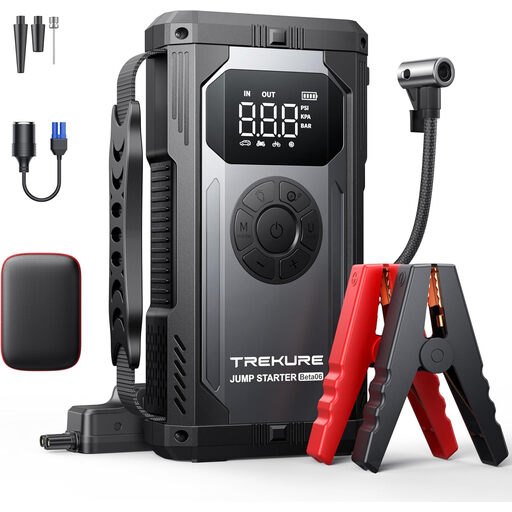
Why it suits this user: Handy for drivers who want to carry a jump starter, tyre inflator and emergency light in one unit. According to the product information, the compressor is suitable for pressures of up to 150 PSI.
According to the product description, the LCD screen shows the battery status and tyre pressure. The automatic shut-off at the set pressure means you don’t need to keep checking it.
Stated 5500A peak current, a compressor with 35 l/min airflow, and USB-A, USB-C and 12V connections.
We’ve put together a complete, up-to-date list of products that meet these strict selection criteria and the current European safety regulations.
Only use the force-start function when you’re certain the connection is correct. A jump starter won’t fix a damaged or leaking battery; have the vehicle checked instead.
Some models can, according to their product descriptions, but the result depends on the battery, temperature, cable connection and engine. A force-start function may be designed for very low voltage. Only use it as instructed in the manual.
Its lifespan depends on charging cycles, storage temperature and maintenance. Recharge the device periodically when it’s not in use, and don’t leave it in a hot car for long periods. Specifications such as the ‘number of starts’ are claims made by the brand, not a guarantee for every use case.
A built-in compressor can be useful if you regularly go on long drives, camp or use a campervan. If you only need help with a flat battery, a simpler model may be enough. So first compare your vehicle, storage space and preferred features.
