
Vandaag of morgen in huis

Kwaliteit gegarandeerd

Welkomstaanbiedingen ontgrendelen: GRATIS bezorging | Tot 80% korting | Gratis 30 dagen JoyPlus-proefperiode
Download de app
A dead battery is always unexpected and inconvenient. Whether it's on a cold winter morning or after a long holiday, starting issues are frustrating. A modern car jump starter is the perfect solution: a compact device that brings your car back to life in seconds. But the market is flooded with models that promise the world. Many drivers fall for marketing traps and end up with a device that lets them down when they need it most.
As a Joybuy Product Recommendation Officer, I'll help you cut through the marketing jargon. We'll look at the specs that truly matter, so you can choose a reliable jump starter for your car. These are the 3 most common pitfalls to watch out for.
Manufacturers often advertise impressive peak amp figures like 4000A or even 8000A. This number represents the maximum current the jump starter can deliver in a fraction of a second. While not unimportant, it's often misleading. An extremely high peak current is useless if the jump starter can't sustain it long enough to actually start your engine. Instead, focus on a realistic starting current and whether the model is explicitly suitable for your engine type (petrol or diesel).
A high capacity in milliampere-hours (mAh) sounds great, especially since many models also function as a power bank with jumper cables. But this number alone says little about performance. The quality of the internal battery cells and the efficiency of the electronics determine how many starts you actually get from a full charge. A cheap emergency car starter with a supposedly high capacity might be dead after a single start attempt, while a quality model with a lower, but more honest, capacity can handle multiple attempts.
This is the most dangerous pitfall. A jump starter works with high currents. Without the right protection, a simple mistake like connecting the clamps incorrectly can lead to sparks, short circuits, or even damage to your car's electronics. Cheap models often cut corners on these features. A reliable jump starter always has 'smart' clamps with built-in protection against reverse polarity, overheating, and short circuits.
To avoid a bad purchase, there are a few technical specifications you need to check. These determine whether a car battery booster is suitable for your vehicle and safe to use.
The required starting power depends on your engine. A jump starter for diesel engines needs significantly more power than one for a small petrol engine, especially in cold weather.
Always check the manufacturer's specifications for the recommended engine displacement.
Most modern jump starters use a lithium-ion battery. These are compact, lightweight, and hold their charge for a long time. Look for the following features:
A good jump starter is foolproof. The 'smart' jumper cables are essential for this. They should offer at least the following protections:
A clear display that shows the status of the battery and the starting process also contributes to ease of use.
Based on these criteria, we have selected a number of models that suit different user profiles.
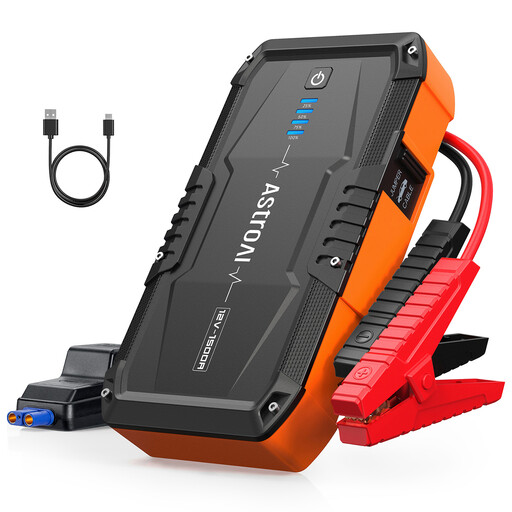
Why This Fits Their Persona: Perfect for those seeking a reliable, compact, and affordable solution for a standard petrol or small diesel car. It fits easily in the glove compartment and is ideal for emergencies.
This model focuses on the essentials: it delivers a realistic 1500A peak current and is equipped with 8 essential safety features, without boasting unnecessarily high numbers.
Very compact and lightweight. Features a 'Boost' mode for completely dead batteries, a function often missing in entry-level models.
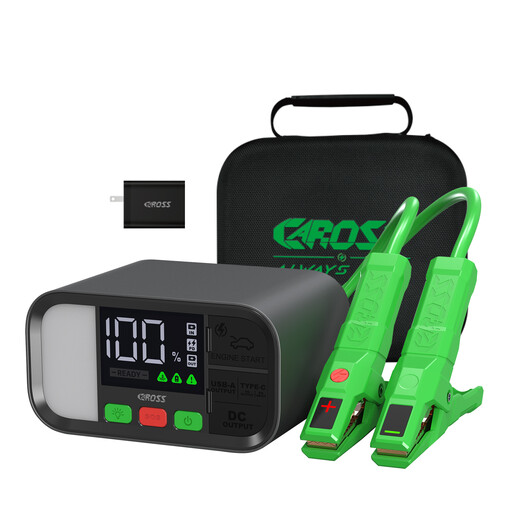
Why This Fits Their Persona: For the driver who values premium design, maximum ease of use, and the flexibility to also charge a laptop. Ideal for the mobile professional or freelancer.
The 'Smart Connect' technology with non-polarised clamps makes incorrect connection impossible. This tackles one of the biggest safety risks at the source.
The bidirectional 65W PD fast-charging function not only charges your laptop but also ensures the jump starter itself is fully recharged ultra-fast. The 3-inch LED screen clearly displays all information.
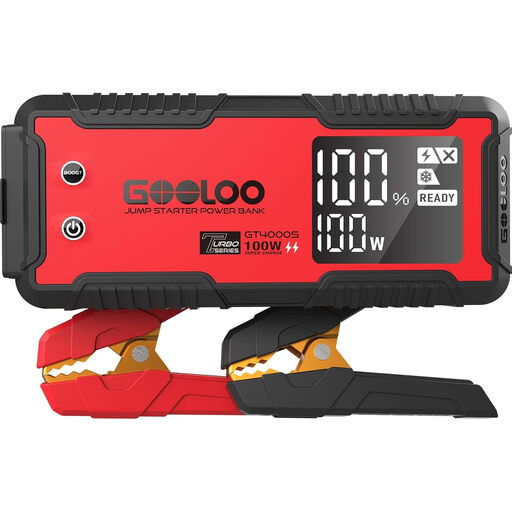
Why This Fits Their Persona: Specifically for owners of RVs, vans, boats, or cars with large diesel engines. This model delivers the serious power needed to start engines up to 10.0L diesel.
Where other brands claim high peak amps for marketing, the GT4000S delivers a proven powerful and stable current that is genuinely suitable for the toughest 12V engines.
Charges extremely fast thanks to the included 100W charger (full in about 1.2 hours). The large 3.2-inch screen clearly displays the status, which is essential for powerful equipment.
We have compiled a complete, up-to-date list of products that fully meet these strict selection criteria and safety regulations.
Most manufacturers recommend charging the jump starter every 3 to 6 months, even if you don't use it. Lithium-ion batteries have low self-discharge but will lose some charge over time. By periodically charging it, you ensure it's always ready for an emergency. Consult your specific model's manual for the exact advice.
That depends on the model. Many modern jump starters have a 'Boost' or 'Force Start' function, specifically designed for batteries with a very low voltage (e.g., below 2V), where a standard start attempt won't work. If your car has been sitting for a long time and the battery is completely dead, a model with this feature is a wise choice.
Yes, a modern car battery booster with 'smart' clamps is safe for the sensitive electronics in your car. The built-in safety mechanisms, such as protection against reverse polarity, short circuits, overvoltage, and overcurrent, prevent damage. It is crucial to always follow the instructions in the manual and choose a model that has these safety features.
