
Vandaag of morgen in huis

Kwaliteit gegarandeerd

Welkomstaanbiedingen ontgrendelen: GRATIS bezorging | Tot 80% korting | Gratis 30 dagen JoyPlus-proefperiode
Download de app
A flat battery often happens at the worst possible moment: in a car park, on a camping trip or on a dark country lane. With a car jump starter, you can sometimes start your vehicle yourself, without another car or roadside assistance. However, not every model is suitable for every vehicle.
The big numbers on the packaging don’t tell the whole story. A high peak current doesn’t automatically mean a device is suitable for your diesel engine. Features such as a compressor, power bank and torch are only useful if the jump starter has enough capacity and is maintained properly.
The stated peak current, for example 2.000 A or 5.500 A, is a product specification measured under certain conditions. Practical suitability also depends on the engine type, engine size, battery condition and temperature.
So always check:
A compact 12V jump starter for a small petrol car has different requirements from an emergency starter for a motorhome, van or diesel car.
A jump starter with a compressor is often advertised as reaching 150 PSI. That’s the maximum pressure, not how quickly it will inflate a car tyre. Check the airflow rate, maximum operating time and automatic shut-off too.
A digital gauge with adjustable pressure is handy on a car tyre inflator. Also check that the hose and nozzles are suitable for your valves. A compressor is designed for topping up and emergencies; you should have a severely deflated or damaged tyre checked.
Incorrectly connected clamps can cause damage. Choose a model with a clear reverse-polarity warning, short-circuit protection and an easy-to-see status indicator. These features won’t prevent every mistake, but they can make the device easier to use.
A jump starter power bank gradually loses charge while in storage. Fully charge the device before first use and check its charge level every two to three months, or as instructed in the manual. Store lithium batteries in a cool, dry place out of direct sunlight. Don’t leave a jump starter in a very hot car for extended periods.
Use the engine details in your car’s handbook as a guide. Product information usually gives an upper limit, such as “up to 8,0 litres petrol” or “up to 6,0 litres diesel”. This doesn’t guarantee that every battery or vehicle will start in all conditions.
For a typical car or motorbike, a 1.500 to 2.000 A model may be sufficient, depending on the product specifications. For a large diesel, motorhome or commercial vehicle, a more powerful car jump starter is likely to be a better choice. Bear in mind that cold temperatures place extra demands on the battery.
A larger battery pack can support more starting attempts and extra features, but it’s usually heavier. Look for:
A portable car jump starter should fit in your vehicle and be within reach when the boot is full.
A jump starter with an air compressor is a good option for drivers, motorcyclists and outdoor enthusiasts who want several functions in one device. Check the maximum pressure, airflow rate, nozzles included and maximum continuous operating time.
An LED torch with a steady beam, flashing mode or SOS mode can help when checking your vehicle in the dark. Some brands’ product descriptions state that these modes are for lighting and signalling; don’t use them instead of a warning triangle or other required safety measures.
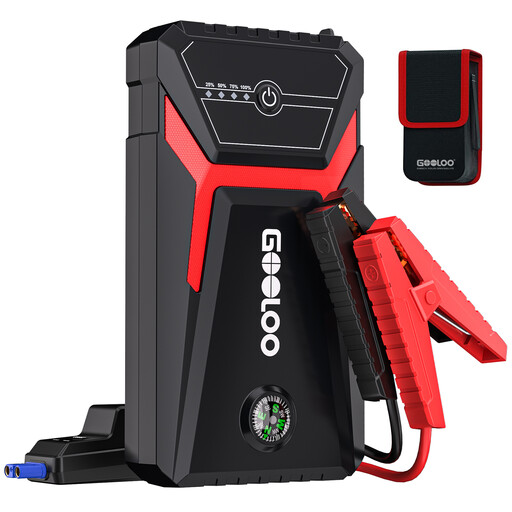
Why it suits this user: The GE1500 is a relatively compact jump starter for 12V vehicles. According to the product information, it’s designed for petrol engines up to 6,0 litres and diesel engines up to 4,0 litres, and has USB outputs and a 400-lumen torch.
The product information gives specific engine limits, rather than simply showing a high amp rating. Always check these limits against your vehicle details.
1.500 A peak current according to the product details; 10 listed safety protections, USB outputs and three lighting modes.
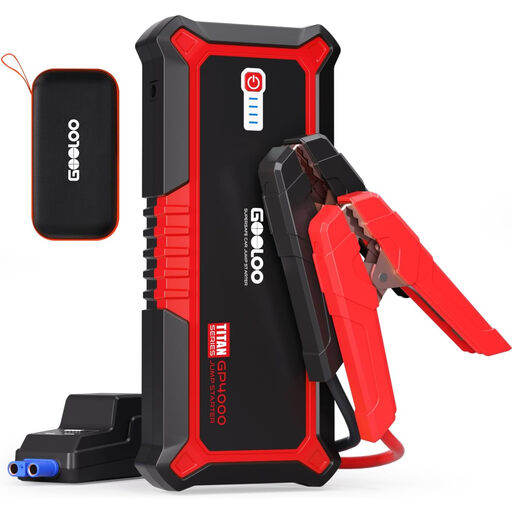
Why it suits this user: This model is aimed at users who want extra starting power and a robust casing for a car, motorhome, pick-up or van.
The product page states that it’s suitable for 12V vehicles and gives engine limits of up to 10,0 litres for both petrol and diesel. This makes it easier to compare models than relying on peak current alone.
4.000 A according to the product specifications; USB and USB-C ports, metal clamps and a carry case.
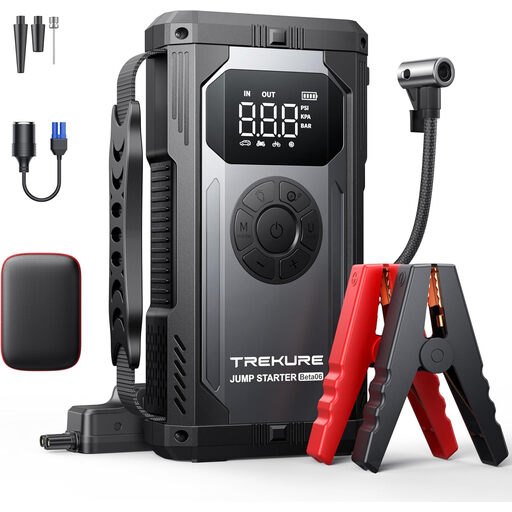
Why it suits this user: This model combines a powerful 12V starting function with a compressor for tyres, bicycles and other inflatables. It’s a good fit for motorhomes, vans and outdoor trips.
As well as 5.500 A, the product information lists an airflow rate of 35 l/min, 150 PSI, an LCD screen and automatic shut-off. Do check the compressor’s operating time.
Suitable, according to the product specifications, for petrol engines up to 10,0 litres and diesel engines up to 10,0 litres; compressor with adjustable pressure and 12V output.
We’ve put together a complete, up-to-date list of products that meet these strict selection criteria and current European safety regulations.
Don’t use a jump starter with a damaged, leaking or frozen battery. If in doubt, consult the manuals for both your vehicle and the device.
Its lifespan depends on charging cycles, storage temperature, use and maintenance. Recharge it regularly, even if you haven’t used it, and don’t store it permanently in a hot car. The stated warranty and number of charging cycles vary by model.
Only if the product specifications say it’s suitable. Diesel cars generally need more starting power than comparable petrol cars. Check the maximum diesel engine size, 12V compatibility and whether it has a boost function before buying.
It depends on how you’ll use it. If you only want to get a flat battery going, a compact car battery booster is often enough. If you regularly go on long journeys, go camping or want to carry a car tyre inflator, you may benefit from a built-in compressor, digital pressure gauge and automatic shut-off.
