
Vandaag of morgen in huis

Kwaliteit gegarandeerd

Welkomstaanbiedingen ontgrendelen: GRATIS bezorging | Tot 80% korting | Gratis 30 dagen JoyPlus-proefperiode
Download de app
A flat battery often strikes at an inconvenient time: on a cold morning, during a camping trip or after your car has been parked for a long time. A portable jump starter could get you back on the road without relying on another car or breakdown assistance.
However, not every car battery booster is suitable for every vehicle. Marketing often focuses on a high amperage, but other specifications are just as important. Watch out for these three common pitfalls:
A car jump starter with a peak current of, say, 1,200A or 2,000A may look appealing, but check the stated engine-size limit too. Diesel engines generally need more starting power than petrol engines.
Use this checklist:
For a compact city car, a model rated for, for example, 6.0-litre petrol and 4.0-litre diesel engines will often offer more capacity than you need. For an SUV, van, campervan or lorry, a higher limit is more practical. However, a powerful jump starter isn’t automatically suitable for a 24V lorry system.
A good car jump starter should come with clear instructions and appropriate safety features. Look for:
A CE mark indicates that the manufacturer declares the product meets the relevant EU requirements. Also check the manual, the seller’s contact details and the warranty terms. A CE mark alone doesn’t guarantee a particular level of starting performance.
A jump starter power bank is only useful if you can take it with you and keep it charged. Look at:
A higher capacity in mAh doesn’t automatically mean the device can start a vehicle more often. Usable capacity, cranking current and charge level all play a part. Store the device in a dry place, out of direct sunlight and within the temperature limits stated in the manual.
The selection below is based on the stated product specifications. Claims made by brands about starting performance, standby time or charging speed have not been independently verified, so always use the product specifications and manual as your guide.

Why it suits this type of user: According to the product specifications, this compact model weighs around 330 grams and is designed for 12V petrol and diesel vehicles. The LCD display lets you check the charge level before setting off.
As well as a 1,200A peak current, the specifications list a cranking current of 600A and a 12800mAh battery. This gives you more context than a big marketing number alone.
LCD display, USB output, Type-C input and an LED light with three modes. The stated charging time is around four hours.
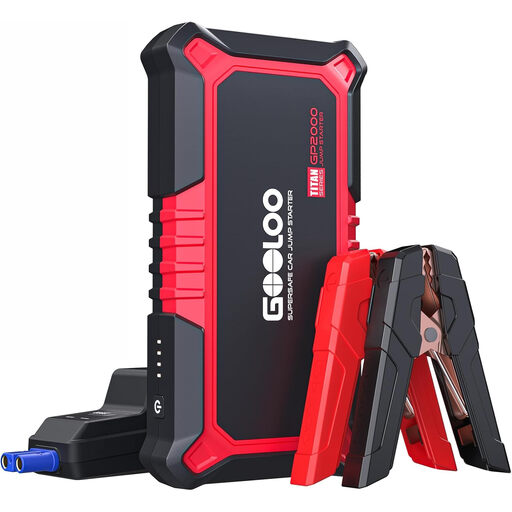
Why it suits this type of user: The GP2000 combines a 2,000A peak current with support for petrol engines up to 8.0 litres and diesel engines up to 6.0 litres, according to the product information. It’s a good fit for drivers with an SUV, campervan or larger van.
The product specifications list ten safety features and a green ready indicator. Even so, check the polarity and connection procedure in the manual.
Two USB outputs, a 400-lumen LED light with SOS and flashing modes, metal clamps and a stated weight of around 545 grams.
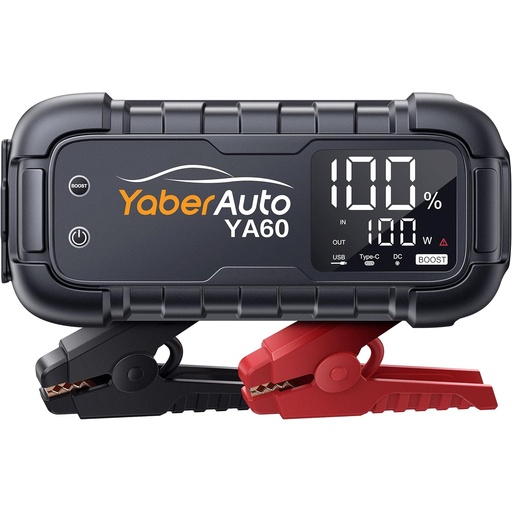
Why it suits this type of user: According to the product specifications, this model is designed for larger 12V vehicles, supporting petrol and diesel engines up to 12.0 litres. The extra DC output is useful for campervans, outdoor use and vehicles with accessories.
The specifications list 10 intelligent safety features, 8AWG cables and instructions on leaving a pause between starting attempts. Only use the device within the stated vehicle and temperature limits.
65W USB-C charging, two USB-A outputs, a 150W DC output and a 600-lumen light. The stated weight is around 1 kilogram.
We’ve put together a complete, up-to-date list of products that meet these strict selection criteria and the applicable European safety requirements.
Read the manual before connecting the jump starter for the first time. Check that it has enough charge and switch off all the vehicle’s electrical accessories. The usual procedure is:
Don’t use a jump starter with a damaged, leaking or swollen battery. A jump starter is for emergency assistance; it won’t fix a faulty battery or an alternator problem.
This varies by model, charger and remaining capacity. The specifications for the models mentioned give a charging time of around three to five hours. Fully charge the device before first use and check its charge level regularly while it’s in storage.
Only if it’s within the manufacturer’s temperature and storage limits. A parked car can get very hot in summer. Keep your car battery booster dry and out of direct sunlight, and don’t leave it loose next to metal objects that could cause a short circuit.
It depends on the stated engine size, cranking current and vehicle type. Check the diesel rating in particular; it’s often lower than the petrol rating. A 12V jump starter also isn’t suitable for a 24V system unless compatibility is explicitly stated.
