
Vandaag of morgen in huis

Kwaliteit gegarandeerd

Welkomstaanbiedingen ontgrendelen: GRATIS bezorging | Tot 80% korting | Gratis 30 dagen JoyPlus-proefperiode
Download de app
A flat car battery often strikes at the worst possible moment: on a cold morning, during a holiday or in a remote car park. A car jump starter can get you moving again without needing another car and jump leads. But not every model is suitable for every vehicle.
If you only look at the highest amp rating, you could end up spending money on a device that isn’t right for your car, doesn’t come with enough accessories or turns out to be low on charge after months in storage. Read on to find out what to look for in a car battery jump starter, which marketing claims to treat with caution and which type might suit your needs.
A rating such as 2,000A, 4,000A or 8,000A sounds clear-cut, but it doesn’t tell the whole story. The stated peak current is a maximum reached for a short time. So also check the petrol and diesel engine sizes the manufacturer says the device is suitable for.
A compact 12V jump starter for a small petrol car doesn’t need the same capacity as a jump starter for a motorhome, van or large diesel engine.
Most models in this category are designed for 12V battery systems. That doesn’t mean they’re suitable for 24V lorries, electric vehicles with high-voltage batteries or a damaged battery. Check your vehicle’s handbook and the product page before placing an order.
A car jump starter also isn’t a permanent fix for a worn-out battery. If your battery keeps going flat, have the battery and charging system checked.
A compressor, power bank and LED light can be handy, but only if the device is easy and safe to use. Look for clear status indicators, sturdy clamps, a suitable storage case and an instruction manual. A compressor’s high pressure rating, for example, doesn’t automatically tell you how quickly it can inflate a car tyre.
Start by checking these three points:
According to its product description, the GOOLOO GP2000 is rated at 2,000A and supports petrol engines up to 8.0 litres and diesel engines up to 6.0 litres. The GOOLOO A3 is rated at 3,000A and supports petrol engines up to 9.0 litres and diesel engines up to 6.5 litres. These figures are the manufacturer’s product specifications; actual performance also depends on the battery’s condition, the temperature and whether the device is connected correctly.
A good battery booster should ideally have protection against:
Also check that the smart jump leads provide clear alerts and that the clamps fit securely onto the battery terminals. Safety features reduce the risk of incorrect connection, but they don’t replace careful use. Connect the red clamp to the positive terminal and the black clamp to the negative terminal or a suitable unpainted earth point, as shown in the manual.
For a jump starter with a compressor, the maximum pressure, airflow, hose and automatic shut-off are the main things to check. According to the product description, a model rated at 150 or 160 PSI can be used for a range of applications, but always follow your car’s recommended tyre pressure. The PSI rating is a maximum, not a recommended tyre pressure.
Keep an eye on the charge level, too. If a portable jump starter spends months in your boot, it needs to be recharged regularly, as set out in the manual. Many models recommend recharging after use or topping up the charge periodically during storage. Keep the device dry and avoid leaving it exposed to high temperatures for long periods in a parked car.
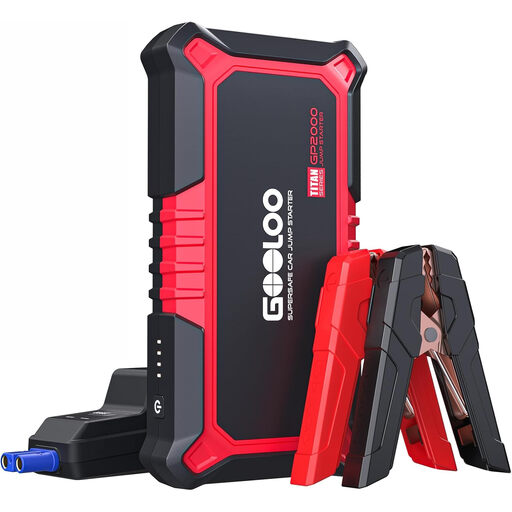
Why it suits this type of user: A straightforward 12V car jump starter for drivers who mainly want to deal with a flat battery and charge their phone too.
The product description lists 10 safety features, a status light and compatibility with 12V lead-acid batteries. Be sure to check the engine limits yourself: 8.0 litres for petrol and 6.0 litres for diesel.
2,000A peak current, two USB outputs, a 400-lumen light and a weight of around 545 grams, according to the product details.
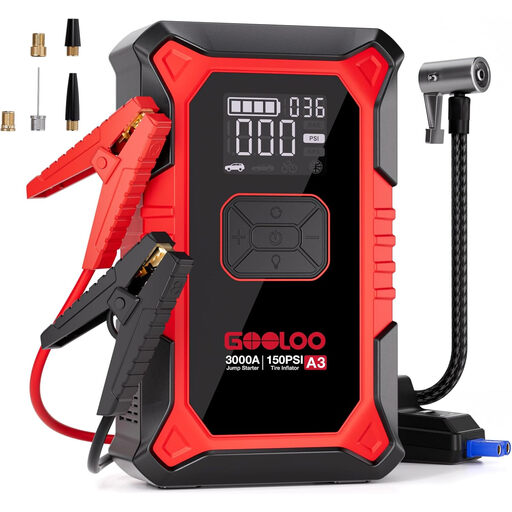
Why it suits this type of user: A good choice if you want one device for jump-starting, topping up tyres, lighting and portable power.
The digital pressure gauge and automatic shut-off make the compressor easier to control than a model without a display. The manufacturer also lists 10 safety features.
3,000A, a compressor rated up to 150 PSI, airflow of 35 l/min and five inflation modes, according to the product description.
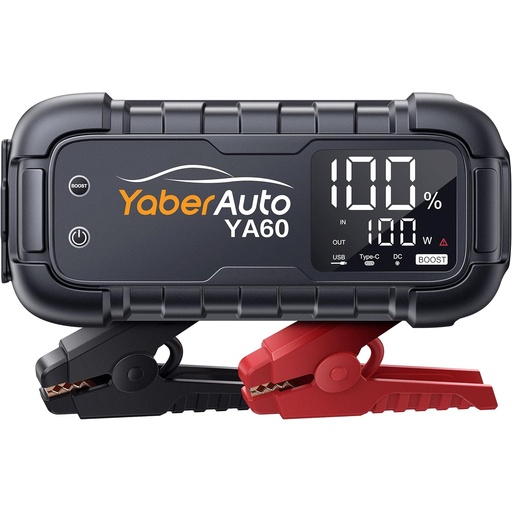
Why it suits this type of user: An option for larger vehicles, frequent travellers and anyone who also wants to power a laptop or other 12V equipment.
The product details list a 65W USB-C port, 10 safety features and a 150W DC output. Use these features only within the stated specifications.
8,000A peak current, support for diesel engines up to 12.0 litres according to the manufacturer, and two USB-A outputs alongside USB-C.
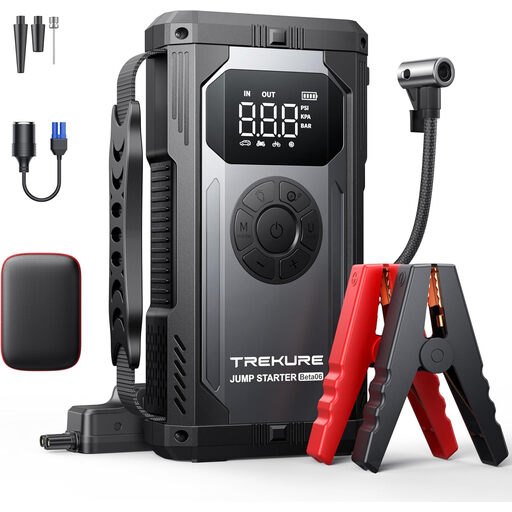
Why it suits this type of user: A handy choice for cars, vans, motorbikes and camping equipment if you want jump-starting and tyre inflation in one unit.
According to the product description, the LCD screen displays the battery status and tyre pressure. The automatic shut-off helps prevent you from having to keep checking while inflating.
5,500A, a compressor rated up to 150 PSI, airflow of 35 l/min, a 23800mAh battery and dual USB output, according to the information provided.
We’ve put together a full, up-to-date list of products that meet these strict selection criteria and comply with current European safety regulations.
Only use forced boost mode if the manual allows it and you’ve checked the polarity carefully.
It depends on the battery type, storage temperature, charging habits and how often you use it. Recharge the device after use and check it periodically if you keep it in your car. Any stated number of charge cycles or standby time is a manufacturer’s product specification, not a guarantee for every situation.
Some models have a boost or forced-start function for batteries with very low voltage. According to the product description, this may help with certain models, but it isn’t guaranteed to work with every completely faulty or damaged battery. Always follow the manual and avoid making repeated, lengthy starting attempts.
Power consumption depends on the battery capacity, tyre pressure and how long the compressor runs. For occasional use, the main costs are usually the purchase price and any replacement needed in the longer term. Regular recharging generally costs very little, but don’t leave the device permanently connected to the car charger unless the manual says you can.
