
Vandaag of morgen in huis

Kwaliteit gegarandeerd

Welkomstaanbiedingen ontgrendelen: GRATIS bezorging | Tot 80% korting | Gratis 30 dagen JoyPlus-proefperiode
Download de app
A flat battery often happens at the worst possible moment: on a cold morning, by the motorway or just before setting off with the caravan. A car jump starter can get you moving again, but not every model is suitable for every vehicle. If you only look at the highest amp rating, you could pay too much for features you do not need or choose a car battery booster that is simply not powerful enough.
The main pitfalls:
A 12V jump starter is designed for vehicles with a 12V battery system. Check the vehicle, motorbike, campervan or boat manual to make sure this matches. Then look for separate figures for petrol and diesel.
Examples from the product specifications:
These figures are provided by the brands or sellers. Treat them as an indication for choosing a model, not as a guarantee that a damaged, frozen or completely failed battery can be restarted.
A high peak current sounds appealing, but it does not tell you everything about everyday use. Also check:
A jump starter power bank is practical for charging a phone, tablet or sat-nav, but USB capacity is not the same as starting power for a car engine.
Choose a car jump starter with smart clamps and clear status indicators. Many models list protection against:
According to the product information, various GOOLOO, ACEZUK and BuTure models include several of these safety features. That is useful, but correct connection is still essential. Always read the manual, connect the red clamp to the positive terminal and the black clamp to the negative terminal or a suitable unpainted metal earth point, if instructed to do so in the manual.
Do not use a jump starter if the battery is visibly leaking, damaged or frozen. Starting attempts usually last only a few seconds; allow the device to cool between attempts when the instructions specify this.

Why it suits this profile: According to the product information, this compact model weighs around 330 grams and is suitable for 12V petrol and diesel vehicles. It therefore fits easily in a glove compartment or emergency kit.
The specifications list a peak current of 1200 A and a starting current of 600 A separately, along with support for petrol and diesel. This makes comparisons clearer than looking at just one amp figure.
Stated capacity of 12800 mAh, LCD display, 10 W USB output and three light modes.
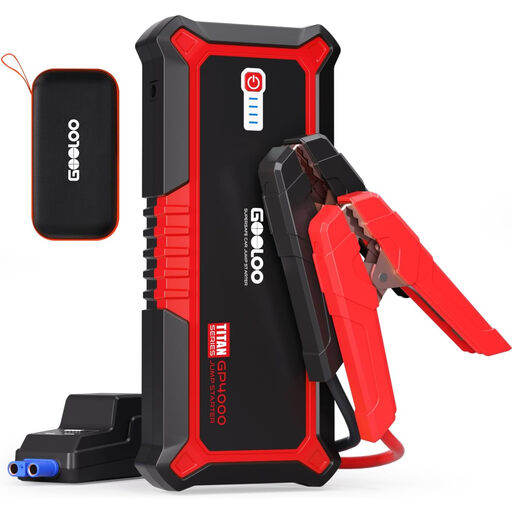
Why it suits this profile: According to the product description, this is a powerful jump starter for larger 12V vehicles, including campervans, pick-ups, tractors and lorries.
The manufacturer states a peak current of 4000 A and a range of up to 10.0 litres for diesel engines. Always check that this matches your exact engine and battery system.
Ten listed protection features, two USB ports and a robust housing with an LED torch.
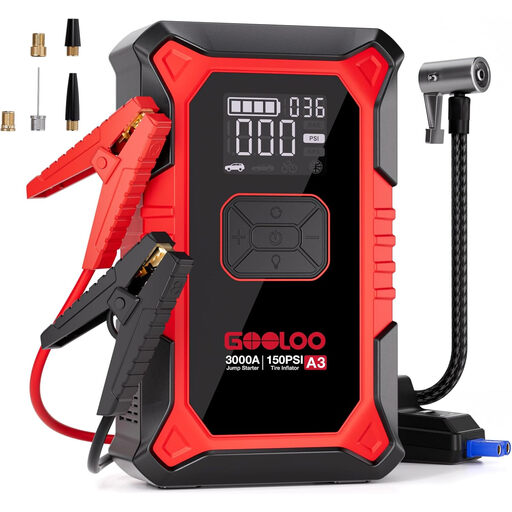
Why it suits this profile: Campervan owners, motorcyclists and outdoor enthusiasts get a built-in tyre inflator as well as an emergency car jump starter.
According to the product specifications, the compressor has a digital pressure gauge, automatic shut-off and multiple modes. Check the maximum pressure and allow the device to cool during prolonged inflation.
3000 A peak current, compressor up to 150 PSI and support for 12V petrol and diesel vehicles.
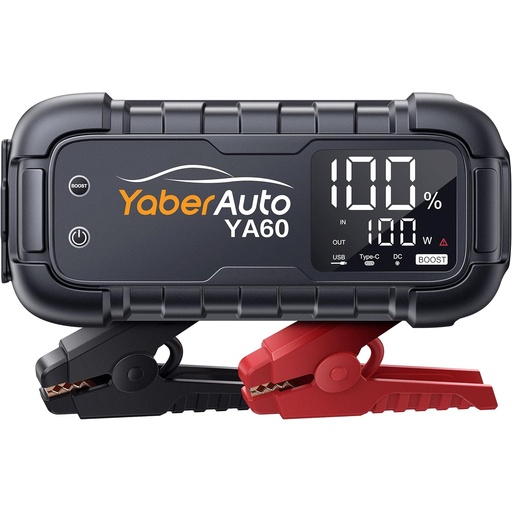
Why it suits this profile: This model is aimed at users with larger vehicles and multiple power requirements during travel, work or camping.
The product information lists 8000 A peak current, 8AWG cables and ten safety features. The stated compatibility extends to diesel engines up to 12.0 litres, but check this against the vehicle documentation.
26800 mAh, USB-C 65 W, two USB-A outputs and a 150 W DC output for compatible devices.
We have put together a complete, up-to-date list of products that fully meet these strict selection criteria and the applicable European safety regulations.
Fully charge a new jump starter before using it for the first time. When storing it in the car, heat is an important consideration: a vehicle can become extremely hot in summer when it is closed up. It is therefore best to store the device somewhere dry and avoid leaving it in direct sunlight for long periods.
Check the charge level every two to six months, depending on the manufacturer's instructions. Products such as the GOOLOO GP4000 and YaberAuto YA60 specify periodic charging as part of their maintenance. Also inspect the clamps, cables and housing before setting off.
This is not always guaranteed. Some models have a boost function for very low voltage, but a damaged or faulty battery cannot be repaired this way. Check the minimum voltage and procedure in the manual.
Its lifespan depends on charging cycles, storage temperature and maintenance. Regular charging, dry storage and avoiding deep discharge help preserve the available capacity. A manufacturer's warranty provides information about formal cover, not unlimited service life.
That depends on how you plan to use it. If you only want to get a flat battery going again, a compact jump starter will often be enough. If you regularly take long journeys, use a campervan or motorbike, or want to inflate tyres and sports equipment, a jump starter with compressor could be a worthwhile choice. Check the maximum pressure, air flow rate and cooling time.
