
Vandaag of morgen in huis

Kwaliteit gegarandeerd

Welkomstaanbiedingen ontgrendelen: GRATIS bezorging | Tot 80% korting | Gratis 30 dagen JoyPlus-proefperiode
Download de app
A clicking sound instead of a roaring engine. It's a familiar scenario, especially on a cold, wet morning when you're in a hurry. A dead battery is the most common cause of a car breakdown. In the past, you had to rely on jumper cables and a helpful neighbour. Today, there's a more compact and self-reliant solution: the car jump starter, also known as a battery booster.
But the market is flooded with models that promise the world. Before you make a purchase, it's important to see through the marketing hype. Many buyers fall for the same pitfalls:
As a Joybuy Product Recommendation Officer, I'm here to help you make the right choices. In this guide, we'll explain what you really need to look for, so you can choose a reliable car jump starter that works when you need it most.
To avoid a bad purchase, you need to check three technical aspects. These determine whether a jump starter is suitable for your vehicle and situation.
Most manufacturers emphasize peak amps, for example, 2000A or 4000A. This is the maximum current the booster can deliver for a fraction of a second. It's a marketing number. More important are the cranking amps, the sustained current needed to actually turn the engine over. Unfortunately, this figure is mentioned less often.
Practical Guideline:
A jump starter with a power bank function is convenient, but the capacity in milliamp-hours (mAh) doesn't tell the whole story. A high mAh value doesn't automatically mean you can start the car more times. The battery's efficiency and the rate of self-discharge are crucial.
A good lithium-ion jump starter should still have at least 75% of its charge after 3-6 months in the car. Some newer models with sodium-ion technology even claim a standby time of several years. Check the manufacturer's recommendations on how often you should preemptively charge the device.
Modern jump starters are much safer than old-fashioned jumper cables. They are equipped with built-in protections. Look for the following features:
The quality of the jumper clamps is just as important. Sturdy, all-metal clamps with a strong spring ensure a good connection to the battery terminals. Cheap plastic clamps can break or make poor contact, rendering the jump starter useless.
We have selected several popular models and matched them with specific user profiles. This will help you find a model that fits your car and lifestyle.
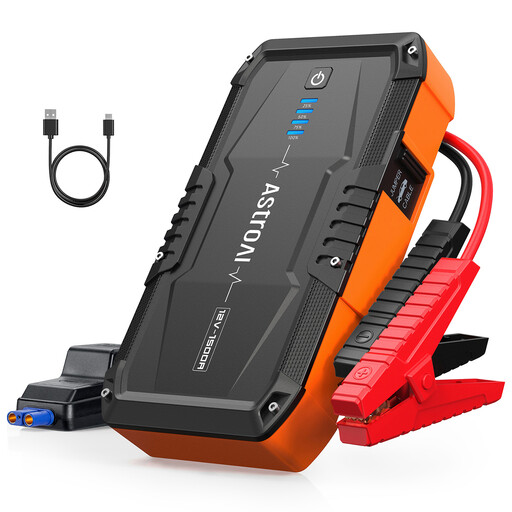
Why This Fits Their Persona: Perfect for those who rely on their car daily. This model is compact enough for the glove compartment and provides enough power for most petrol and smaller diesel cars. The power bank function is a handy bonus for charging your phone on the go.
It focuses on the essentials: reliable starting. The 1500A peak current is realistic for the intended vehicles (up to 6.0L petrol/3.0L diesel) and the metal clamps are high quality, reducing the risk of a failed jump-start.
Compact size (0.95 lbs / 430g) and a "BOOST" mode for completely dead batteries. Includes 8 built-in safety features.

Why This Fits Their Persona: For those who want more than just a jump-start. The built-in compressor (150 PSI) is ideal for inflating car, bike, or RV tyres. The high peak current makes it suitable for larger engines, turning it into a versatile tool for the garage or campsite.
This is no gimmick. The jump-start function is extremely powerful with 8000A peak current (suitable for all petrol and 10.0L diesel engines), and the compressor is a fully-fledged addition, not a weak extra. The large 3.4-inch screen provides clear information.
2-in-1 functionality: a powerful jump starter and a cordless air compressor. Includes 10 safety features and a bright LCD screen for status updates.
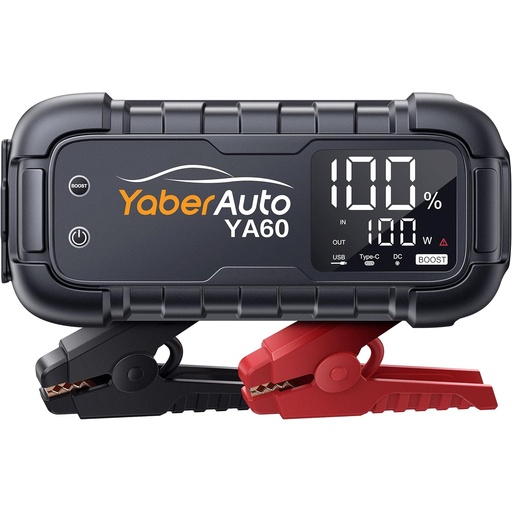
Why This Fits Their Persona: For owners of large SUVs, vans, boats, or vehicles with a heavy-duty diesel engine. This model delivers a massive 8000A peak current, capable of starting engines up to 12.0L diesel. The focus here is purely on maximum, reliable starting power.
This model lives up to its claims with specs geared towards heavy-duty vehicles. The 65W fast-charging feature ensures the large 26800mAh battery is quickly topped up, and the 24-month standby time (according to the manufacturer) avoids the 'dead booster' trap.
Extreme starting power for all petrol engines and diesels up to 12.0L. Very fast to recharge (1.5 hours) and functions as a powerful power bank with a 150W DC output.
We have compiled a complete, up-to-date list of products that fully meet these strict selection criteria and safety regulations.
This depends on the model and battery technology. Most manufacturers of lithium-ion boosters recommend charging the device every 3 to 6 months, even if you don't use it. This prevents deep discharge and extends its lifespan. Always consult the manual for your specific model for the best advice.
Yes, a modern battery booster is designed to be safe for the sensitive electronics in your car. Unlike traditional jumper cables, they have built-in safety circuits that prevent voltage spikes, short circuits, and incorrect connections (reverse polarity). As long as you choose a model with these intelligent protections, you run no risk.
No, not every jump starter is powerful enough for a diesel engine. Diesel engines have a higher compression ratio and require significantly more starting power (cranking amps) than petrol engines, especially in cold weather. Always check that the jumpstarter's specifications explicitly state that it is suitable for your type and size of diesel engine (e.g., "up to 8.0L diesel"). A booster that is too weak will not be able to start the engine.
