
Vandaag of morgen in huis

Kwaliteit gegarandeerd

Welkomstaanbiedingen ontgrendelen: GRATIS bezorging | Tot 80% korting | Gratis 30 dagen JoyPlus-proefperiode
Download de app
A dead battery always happens unexpectedly and at the worst possible moment. Whether it's on a cold winter morning or just before you leave for vacation, the result is the same: you're stranded. A portable car jump starter seems like the perfect solution, but the market is flooded with models that overpromise and underdeliver. As a Joybuy Product Recommendation Officer, I'll help you see through the marketing hype and choose a model that won't let you down.
Before you spend any money, it's important to recognise the three most common pitfalls:
To choose a reliable battery booster, you need to look beyond the big numbers on the box. These are the specs that really matter.
The peak current (peak amps) is the maximum current a 12v jump starter can deliver for a very short time. The starting current is the continuous current needed to actually turn the engine over.
diesel jump starter requires more power due to higher compression. Count on a model with at least 1500A to 2000A peak power for a reliable start, especially in cold weather.So, don't blindly focus on the highest peak rating, but check if the power is suitable for your engine type.
The capacity, expressed in mAh, determines how many times you can start a car or charge your phone. A power bank with jumper cables with 10,000 to 16,000 mAh offers a good balance between size and performance. This typically allows for multiple start attempts and leaves you with enough reserve power to charge your devices. Modern lithium-ion batteries are the standard here, as they are more compact and hold their charge longer than older technologies.
A good emergency car starter is more than just a battery with cables. It's a tool that must be safe for both you and your vehicle. Look for the following built-in safety features:
These features are non-negotiable for a safe and worry-free experience when starting a car with a dead battery.
Not everyone needs the same car starter. Below are some choices tailored to specific user profiles.
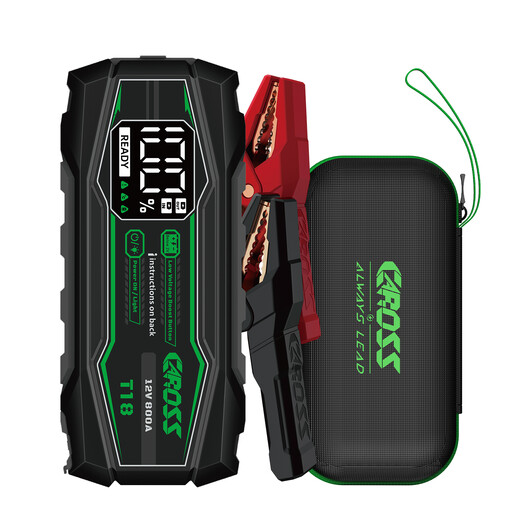
Why This Fits Their Persona: Ideal for drivers of compact or mid-size cars (petrol up to 4.0L). This model is compact enough for the glove compartment and offers enough power for the most common situations, without unnecessary frills.
This model focuses on the essentials: reliable starting power with all crucial safety features (spark-proof, reverse-polarity protection) without advertising unrealistic peak amps.
The Boost function helps even with very low battery voltage. The clear 2.3'' screen and the included storage case make it very user-friendly.
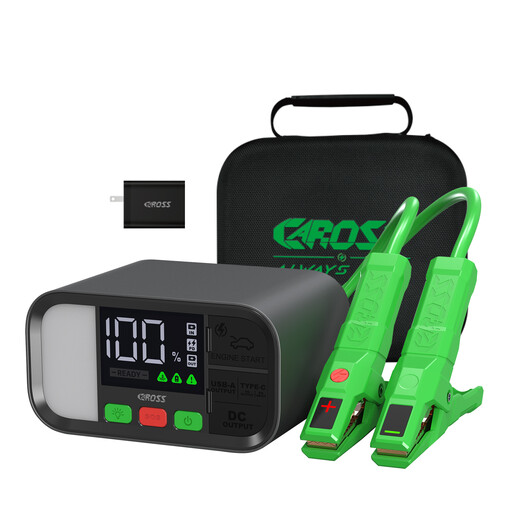
Why This Fits Their Persona: For the driver of a larger SUV or diesel car (petrol up to 6.0L, diesel up to 4.0L) who values premium quality, speed, and multifunctionality, such as charging a laptop on the go.
The Smart Connect technology with non-polarised clamps makes incorrect connection impossible. This is an advanced safety feature that completely eliminates the risk of damage, a common problem with basic models.
The PD65W fast-charging function not only charges the jump starter itself at lightning speed, but also laptops and other power-hungry devices. The aluminium housing and large 3'' screen provide a premium feel.
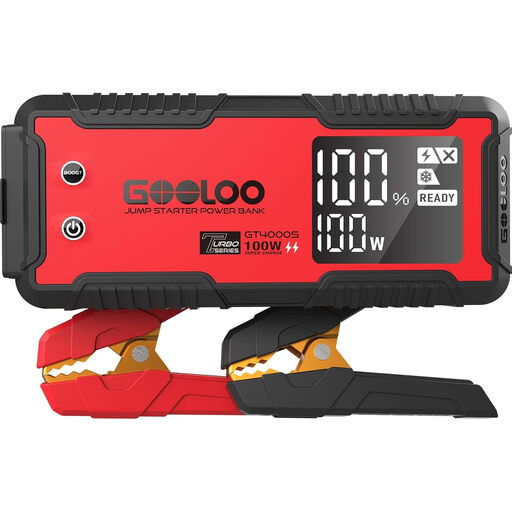
Why This Fits Their Persona: For the owner of an RV, van, boat, or a vehicle with a large diesel engine (up to 10.0L). This is a powerhouse built for the toughest jobs, offering maximum starting reliability.
While other brands only advertise peak amps, this model actually delivers the immense power needed for large engines. Its specs are focused on real-world performance, not marketing hype.
The 100W two-way fast-charging function is unique: the jump starter itself is fully charged in just over an hour, and it can also charge your MacBook at full speed. According to the manufacturer, it can provide up to 60 starts on a single charge.
We've compiled a complete, up-to-date list of products that fully meet these strict selection criteria and safety regulations.
Even when not in use, a jump starter slowly loses its charge. It's advisable to fully charge a portable jump starter every 3 to 6 months. This ensures it's ready to go when you need it. Modern models with a low self-discharge rate hold their charge for longer.
Yes, many modern jump starters are equipped for this. They have a special 'Boost' or 'Force' mode. This function is necessary because a jump starter's safety systems normally need to detect a minimum voltage from the battery. With a completely dead battery (e.g., below 2 volts), the boost mode bypasses this check and delivers power directly. Always read your specific model's manual for the correct procedure.
Not necessarily. A jump starter with much more power than you need is unnecessarily expensive and often larger and heavier. The most important thing is to choose a model that matches your vehicle's engine. A 4000A model is overkill for a small city car, while an 800A model might fall short for a large diesel SUV in the winter. Choose the right balance of power, size, and price for your situation.
