
Vandaag of morgen in huis

Kwaliteit gegarandeerd

Welkomstaanbiedingen ontgrendelen: GRATIS bezorging | Tot 80% korting | Gratis 30 dagen JoyPlus-proefperiode
Download de app
A dead battery always happens unexpectedly and at the worst possible time. Waiting for roadside assistance is often the only option. A car jump starter, also known as a battery booster, offers an immediate solution, allowing you to start your car yourself within minutes. However, the market is flooded with models promising impressive specs. Unfortunately, these marketing claims often lead to a bad purchase.
Before you invest in a portable jump starter, it's crucial to recognise two common pitfalls:
To choose a reliable car jump starter, focus on the specifications that truly matter. Don't get distracted by marketing jargon.
The most important factor is whether the jump starter is suitable for your engine type and displacement (in liters). Diesel engines have a higher compression ratio and therefore require considerably more starting power than gasoline engines of a similar size.
Almost every emergency car starter also functions as a power bank with jumper cables. The capacity, expressed in milliampere-hours (mAh), determines how many times you can start a car or charge your phone. Be aware: the advertised capacity is that of the internal battery. The actual output is always lower due to energy loss.
Some models offer a built-in jump starter with a compressor. This is useful for inflating a soft tyre, but it makes the device larger and heavier. Consider whether you really need this extra feature or if a compact size that fits in the glove compartment is a priority.
To help you with your choice, we have matched several popular models to specific user profiles. These recommendations are based on objective product specifications.
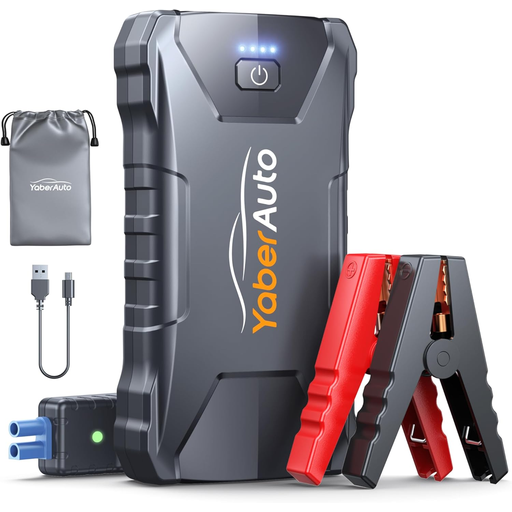
Why it fits this profile: Ideal for those seeking a compact, reliable, and no-fuss solution for a standard passenger car. Weighing only 340 grams, it fits easily in the glove compartment and is always on hand for emergencies.
This model doesn't focus on extreme peak amps but offers realistic and ample coverage for most common cars (up to 7.0L gasoline / 5.5L diesel) without making you pay for unnecessary overcapacity.
Compact and lightweight: Very easy to store. Multifunctional: Also works as a power bank and has an LED flashlight with 3 modes (solid, SOS, strobe).
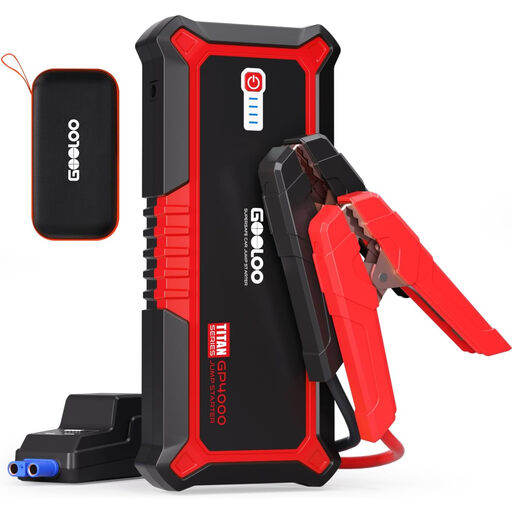
Why it fits this profile: Specifically designed for heavy-duty vehicles. With power suitable for all gasoline engines and diesel engines up to 10.0L, this starter provides the peace of mind that owners of SUVs, vans, and powerful diesels need, especially in cold weather.
This model bypasses the "one-size-fits-all" myth by clearly positioning itself as a high-power solution. Its specifications are focused on delivering the high starting current needed for large engines, and it features a "BOOST" button for deeply discharged batteries.
Powerful performance: Suitable for engines up to 10.0L diesel. Robust clamps: All-metal clamps for durability and excellent conductivity. Fast-charge function: Works as a high-speed power bank for other devices.

Why it fits this profile: This is more than a battery booster; it's a complete emergency kit. For campers, road-trippers, and DIY enthusiasts who want to be prepared for anything. The combination of a powerful jump starter with a 150 PSI air compressor makes this an extremely versatile tool for the road.
Where many multifunctional devices compromise on the core function, this model combines a very high peak current (8000A) with a fully-fledged compressor. It's not a gimmick, but a functional combination that breaks the "one-size-fits-all" myth by being both versatile and powerful.
All-in-one: Jump starter, 150 PSI compressor, power bank, and dual LED lights. Large display: A 3.4-inch screen clearly shows status, battery level, and tyre pressure. Powerful: Suitable for all gasoline engines and diesels up to 10.0L.
We have compiled a complete, up-to-date list of products that fully meet these strict selection criteria and safety regulations.
Most manufacturers recommend charging the jump starter every 2 to 3 months, even if you don't use it. This is necessary to keep the internal lithium-ion battery in good condition and ensure it's ready for use when you need it. A fully charged device always performs better, especially in cold weather.
Yes, modern jump starters are equipped with 'smart' jumper cables. These cables have multiple built-in safety features, such as protection against reverse polarity, short circuits, overheating, and over-voltage. If you connect the clamps incorrectly, the device will not activate and will often give a warning signal. This minimises the risk of damage to your car's electronics.
No, this is a common mistake. Diesel engines require significantly more starting power than gasoline engines. Always check the jump starter's specifications to see the maximum engine displacement (in liters) it is rated for, for both gasoline and diesel. A diesel jump starter is specifically designed to deliver this higher current. A starter that is too weak will not be able to start a diesel engine, especially in the winter.
