
Vandaag of morgen in huis

Kwaliteit gegarandeerd

Welkomstaanbiedingen ontgrendelen: GRATIS bezorging | Tot 80% korting | Gratis 30 dagen JoyPlus-proefperiode
Download de app
A flat car battery usually happens at the worst possible time: before you leave for work, during a camping trip or on a dark Dutch road. With a car jump starter, you may be able to provide independent assistance to a flat 12V battery, without relying on another car and jump leads.
However, not every portable jump starter is suitable for every car. High amp ratings, large capacities and extra features may sound appealing, but they only matter if they match your vehicle and how you intend to use the device. The Joybuy Product Recommendation Officer highlights the key points to consider.
A rating such as 3000A, 5500A or 7000A usually refers to the peak current. This is not automatically the same as the normal starting current. You should therefore also check:
A 12V booster is not intended for the 24V system found in some lorries or buses, for example. Nor can it be used to start an electric car with a high-voltage battery.
According to the manufacturers’ own product information, some models can perform dozens of starts, work at very low battery voltages or operate at temperatures from -20 °C to 60 °C. Treat this information as the brand’s product specification, not as a guaranteed result in every situation.
A jump starter also does not replace a faulty battery. Do not use the device with a battery that is visibly leaking, damaged or frozen. Always read the manual and check that the clamps are connected correctly.
A jump starter with compressor can be useful when a tyre is low, but the pump makes the device heavier and often larger. A built-in power bank, USB-C port and LED emergency light are practical for travellers, but not essential if you are only looking for a car emergency starter.
Think in advance about where you will store the device. A model that does not fit in the glove compartment may still be suitable for the boot, but it should be protected from heat and moisture there.
Choose a model whose stated vehicle compatibility exceeds your own engine specifications. For a compact petrol car, a model rated at 1000A to 2000A may appear sufficient based on the product specifications. For a diesel, SUV, motorhome or commercial vehicle, a larger margin is more practical.
Pay particular attention to the separate distinction between petrol and diesel. For example, a product may be described as suitable for petrol engines up to 9.0 litres, but diesel engines up to 8.5 litres. These limits are not interchangeable.
Capacity is often stated in mAh, but the usable output may be lower. Alongside capacity, therefore, look at:
Many manufacturers recommend charging the car battery booster every two to three months when it is not being used. Check this for each model. A flat power bank will not help when you need a jump start on the road.
Choose a model with a clear polarity warning and protection against short circuits, overheating and reverse connection, among other hazards. According to the manufacturers’ own product information, several models from the brands mentioned have multiple protection features. However, check exactly what the manual says.
Connect red to the positive terminal and black to the negative terminal or a suitable unpainted metal earth point, depending on the instructions. Do not make repeated attempts one after another. Allow the device to cool down if instructed to do so, and remove the clamps after starting in the specified order.
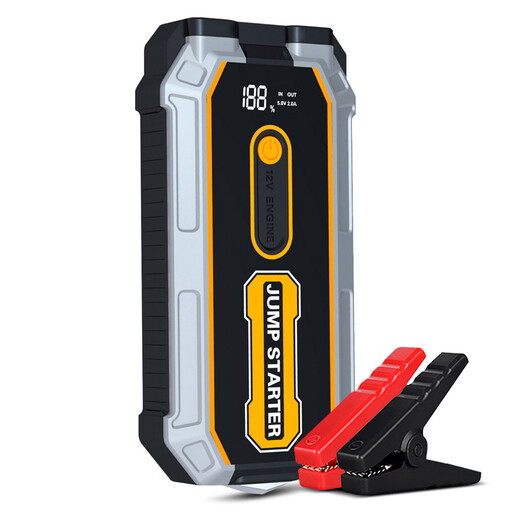
Why it suits this profile: According to the product information, this compact model weighs approximately 330 grams and is intended for 12V petrol and diesel vehicles, motorbikes, boats and snowmobiles. The LCD display shows the battery level.
The stated limits are clearly listed: 1200A peak current for 12V systems, with support for petrol and diesel vehicles. This allows you to compare its suitability with your vehicle specifications.
12800mAh capacity according to the product description, a 10W USB output and an LED emergency light with continuous, flashing and SOS modes.
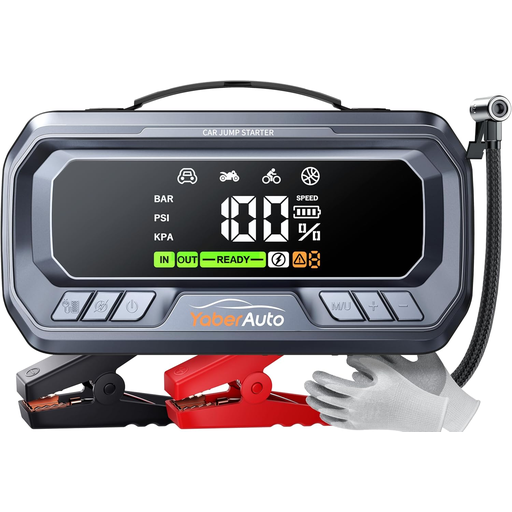
Why it suits this profile: This combination is aimed at drivers of SUVs and larger cars, as well as travellers who want to carry a portable compressor and extra charging options alongside jump-starting capability.
The product details list the jump-start function, 160 PSI compressor capacity and an LCD screen separately. This makes it clear which extra features you actually get.
According to the product information: 65W USB-C PD, 16000mAh, an LCD pressure display and LED lighting with multiple modes. The stated compatibility extends to diesel engines up to 8.0 litres.
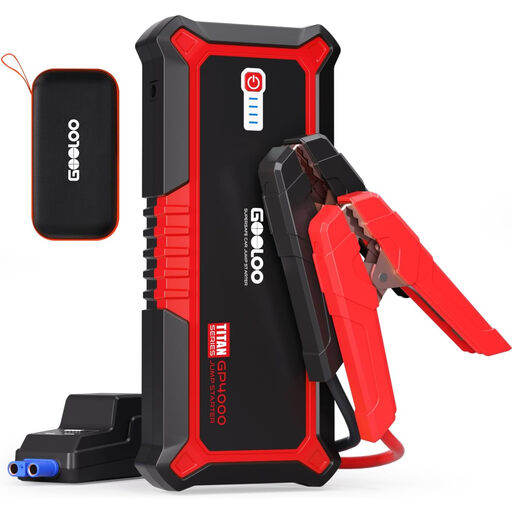
Why it suits this profile: The manufacturer states that it supports all petrol engines and diesel engines up to 10.0 litres. This makes the model relevant for larger vehicles, motorhomes, tractors, vans and lorries with a 12V system.
The product description mentions 12V compatibility, a BOOST function and metal clamps. Nevertheless, check your vehicle manual and the manufacturer’s current instructions before buying.
4000A peak current according to the product details, two USB ports, USB-C 5V/3A, a storage case and a built-in torch. According to the description, a wall charger is not included.
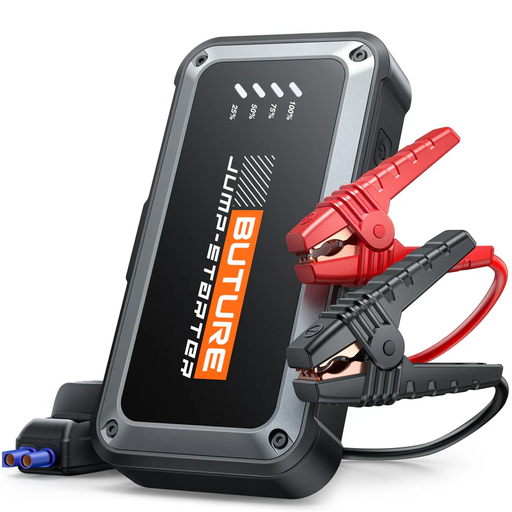
Why it suits this profile: According to the product information, the 3-in-1 design combines a jump starter, 16800mAh power bank and wide-angle LED light. This is practical for roadside breakdowns, travelling and camping.
The stated engine limits are listed separately: up to 9.0 litres for petrol and 8.5 litres for diesel. The instructions also state that the unit must cool down between multiple starting attempts.
Approximately 0.370 kg according to the product details, two USB outputs and four light modes: torch, white strobe, orange strobe and SOS.
We have put together a complete, up-to-date list of products that fully meet these strict selection criteria and the applicable European safety regulations.
Store a car battery booster in a cool, dry place. Do not leave a lithium device in a hot, enclosed car for extended periods. Regularly check the cables, clamps, casing and charge level.
No. Check the voltage, engine size and specified fuel type. You must not attempt to start a damaged, leaking or frozen battery with a jump starter. A jump starter is also not suitable for 24V systems or the high-voltage batteries used in electric vehicles.
This depends on the battery type, storage temperature, use and maintenance. Charge the device according to the manual, often every two to three months when it is not being used. Do not store it in direct sunlight or extreme heat for extended periods.
Not necessarily for the jump-starting function, but car jump leads can be a useful addition when another car or external battery is available. A jump starter primarily gives you independence; always check that the supplied cables are suitable for your vehicle and intended use.
