
Vandaag of morgen in huis

Kwaliteit gegarandeerd

Welkomstaanbiedingen ontgrendelen: GRATIS bezorging | Tot 80% korting | Gratis 30 dagen JoyPlus-proefperiode
Download de app
A car jack may seem like a straightforward purchase, but models can differ considerably. A low-slung car calls for a different approach from an SUV, van or workshop vehicle. So don’t base your choice solely on maximum lifting capacity or an especially low price.
As a Joybuy Product Recommendation Officer, I focus on specifications you can check: lifting range, minimum clearance, construction materials, operation and how you plan to use the jack. This helps you avoid buying a model that won’t fit under your car, doesn’t lift high enough or is used without additional support.
A 3-tonne car jack may have enough capacity on paper for many cars, SUVs and MPVs. However, this figure alone doesn’t tell you whether the model is right for your vehicle. Always check your vehicle’s weight and the recommended jacking points in the owner’s manual.
A jack is designed to lift a vehicle, not to support it for an extended period. When working underneath the car, use suitable axle stands and place the jack on firm, level ground.
A standard trolley jack may not fit under the chassis of a sports car or a car with lowered suspension. In this case, a low-profile jack with a clearance of, for example, 85 to 90 mm gives you more options.
For an SUV or van, maximum lifting height is more important. Low clearance alone isn’t enough: also check that the jack can lift high enough to raise the wheel clear of the ground.
A pneumatic jack uses compressed air and can lift quickly, but it requires a suitable compressor and a compatible connection. Without an air supply, you won’t get much benefit from its fast lifting action. Also check the ground surface, the stability of the air-bag construction and how the vehicle will be supported.
Be mindful of marketing claims, too. When a brand mentions a particular lifting speed or extra stability, treat this as a statement from the brand’s product description. Check the technical details and manual before relying on it.
Choose a capacity that gives you enough headroom for your vehicle’s weight. For many household uses, a 1.5- or 3-tonne hydraulic car jack may be a practical choice. For heavier vehicles, regular garage work or roadside assistance, a 5-tonne garage jack or air jack may be more suitable.
A higher capacity doesn’t automatically make a model more convenient. A heavy steel jack is often harder to move than an aluminium car jack. Weight matters if you need to move it around, change a tyre at the roadside or store it in a small garage.
Always check:
A model with a range of 150 to 530 mm is suited to different vehicles from one with a range of 90 to 358 mm. An extension can increase the lifting range, but check whether it’s included as standard and can be fitted without tools.
Some models in the range list EN 1494 and CE. EN 1494 is a European standard for certain mobile or movable jacks. A CE marking is the manufacturer’s declaration that the product has been assessed in line with the relevant EU rules. It’s no substitute for correct use, a suitable surface or axle stands.
Read the manual before use, find your vehicle’s official jacking points and check that the jack remains stable before removing a wheel.
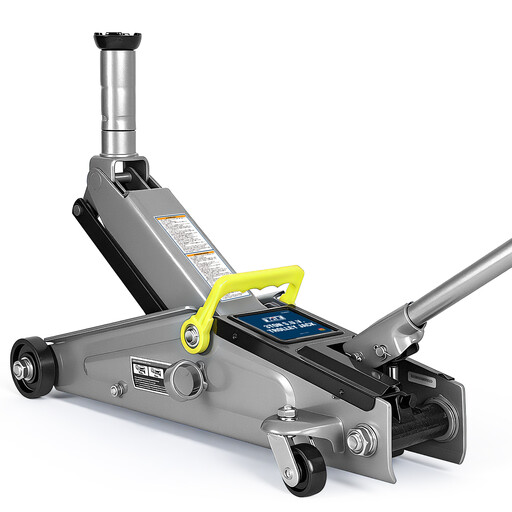
Why it suits this type of user: This hydraulic car jack is aimed at private motorists who want to change tyres or carry out simple jobs on a car, SUV or MPV. The product description lists a range of 150 to 530 mm and a capacity of 3 tonnes.
The specifications show both the lifting capacity and range, so you don’t have to rely on the 3-tonne figure alone. The stated overload valve should still be used in accordance with the manual.
Steel construction, a stated capacity of 3 tonnes and a height range that may suit a variety of cars.
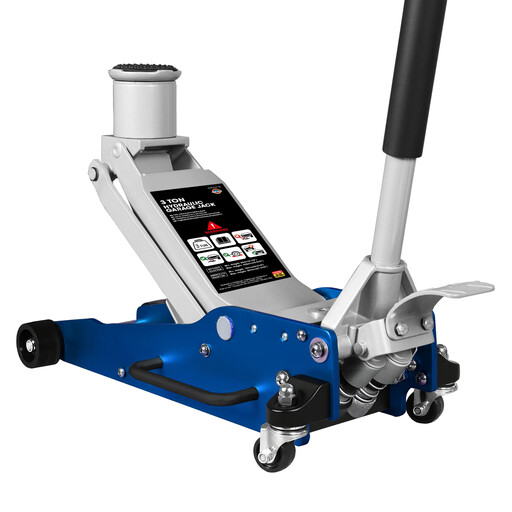
Why it suits this type of user: The combination of aluminium, low clearance and two lifting modes makes this a good fit for sports car, SUV and MPV enthusiasts looking for a portable jack with a broader range.
The 85 mm minimum height reduces the risk of the jack not fitting under a low-slung car. According to the product description, the listed height extension increases the range to 541 mm.
Stated capacity of 3 tonnes, aluminium construction, twin pump and, according to the product listing, EN 1494 and CE.
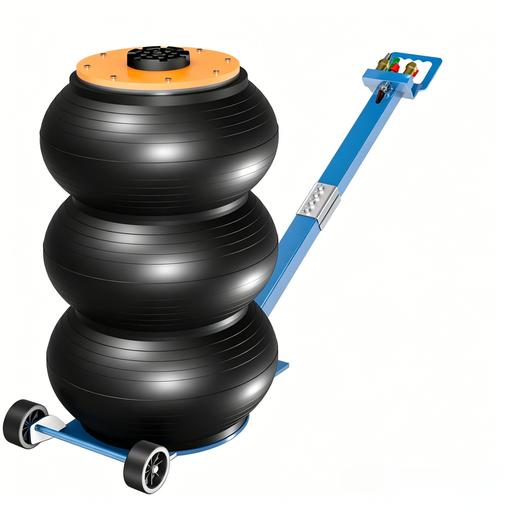
Why it suits this type of user: This pneumatic jack is designed for garages, workshops and roadside assistance teams with access to a compressor, who regularly lift cars, vans or heavier vehicles.
The product description lists a range of 5.9 to 15.75 inches, a capacity of 5 tonnes and an adjustable valve. Make sure to check your compressor, connection and ground surface beforehand.
Stated capacity of 5 tonnes, pneumatic operation, detachable handle and a slowly adjustable air release, according to the product information.
We’ve put together a complete, up-to-date list of products that meet these strict selection criteria and the applicable European safety requirements.
First, check your vehicle’s weight, jacking points and required lifting height. A 3-tonne hydraulic car jack may suit some SUVs and MPVs, but you should always compare the stated capacity with your vehicle’s specifications. For heavier vehicles, a 5-tonne garage jack or pneumatic model may be a better choice.
An aluminium car jack may be a good option if portability is important. As well as the material, check the stated capacity, lifting range, wheels and manual. For frequent use in a permanent garage, a heavier steel model may be more practical.
Keep the jack clean and dry, and regularly check for leaks, damaged wheels and a properly working valve. For a hydraulic model, check the oil level as instructed in the manual. Never use a garage jack as permanent support: place the vehicle on suitable axle stands before working underneath it.
