
Vandaag of morgen in huis

Kwaliteit gegarandeerd

Welkomstaanbiedingen ontgrendelen: GRATIS bezorging | Tot 80% korting | Gratis 30 dagen JoyPlus-proefperiode
Download de app
Replacing a faulty headlight may seem straightforward, but the wrong fitting, an unsuitable light source or a missing CANbus solution can quickly lead to extra costs. Marketing claims such as “300% brighter” or “fits 99% of cars” don’t tell the whole story either. Light output depends on the headlight housing, alignment, power supply and approval for use in your vehicle.
This buying guide will help you compare car headlights with confidence. Find out what to look for in LED, halogen and xenon bulbs, which specifications matter and which options suit different needs.
A colour temperature of 6000K for LED headlights gives a cool, white appearance. That doesn’t automatically mean the beam will perform better on the road. If the LED chip is in the wrong position, it can create dark spots or dazzle other drivers. So check not only the stated brightness, but also the light source design and whether it’s suitable for your headlight unit.
A bulb may be easy to fit physically, yet still trigger a warning light, flicker or cause a fault. Modern cars with sensitive electrical systems may need a CANbus adapter or decoder. Always check the fitting, car’s year of manufacture and model in the handbook, or use the original part number.
An LED retrofit in a halogen headlight isn’t automatically road legal. Check the official approval information for your vehicle, lighting function and country. For OSRAM products, the product information advises checking the latest compatibility list on the OSRAM website. The wrong bulb can also change the beam pattern, even if it fits the socket.
The fitting determines whether the bulb will fit your headlight:
If you’re unsure, check the markings on the old bulb, your handbook or the part number. H8, H9 and H11 fittings can look similar, but they aren’t necessarily interchangeable.
Halogen headlights are usually a direct replacement, with no changes to the electronics needed. They’re a practical choice for drivers who want to keep their existing setup. Bulbs such as OSRAM NIGHT BREAKER are halogen bulbs with a stated light output above the legal minimum. According to the manufacturer, the stated percentages are comparisons with that minimum; the actual experience will vary depending on the headlight unit and vehicle.
LED bulbs generally use less energy and can produce a white light. With LED bulbs, check the cooling system, the space available behind the bulb and whether a fan is fitted. A manufacturer’s stated lifespan, such as 50,000 or 60,000 hours, is not a guarantee that the bulb will last as long in every car.
Xenon headlights use a ballast and high voltage. Replacing them is therefore less suitable as a DIY job if you’re not familiar with the system. A D3S bulb is designed for an original D3S xenon system, not a halogen headlight.
Check the stated voltage and wattage. A standard H7 halogen bulb usually runs at 12 volts and 55 watts, while LED retrofits have different electrical specifications. For LED bulbs, the aluminium housing, heat transfer and fan are all worth checking. Make sure the bulb will also fit behind the dust cap.
After replacing car bulbs, check the beam pattern. If the bulb isn’t seated correctly, the beam may point too high or dazzle oncoming drivers. Have the headlights realigned if necessary.
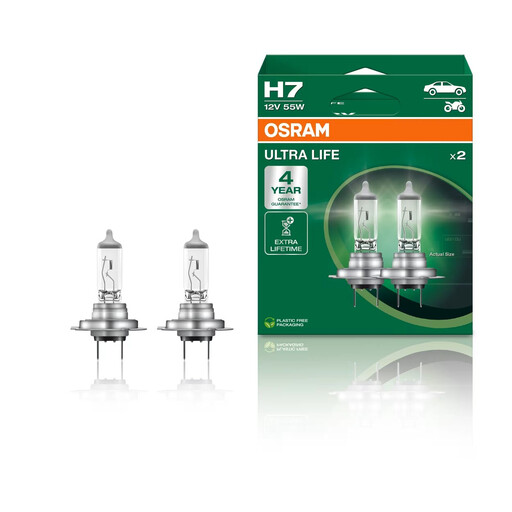
Why it suits this profile: A straightforward H7 replacement for drivers who want to keep their existing halogen setup rather than switch to LED straight away.
The bulb uses standard H7 halogen technology, so you won’t need an LED decoder or extra cooling for a suitable original H7 setup.
55 watts, supplied as a pair and designed by OSRAM to last longer than standard halogen bulbs.
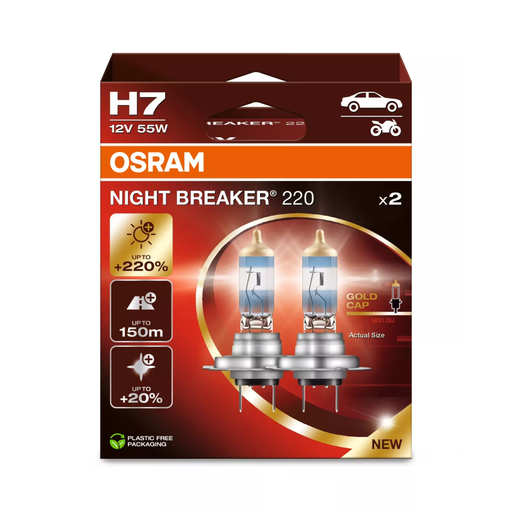
Why it suits this profile: For drivers looking for a powerful halogen upgrade without changing the headlight unit.
The fitting and power are clearly specified as H7 and 55 watts. Be sure to check the official compatibility list first.
Up to 220% more brightness than the legal minimum, according to OSRAM, and a colour temperature of 3700K.
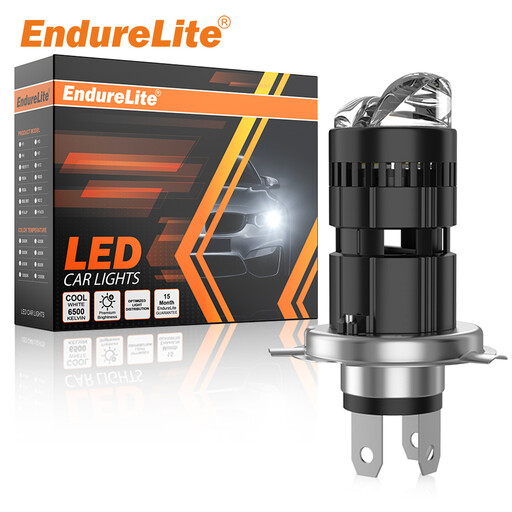
Why it suits this profile: An option for drivers looking for a 6000K white light and a compact H4 LED solution for regular night-time driving.
The product information specifies a 1:1 beam pattern, built-in CANbus technology and IP68 protection. Still, check that it’s suitable for your vehicle and check the legal requirements for use.
High and dipped beam in one H4 bulb, a built-in fan and a stated colour temperature of 6000K.
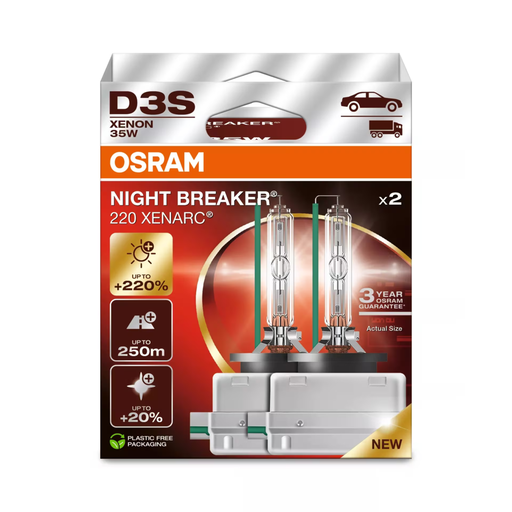
Why it suits this profile: Designed for cars with an original D3S xenon headlight and drivers looking for a suitable replacement bulb.
The product information explicitly specifies D3S and 35 watts. The bulb isn’t suitable for halogen, D1S, D2S or D4S systems. Professional fitting is recommended.
D3S fitting, 3200 lumens and 4400K, according to OSRAM’s product specifications.
We’ve put together a complete, up-to-date list of products that meet these strict selection criteria and the applicable European safety regulations.
Where possible, replace halogen and LED bulbs in pairs. This helps keep the colour and brightness consistent on both sides. Switch off the lights, let the bulb cool completely and avoid touching the glass of halogen or xenon bulbs with bare fingers. Use gloves or a clean cloth.
After fitting, check:
Not necessarily. LED bulbs can produce a whiter light and use energy differently, but the result depends on the chip position, reflector, lens and alignment. Compare the beam pattern and compatibility, not just the lumen claim.
It varies depending on the light source, how it’s used and the vehicle. Halogen bulbs are often replaced in pairs when one fails. LED and xenon bulbs may have a longer stated lifespan according to the manufacturer, but heat, vibration and electronics all affect how they perform in practice.
Sometimes. A built-in CANbus solution can help reduce warning lights or flickering, but it isn’t guaranteed to work with every car model. Check your vehicle’s specifications and allow for a separate decoder if the car’s onboard computer doesn’t recognise the new bulb.
