
Vandaag of morgen in huis

Kwaliteit gegarandeerd

Welkomstaanbiedingen ontgrendelen: GRATIS bezorging | Tot 80% korting | Gratis 30 dagen JoyPlus-proefperiode
Download de app
Replacing a faulty bulb sounds simple, until you discover that H7, H15, H1, H4, D1S, D2S, D3S and D4S aren’t interchangeable. Even a bulb that physically fits may not be suitable for your headlight unit, on-board electronics or Dutch road regulations.
If you’re looking for car headlight bulbs, you’re probably looking to do one of three things: replace a faulty bulb, choose a whiter light or switch from halogen to LED. The right choice starts not with the lumen count on the packaging, but with compatibility and approval.
An H7 bulb only fits a system designed for H7. The same applies to H15, H1 and H4. Xenon bulbs also come in different versions: D1S, D2S, D3S and D4S. So always check:
An H15 bulb, for example, often combines daytime running lights and main beam in a single bulb. The wrong bulb can therefore do more than simply fail to light up: it can also make the light function work incorrectly.
With LED headlight bulbs, plug-and-play usually means the electrical connection is straightforward. It doesn’t automatically mean that the bulb is road legal for every vehicle. For LED retrofits, approval must apply to the specific vehicle model, light function and country.
The OSRAM NIGHT BREAKER LED H1 is described in the product information as an H1 LED retrofit with road approval. According to the product information, you should check OSRAM’s current compatibility list before buying. Some cars may also need an adapter, a suitable retaining clip, a modified dust cap or documentation kept in the car.
Claims such as “300% brighter” or “20,000 lumens” are product claims, not a universal guarantee of better visibility. Light distribution also depends on the reflector, projector, alignment and condition of the headlight unit. A badly shaped beam can dazzle oncoming drivers, even if the bulb itself produces a lot of light.
Also check how many bulbs are included. Many OSRAM bulbs are sold in pairs, while some LED products are supplied as a set or as a single bulb.
Start with the fitting. Common halogen bulbs include H7 bulbs, H1, H4 and H15. H4 usually combines dipped beam and main beam in a single bulb. H15 is often used for daytime running lights and main beam.
Factory-fitted xenon systems use bulbs such as xenon D1S, xenon D2S, xenon D3S and xenon D4S. These versions aren’t interchangeable. A D2S bulb, for example, is designed for a D2S xenon system, not a D1S, D3S or D4S unit.
Halogen headlight bulbs are often a straightforward replacement. A standard H7, for example, operates at 12 volts and 55 watts, which suits many original systems. The OSRAM ULTRA LIFE H7 is designed to extend the interval between replacements; according to OSRAM, its stated service life is up to four times longer than that of standard halogen bulbs. The product information also states that a four-year warranty is available after online registration, with registration required for the fourth year.
LED bulbs generally use less energy, but they need to dissipate heat. A built-in fan or aluminium housing can affect the space available behind the headlight. Check that the dust cap still fits and that the bulb can be secured correctly.
Xenon bulbs operate at high voltage, so replacing one isn’t the best first DIY job. If you’re unsure, have a garage carry out the installation.
Colour temperature is measured in kelvin. Halogen bulbs often produce a warm white light, while LED and some xenon bulbs have a whiter appearance. A higher kelvin rating doesn’t automatically mean more light on the road.
If you’re looking for white car lighting, you could consider OSRAM COOL BLUE INTENSE. According to the product information, the H7 version has a colour temperature of up to 5,000 kelvin. For H15, the stated figure is up to 3,700 kelvin. So the colour isn’t the same across different fittings.
Where possible, replace bulbs on both sides at the same time. This helps keep the brightness and colour more consistent. Don’t touch the glass of halogen or xenon bulbs with bare fingers; grease from your skin can create localised hot spots. Always check the beam after fitting.
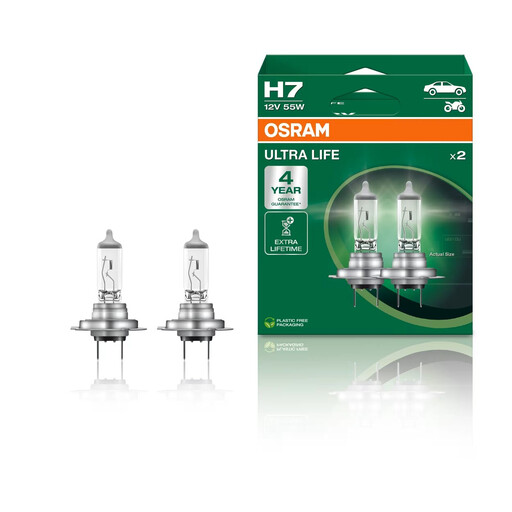
Why it suits this user: A practical replacement for drivers with a standard H7 system who don’t want to convert to LED.
The fitting and power are clearly specified as H7, 12 volts and 55 watts. Do check that your car uses this type.
A pair of H7 bulbs for direct replacement, designed according to OSRAM to last longer than standard halogen bulbs.
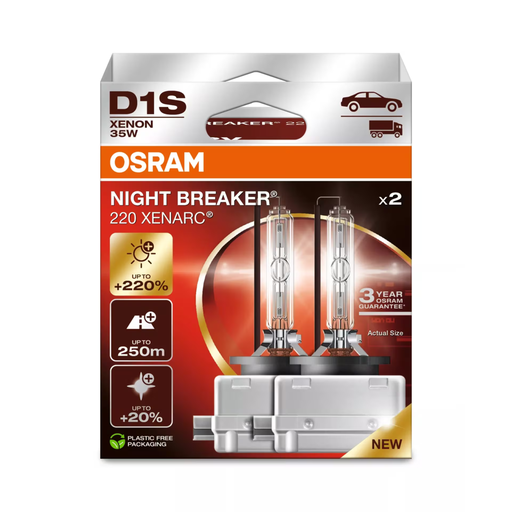
Why it suits this user: For drivers with a car fitted with factory xenon who need a suitable D1S replacement.
The product information makes clear that this xenon bulb isn’t suitable for halogen headlights. Confirm the D1S fitting before buying.
35 watts, 3,200 lumens and supplied as a pair. According to OSRAM, it offers up to 4,500 kelvin and up to 220% more light than the legal minimum standard.
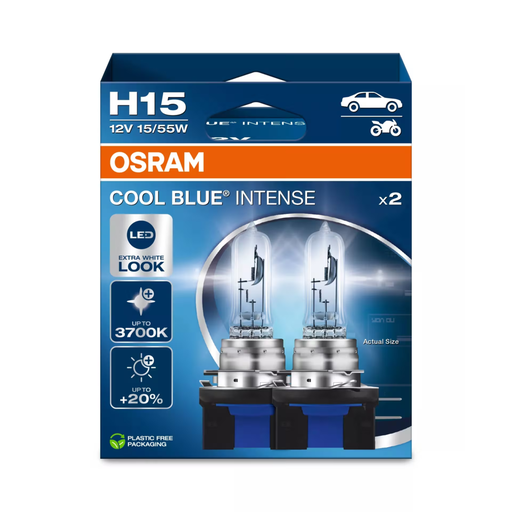
Why it suits this user: For cars with H15 lighting, where daytime running lights and main beam are combined in one bulb.
The H15 fitting and dual function are clearly stated. Still, check OSRAM’s compatibility list for your vehicle and country.
A 55-watt halogen bulb, supplied as a pair, offering up to 3,700 kelvin and up to 20% more light than a standard bulb according to OSRAM.
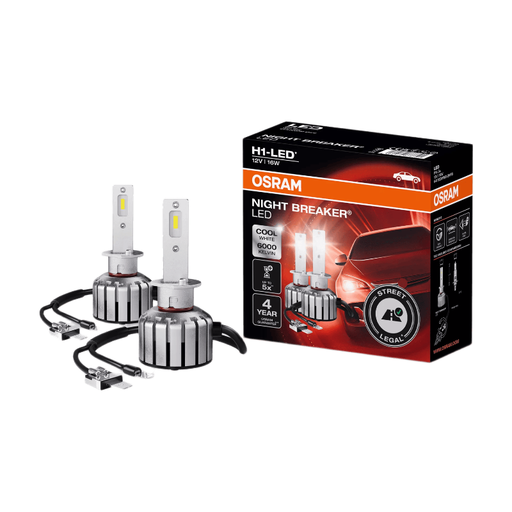
Why it suits this user: For anyone looking for a white LED appearance who wants to make the switch carefully, using the vehicle compatibility list.
The product information points to an official OSRAM compatibility check. Approval doesn’t automatically cover every car with an H1 fitting.
16 watts, 6,000 kelvin and, according to OSRAM, up to five times the service life of a halogen bulb. Check whether stickers and documents are required before use.
We’ve put together a complete, up-to-date list of products that meet these strict selection criteria and the current European safety regulations.
Check your car’s handbook, the old bulb and the fitting on the headlight unit. Then compare your vehicle model and light function with the manufacturer’s compatibility list. For xenon, pay particular attention to the differences between D1S, D2S, D3S and D4S.
Not always. An LED retrofit must be suitable and approved for your specific vehicle, light function and country. Also check the available space, dust cap, fitting and any CAN bus warning. Have the beam checked after installation.
Where possible, yes. Two new bulbs will usually give you a more even colour and brightness. This is particularly relevant for xenon and white car lighting, as an older bulb may look noticeably different in colour from a new one.
