
Vandaag of morgen in huis

Kwaliteit gegarandeerd

Welkomstaanbiedingen ontgrendelen: GRATIS bezorging | Tot 80% korting | Gratis 30 dagen JoyPlus-proefperiode
Download de app
A car charger and EV charger may seem straightforward to choose at first glance. Yet many motorists buy a model that is not compatible with their phone, laptop, vehicle socket or electrical installation. A high wattage on the packaging does not automatically mean that your device will charge at that speed.
The main pitfalls are:
A USB car charger uses the 12V or 24V socket in a car, van, lorry or boat. This type is suitable for smartphones, sat-navs, tablets and sometimes laptops. An electric car charger or EVSE charges the traction battery of an electric car or plug-in hybrid via a Type 2 connection.
Use this classification as a starting point:
With a USB car charger, power is expressed in watts. A fast car charger of 30 to 45 W may be suitable for many smartphones and tablets. Laptops often require more. Do not look only at “160 W total”; also check the power per port and the output when several ports are used at the same time.
For EV chargers, the common levels are:
The actual charging speed also depends on the car’s onboard charger, battery status and electrical installation. A 22 kW charger will therefore not automatically deliver 22 kW to every car.
A USB-C charger may support Power Delivery, but check whether your device uses the relevant profile. The cable must also be suitable for the required power. For example, the Baseus Mini White Series cable used with the PrimeTrip VP2 is specified for up to 60 W and 20 V/3 A.
For EVs, check whether the car uses a Type 2 connector for AC charging. Also pay attention to the type of mains plug. A Type F plug must be connected directly to a suitable, earthed socket. Do not use unapproved adapters or extension leads.
For a 12V car charger, protection against overheating, short circuits and overcurrent are important features. With an EV charger, earth-leakage detection, overtemperature protection, overvoltage and undervoltage protection, and a suitable IP rating are all important.
An IP65 or IP66 rating describes protection against dust and water under certain conditions. It does not mean that you can use the charging unit underwater. Always check the manual and inspect the cable, plug and connector before use.
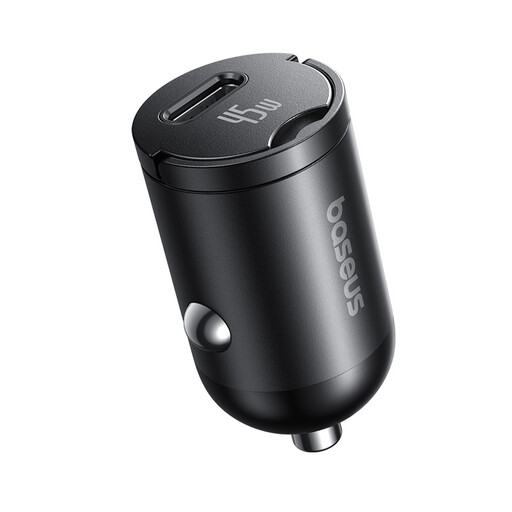
Why it suits this profile: According to the product specification, this 12V car charger operates at DC 12–24V and delivers up to 45 W via USB-C. The included USB-C-to-USB-C cable makes it practical for everyday commuting.
The stated power and supported voltage profiles are clearly specified. However, check that your phone or tablet supports USB-C Power Delivery.
45 W maximum USB-C output; 1-metre cable included; suitable for 12–24V.
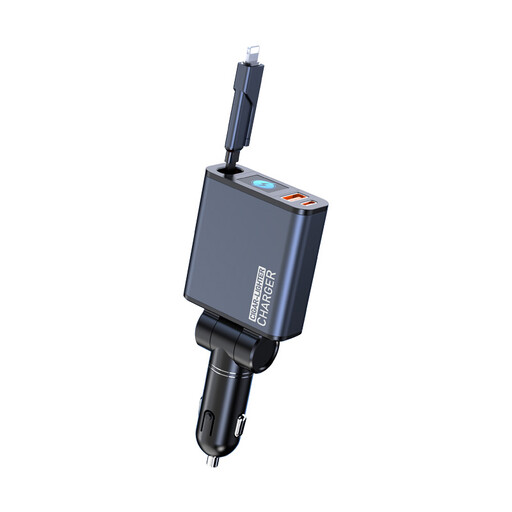
Why it suits this profile: Commuters carrying several devices get three ports, two built-in cables and an included 100W E-Marker cable. The product specification states that it supports 12V and 24V vehicles.
The fuse warning prevents you from focusing solely on the high total figure. Check the vehicle documentation when using several ports at high power simultaneously.
Two USB-C ports and one USB-A port; two 90 cm cables; maximum total output according to the product specification: 160 W.
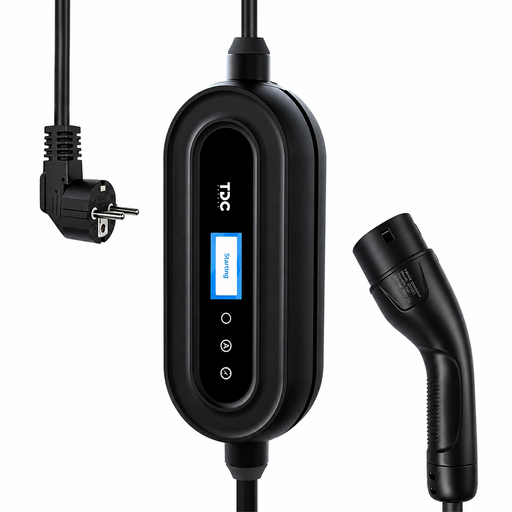
Why it suits this profile: This portable EV charger is designed for charging via a suitable 230V Type F socket. The current can be set to 8, 10, 13 or 16 A, which is useful when the circuit capacity is known.
The adjustable current helps prevent charging at 16 A by default. Only use the charger with a suitable earthed socket and have the installation checked if in doubt.
3,5 kW maximum; 5-metre cable; Type 2 connector; LCD screen; Wi-Fi and Bluetooth according to the product information.
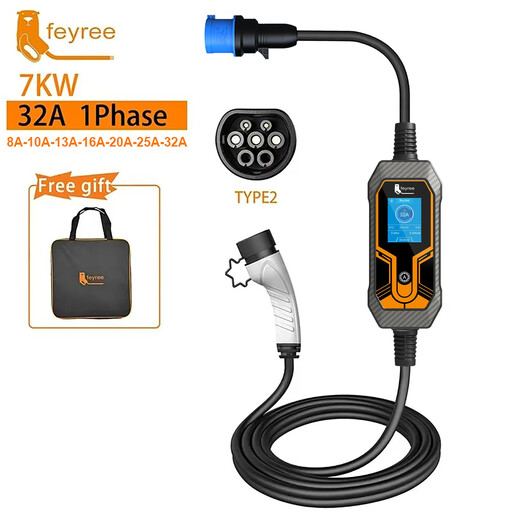
Why it suits this profile: This 7 kW EV charger is intended for users with a suitable single-phase installation and CEE connection. According to the product information, the current can be adjusted from 8 to 32 A.
The adjustable current allows you to match the charger to the installation. Have the CEE connection, wiring and circuit checked to ensure they are suitable for the selected setting.
Up to 7 kW and 32 A according to the product specification; 5-metre cable; LCD screen; Type 2 compatibility; IP65 rating.
We have put together a complete, up-to-date list of products that fully meet these strict selection criteria and the applicable European safety regulations.
Only if the product specification states 12–24V. A Xiaomi car charger with a specified input of 12V/24V or a Baseus car charger with DC 12–24V is intended for this purpose according to the stated specifications. Always check the onboard voltage of a lorry or other commercial vehicle.
The cost depends on the charging power, charging time and electricity tariff. A 3.7 kW charger running at maximum power uses more electricity per hour than one operating at a lower current setting. The car also determines how much energy is actually drawn. For a practical calculation, use the car’s consumption in kWh and multiply it by your current tariff.
Its service life depends on heat, moisture, pulling forces and how often the cable is connected. Store an EV charger in a dry place, coil the cable without sharp bends and never use a damaged plug or connector. With a retractable car charger, such as a model from ATSHARK or Oxerbog, do not pull the cable beyond its physical stop. Stop using it immediately if you notice unusual heat, a damaged casing or a burning smell.
