
Vandaag of morgen in huis

Kwaliteit gegarandeerd

Welkomstaanbiedingen ontgrendelen: GRATIS bezorging | Tot 80% korting | Gratis 30 dagen JoyPlus-proefperiode
Download de app
A flat car battery, a soft tyre or a smartphone with no charge usually happens at the worst possible time. A car charger and jump starter can therefore come in handy for commuters, travellers, campers and drivers of cars, SUVs, vans, motorbikes and boats. Yet many models look alike, even though their features can vary considerably.
Look out for these three common pitfalls:
Most portable jump starters in this category are designed for 12V systems. That doesn’t mean every model is suitable for every car. Check for:
A car battery booster is only safe to use when the connection and vehicle type match the instructions. Don’t use a jump starter with a damaged, leaking or frozen battery.
A 1500A jump starter, 3000A jump starter or 5000A jump starter usually refers to the maximum peak current. Also check whether the manufacturer states a starting current. For example, the Porbi S903 lists a starting current of 800A as well as a peak current of 2000A.
A higher figure can be useful for larger engines, but also consider the capacity of the internal battery, the quality of the cables and the instructions for use. Fully charge the device before keeping it in your car, and check it every few months.
For phones, sat navs and small devices, a USB car charger with 18W to 30W is often sufficient. If you want to charge tablets or laptops, look for a USB-C car charger with Power Delivery, such as a model with 45W or more.
Also look out for:
A 12V car charger is suitable for many passenger cars, but check whether the socket in your van or lorry supplies 12V or 24V. A wireless charger isn’t essential for every driver; a wired USB-C option is often simpler and more predictable.
The following products have been selected based on specifications that can be checked against the product information. Brand warnings and performance claims have not been independently verified, so always follow the instructions and check your own vehicle’s specifications.
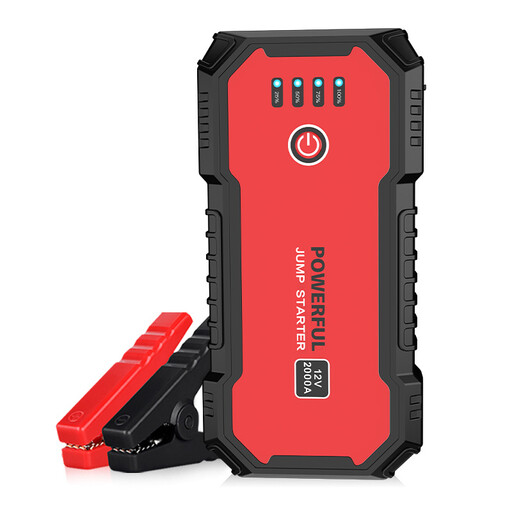
Why it suits this profile: For drivers who mainly want to be prepared for a flat 12V battery and charge USB devices on the go, without needing a compressor.
The product information lists 12V compatibility, a peak current of 1500A and a weight of approximately 430 grams. Be sure to check engine compatibility before buying.
QC3.0 18W output, USB-C input, three-mode LED light and a compact size that fits in your glove compartment or emergency kit.
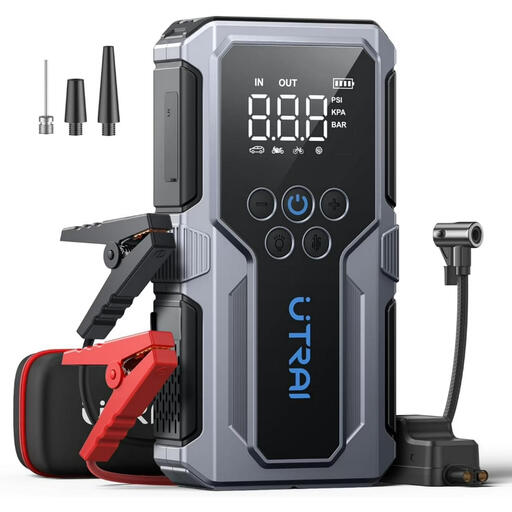
Why it suits this profile: For anyone who wants to carry one device for jump-starting, inflating tyres, lighting and charging mobile devices.
This model features an LCD screen, automatic shut-off at the preset pressure and ten safety features. According to the instructions, the compressor must not run for more than ten minutes at a time.
3000A peak current, compressor up to 150 PSI, USB and USB-C charging ports, and a connection safety indicator.
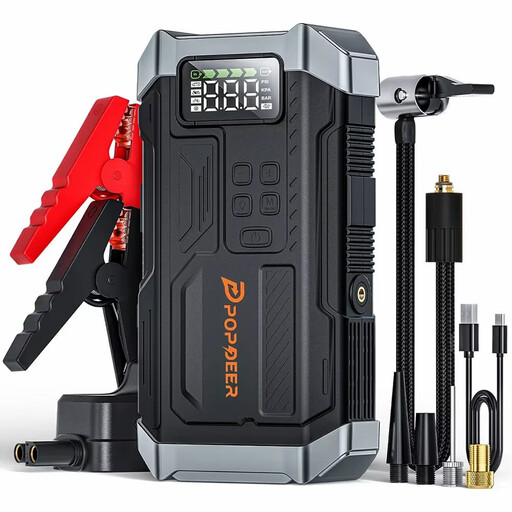
Why it suits this profile: For larger petrol or diesel vehicles, long journeys, camping and situations where a car tyre inflator and several emergency functions are useful.
The listed specifications state a peak current of 5000A, support for petrol engines up to 10 litres and diesel engines up to 8 litres. Check these figures against your vehicle documentation.
150 PSI compressor, four inflation nozzles, preset modes and functions including a power bank, tyre pressure gauge and emergency light.
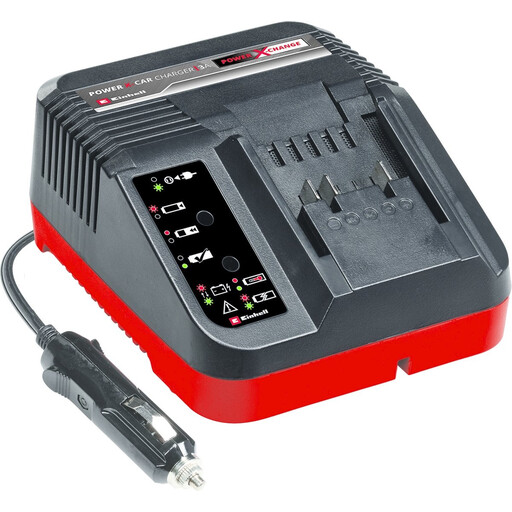
Why it suits this profile: For users who already own Einhell Power X-Change batteries and want to charge them in their car, caravan or boat.
According to the product information, this charger is designed exclusively for Power X-Change lithium-ion batteries. Its compatibility is therefore clearly defined.
12V connection, 3A charging current, seven-stage LED status display and two-stage protection for the vehicle battery, according to the product specifications.
We’ve put together a complete, up-to-date list of products that meet these strict selection criteria and the applicable European safety regulations.
Not automatically. Check that your car has a 12V system and that the model is suitable for your petrol or diesel engine. For SUVs, vans, boats and larger engines, pay particular attention to the stated engine capacity and starting current.
It depends on storage, temperature, charging habits and how often you use it. Recharge the device as instructed, even if you don’t use it often. A lithium battery also gradually loses capacity; replace the device if the battery is visibly damaged or its performance drops significantly.
A USB car charger only uses power when it’s plugged in and charging a device. A higher-powered fast car charger can place a greater demand on the 12V socket. So check your vehicle’s maximum load and fuse rating, especially with models that have several ports or an output of 100W or more.
