
Vandaag of morgen in huis

Kwaliteit gegarandeerd

Welkomstaanbiedingen ontgrendelen: GRATIS bezorging | Tot 80% korting | Gratis 30 dagen JoyPlus-proefperiode
Download de app
A flat phone battery never comes at a convenient time. Yet a car charger isn’t automatically suitable for every smartphone, tablet or laptop. With electric vehicles, the choice is even more critical: the wrong connection, insufficient power supply or unclear installation requirements can lead to slow charging or an impractical purchase.
So don’t just look at words like “fast charge” or a high wattage. Pay attention to the connections, input voltage, charging standard and safety features. Below, you’ll find out what to look for and which options suit different usage scenarios.
A fast car charger, for example with 67W or 160W, only delivers that power under the right conditions. The connected device must support the power, and your vehicle must be able to supply enough current via the 12V or 24V socket. What’s more, when charging multiple devices, the total power is shared.
A 65W laptop car charger might be suitable for a USB-C laptop, but not for every model. Check the required charging standard, such as USB Power Delivery, and the minimum wattage in your laptop’s manual.
A USB-C car charger doesn’t automatically come with a USB-C cable in the box. Conversely, a USB-A car charger may not always support the fast-charging standard you want. Look out for the difference between:
With the Oxerbog Universal Car Charger, for example, the included cable is stated to be compatible with iPhone 15, 16 and 17 series and Android devices, but not with iPhone 14 or older. Details like that help you avoid a wrong purchase.
A Type 2 EV charger is designed for vehicles with a Type 2 connector according to IEC 62196-2. The charging power is also determined by the car, the mains connection and the charging cable. An 11 kW EV charger will only work at the expected level if your car and electrical installation support three-phase charging.
A 22 kW wallbox requires extra attention to the available connection and installation. Have fixed connections checked and installed by a qualified electrician. A portable EV charger is more flexible, but only use it with a suitable socket or CEE connection.
For a passenger car, a 12V car charger is standard. In lorries, campervans and some commercial vehicles, you’ll find a 24V car charger. Many models support both voltages, but always check this in the product specifications.
The Baseus PrimeTrip VP2 has, according to the stated product specifications, an input of DC 12–24V and a USB-C output of up to 45W. The included USB-C to USB-C cable supports up to 60W according to the product information, but the car charger itself determines the actual charging power.
A dual car charger is handy when you want to charge a phone and a sat-nav, tablet or second phone at the same time. Don’t just look at the total wattage; also check the power distribution per port.
The Xiaomi 67W Car Charger, according to the product description, has one USB-A and one USB-C port and supports 12V/24V. The Baseus TuXiang Max, according to the stated specifications, has two built-in cables and additional USB-C and USB-A outputs, with a stated total of up to 90W. When using multiple ports at once, check how much power each combination actually receives.
Look for information about protection against overheating, overcurrent, overvoltage and short circuits. This doesn’t make a product indestructible: stop using it if the cable is damaged, the casing is cracked, you smell burning, or it becomes unusually hot.
For EV chargers, the IP rating, residual current protection and cable quality are also important. The specifications of various feyree models mention, among other things, IP65 or IP66 and Type B residual current protection. These are stated product features from the manufacturer; before installation, also check local regulations and your car’s manual.
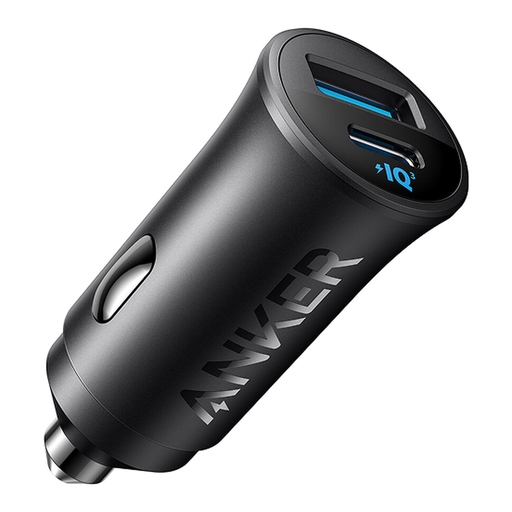
Why this fits the profile: Two USB ports and a maximum of 30W are practical for daily commuting and basic use with smartphones or small USB devices.
The product specifications mention two USB outputs and protection against overcharging, overheating and short circuits. Do check which cable you need.
Two ports, compact design and 30W total power according to the product description.
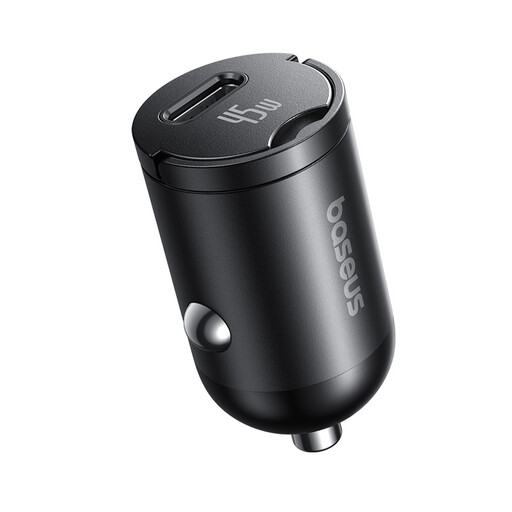
Why this fits the profile: Ideal for anyone who wants a USB-C car charger with clearly described charging profiles and an included cable.
The stated input is DC 12–24V and the USB-C output is specified up to 45W. This makes the comparison clearer than with just a general fast-charging claim.
USB-C up to 45W and an included 1-metre USB-C to USB-C cable according to the product information.
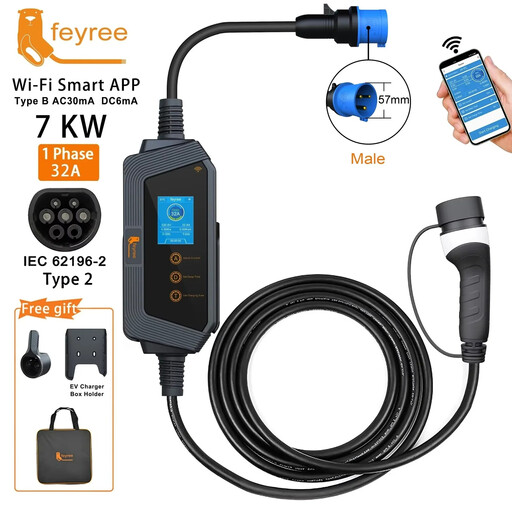
Why this fits the profile: An option for owners of an electric car or plug-in hybrid with a Type 2 connector who want to charge at home and on the go.
The specifications mention an adjustable current from 8A to 32A, Type B residual current protection and connection according to IEC 62196-2. Check whether your installation supports this.
7 kW, a 5-metre cable, portable or wall-mounted use and control via a Tuya app according to the product description.
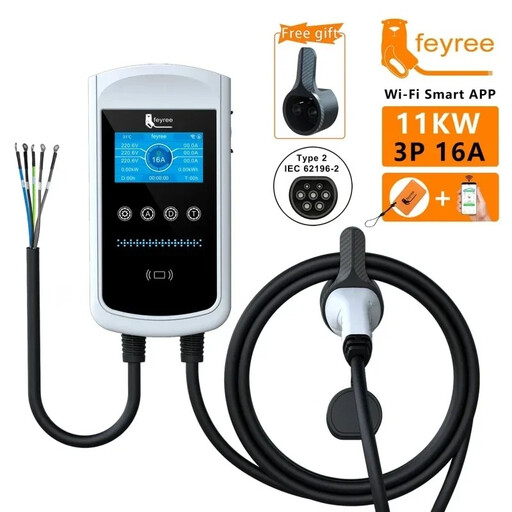
Why this fits the profile: Suits users with a three-phase installation and a car that supports 11 kW AC charging.
The manufacturer states adjustable charging currents from 8A to 16A, Type B residual current protection and compatibility with Type 2. The car itself must be able to accept 11 kW three-phase.
4.3-inch screen, wifi app, charging scheduling and charging logging according to the product description.
We’ve put together a full, up-to-date list of products that fully meet these strict selection criteria and comply with current European safety regulations.
Not always. Passenger cars usually use 12V, while lorries and some campervans use 24V. Choose a model where your vehicle’s voltage is explicitly stated, for example 12–24V. If in doubt, check your vehicle’s manual.
The lifespan depends on heat, frequency of use, cable strain and storage. Don’t pull a built-in cable further than indicated, and don’t leave a charger in a hot car unnecessarily. Replace the product if you notice cracks, loose contacts, a damaged cable or a burning smell.
The cost depends on the charging power, charging time and your electricity tariff. A 7 kW EV charger uses more electricity per hour at maximum power than a 3.7 kW model, but the car determines how much power is actually drawn. Charging scheduling via an EV charger with a wifi app can help you set charging for a desired time. Check in advance whether your energy supplier offers different tariffs and whether your electrical installation can handle the chosen power.
