
Vandaag of morgen in huis

Kwaliteit gegarandeerd

Welkomstaanbiedingen ontgrendelen: GRATIS bezorging | Tot 80% korting | Gratis 30 dagen JoyPlus-proefperiode
Download de app
A car battery tester can help you spot starting problems early. However, not every car battery tester is suitable for every battery. Some models only measure voltage, while others also check starting power, charge status and the alternator. If you choose a device based only on a low price or a large number on the packaging, you could end up with something that offers little practical value.
The main pitfalls:
A digital battery tester usually displays the battery voltage and may also provide readings for State of Charge (SoC) and State of Health (SoH). SoC refers to the current charge level; SoH indicates the battery’s available condition compared with its original capacity.
Use the results as a guide, not as an absolute guarantee. Corrosion on the terminals, a poor earth connection or a recently charged battery can affect the reading. So first check that the clamps are clean and firmly connected.
CCA, or Cold Cranking Amps, indicates a battery’s specified cold-starting power. The value on the battery label needs to match the selected standard, such as CCA, BCI, DIN or SAE. Choosing the wrong standard or entering the wrong CCA value can produce an unusable result.
A good CCA battery tester should therefore do more than quote a wide range: it should also clearly state which standards and battery types it supports. Check the minimum and maximum voltage too. A motorbike, car, SUV, boat or lorry may require different settings.
A starting and charging system tester does more than a basic car battery tester. During a cranking test, it checks how the voltage responds when the engine starts. A charging test can give you an indication of how well the alternator is working.
This makes an alternator tester useful when a vehicle is difficult to start. The battery may be the problem, but it could also be the alternator, wiring or connections. A tester isn’t a substitute for a full repair diagnosis, but it can help you avoid replacing parts without checking them first.
Check the battery type before buying. An AGM GEL EFB battery tester is designed for several modern lead-acid battery technologies. AGM batteries are used, for example, in vehicles with start-stop technology. EFB batteries are also used in some start-stop systems. GEL batteries have a different construction from traditional wet-cell batteries.
Check the voltage too:
Not every 6V 12V 24V battery tester supports all battery types. The BT500 product description states that it supports 6V, 9V, 12V and 24V, standard lead-acid batteries, AGM, GEL and EFB, with a range of 5 to 3000 CCA. The same product description says it isn’t suitable for lithium, deep-cycle or golf cart batteries. Always check these kinds of limitations before ordering.
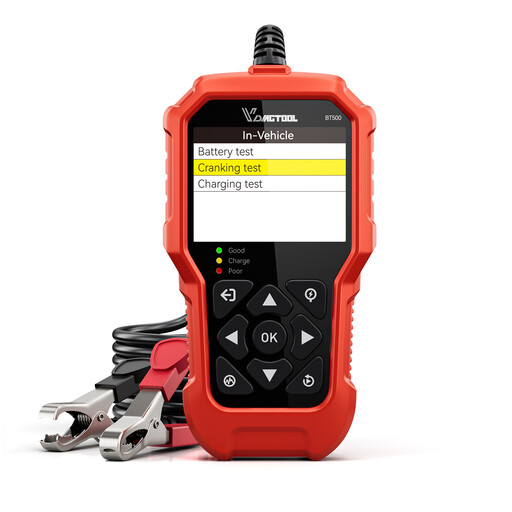
Why it suits this type of user: This car battery tester combines several measurements in one device, making it a good choice for car owners who want to carry out basic checks themselves.
The product description lists not only voltage measurement, but also SoC, SoH, resistance, cranking and charging. Make sure you select the right battery type and CCA standard.
According to the product information, it supports 6V, 9V, 12V and 24V, 5–3000 CCA and several lead-acid battery types. The screen and menu are designed for straightforward operation.
Why it suits this type of user: If you want to check the starting and charging system as well as the battery, a device with cranking and charging functions is a better choice.
This tester does more than take a simple voltage reading. According to the product description, it also analyses starting and charging, helping you avoid mistaking a possible alternator problem for a battery fault.
Support for CCA, BCI, DIN and SAE is listed. According to the product information, the casing is made from shock-resistant ABS and the device has reverse polarity protection.
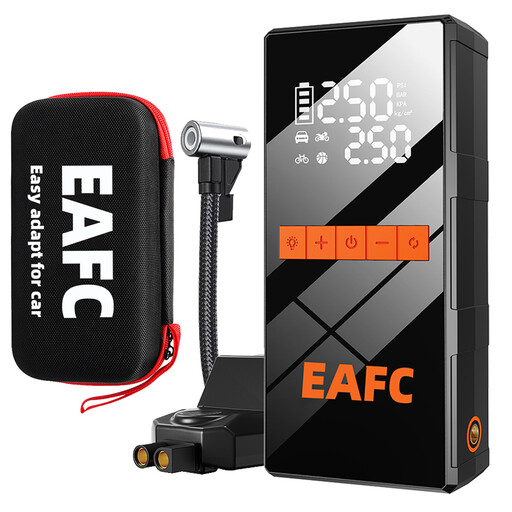
Why it suits this type of user: This is a useful addition for mobile vehicle technicians or drivers who want to carry an emergency solution with them. It isn’t a replacement for a car battery tester.
The product information makes clear that this is a jump starter. So don’t buy it if you want to measure SoH, CCA or alternator performance.
According to the product description, it combines a 12V jump-start function with a 150 PSI compressor, power bank and LED light. The stated limits are 4.0-litre petrol and 2.0-litre diesel engines.
We’ve put together a complete, up-to-date list of products that meet these strict selection criteria and the applicable European safety regulations.
Switch off the vehicle and connect the red clamp to the positive terminal and the black clamp to the negative terminal, unless the instructions say otherwise. Make sure the clamps are clean and firmly attached. Then select the voltage, battery type, standard and CCA value. Always follow the instructions for your specific model.
For normal use, it’s practical to check the battery before a long journey or after a spell of frequent short trips. An older battery, a vehicle that’s often left unused or a motorbike used seasonally may need more frequent checks. A test doesn’t replace maintenance of the charging cables, battery terminals and alternator.
A result may point to a low charge level, reduced starting power or a problem with the charging system. That’s useful information, but it isn’t a replacement recommendation on its own. Repeat any uncertain reading under the right conditions, and if starting problems persist, have the connections, starter motor and alternator checked too.
