
Vandaag of morgen in huis

Kwaliteit gegarandeerd

Welkomstaanbiedingen ontgrendelen: GRATIS bezorging | Tot 80% korting | Gratis 30 dagen JoyPlus-proefperiode
Download de app
A flat car battery often strikes at the worst possible moment: on a cold morning, on the way to the campsite or in a car park with no help nearby. A car battery jump starter can get you out of trouble, but not every model is suitable for every vehicle. The amp rating on the packaging doesn’t tell you everything, either.
As Joybuy Product Recommendation Officer, I separate the key product specifications from the marketing claims. That way, you can see what to look for in a portable jump starter, battery booster or car emergency starter.
Manufacturers often quote a high peak current, such as 3,000A or 8,000A. This is a brief maximum value, not a guarantee that the jump starter will start every vehicle in all conditions. Pay particular attention to the stated engine capacity for petrol and diesel engines.
A small car usually has different requirements from an SUV, van, motorhome or boat. Choose a 12V car jump starter that suits your vehicle’s engine capacity. A standard 12V model is not suitable for a 24V lorry.
A jump starter with a compressor is handy for adjusting tyre pressure or topping up a slowly deflating tyre. However, the maximum pressure, such as 150 PSI, doesn’t tell you how quickly it will inflate a car tyre. Check the airflow rate in litres per minute, the maximum operating time and whether it switches off automatically, too.
A compressor can’t repair a puncture. Check the tyre after inflating it, and have any damaged tyre inspected as soon as possible.
A jump starter power bank contains a lithium battery. If the device is left unused in a hot car for months, its available capacity may decrease. Many product manuals recommend charging it periodically, for example every two to six months. Always follow the manufacturer’s instructions.
Take care when storing it, too: avoid prolonged exposure to heat, moisture, fire and direct sunlight. Don’t use a device with a swollen casing, damaged cables or a leak.
First, check whether your vehicle has a 12V battery system. Then check the maximum engine capacity:
The stated peak current is a useful guide, but also compare the starting procedure, smart clamps, boost function and safety protections. Look for short-circuit protection, reverse polarity protection, overheating protection and overcurrent protection.
If you also want a car tyre inflator, check at least the following:
A device with several modes for cars, motorbikes, bicycles and balls is versatile. However, don’t use the compressor for longer than the manual recommends. The casing may get hot when inflating for extended periods.
A small jump starter fits easily in the glove compartment, but it may have a lower capacity and shorter cables. For larger vehicles, sturdy clamps, cables of sufficient length and a clear display are important.
A built-in torch, power bank and USB-C connection are useful extras. Think of them as added benefits, though: the main purpose is still to safely support a 12V starting system.
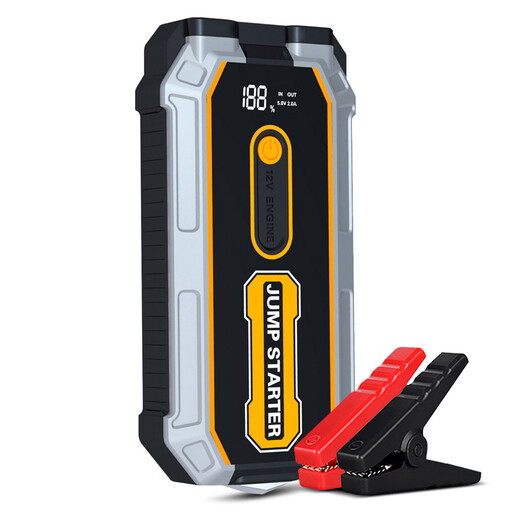
Why it suits this profile: A compact choice for drivers looking for straightforward emergency jump-starting support.
The product specifications state a peak current of 1200A and support for 12V petrol and diesel vehicles. Check that your engine falls within the stated limits.
Around 330 grams, LCD display, USB output and LED lighting with three modes.
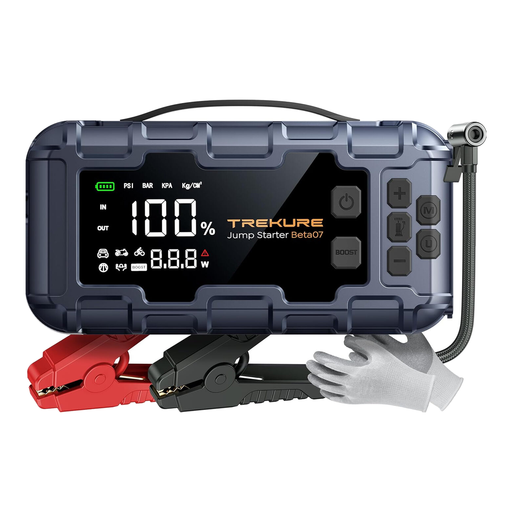
Why it suits this profile: Ideal if you want to combine jump-starting, inflation, a display and charging options in one robust device.
As well as a stated peak current of 6000A, the product description lists a 160 PSI compressor, automatic pressure control and safety protections. Check the manual for the recommended operating time.
45W USB-C, two USB-A ports, 3.3-inch display, 600-lumen light and included insulating gloves.
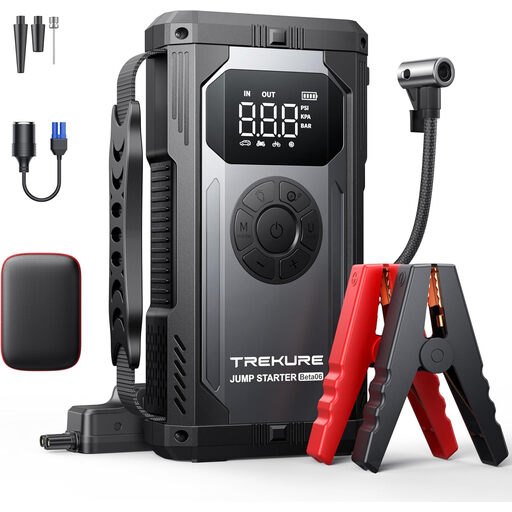
Why it suits this profile: A practical option for SUV, van, motorbike and motorhome owners, as well as travellers who want to inflate tyres and other inflatables.
The stated 35 L/min airflow rate and automatic shut-off tell you more than a PSI figure alone. Only use the force-start function as directed in the manual.
Peak current of 5500A according to the product information, 150 PSI compressor, LCD screen, 12V output and dual USB output.
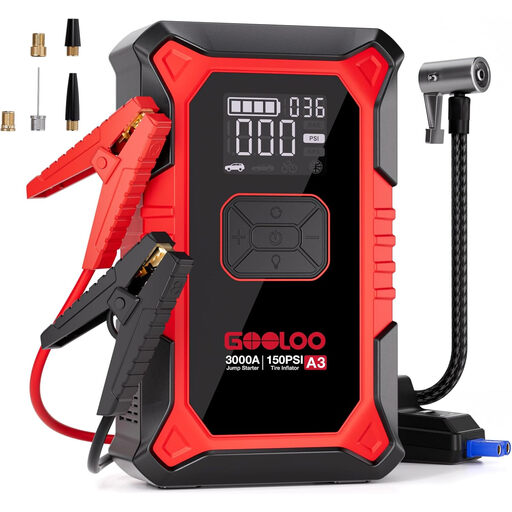
Why it suits this profile: A handy choice for drivers looking for a portable jump starter for cars, motorbikes, bicycles, balls and mobile devices.
The product description specifies 35 L/min, five inflation modes, pressure detection and automatic shut-off. The stated engine compatibility remains the deciding factor.
Peak current of 3000A, 150 PSI, up to 45 minutes of cordless inflation according to the product specifications, torch and power bank function.
We’ve put together a complete, up-to-date list of products that meet these strict selection criteria and the applicable European safety regulations.
No. Check the vehicle voltage and the maximum engine capacity for petrol and diesel engines. A 12V car jump starter isn’t designed for 24V systems or the high-voltage batteries in electric vehicles.
Its lifespan depends on storage temperature, charging frequency and use. Charge the device periodically according to the manual, and store it somewhere dry and out of direct sunlight. Reduced capacity or a damaged casing are reasons to stop using it.
You don’t have fuel or subscription costs, but the compressor uses the internal battery relatively quickly. The actual operating time varies depending on the tyre, the pressure difference and the model. So, check the battery capacity, airflow rate, maximum operating time and cooling breaks rather than looking only at the stated 150 PSI.
