
Vandaag of morgen in huis

Kwaliteit gegarandeerd

Welkomstaanbiedingen ontgrendelen: GRATIS bezorging | Tot 80% korting | Gratis 30 dagen JoyPlus-proefperiode
Download de app
A flat battery often happens at the worst possible moment: on a cold morning, during a camping trip or after the car has been parked for a few weeks. A car battery jump starter can get you moving again without needing a second vehicle and jump leads. However, not every model is suitable for every car.
The highest current rating on the packaging does not tell the whole story. You should also consider engine compatibility, charge level, safety features and how you plan to use the device. Below, we cover the key points to look out for, along with some popular choices for motorists in the Netherlands.
A rating such as 2000 A or 4000 A sounds impressive, but peak current is not the same as continuous starting current. Peak power is only reached for a short time. You should therefore also check which engine sizes and engine types the product is suitable for according to its specifications.
A small petrol engine generally requires less starting power than a large diesel engine. For an SUV, van, motorhome or boat, a model with extra capacity is a more sensible choice than a compact emergency starter designed for a city car.
Most portable jump starters are designed for 12V lead-acid batteries. That does not mean they are suitable for 24V lorries or an electric car’s high-voltage battery. Hybrid vehicles may also have several different electrical systems. Always check the vehicle manual and product specifications.
A jump starter will not always start the car if the battery is internally faulty or its voltage is extremely low. Some models have a boost function, but even then, the product description may state that starting is not guaranteed when the battery is below a certain threshold.
A jump starter with a compressor is useful when a tyre is soft, but 150 PSI does not mean every car tyre will be inflated in the same amount of time. Check the airflow in litres per minute, the maximum operating time and the cooling period. A portable air compressor is primarily intended for topping up tyres and emergency situations, not automatically for prolonged professional use.
You should also avoid leaving the device unused for years. A car power bank needs to be recharged regularly, even if you have not experienced an emergency.
Use the following information as a practical checklist:
A car battery jump starter for occasional use with a compact petrol car does not need the same capacity as a mobile jump starter for a motorhome or large diesel van.
Choose a model with a clear polarity warning and multiple safety features wherever possible. Relevant functions include:
These features make connecting the device more straightforward, but they do not replace the instructions. Connect red to the positive terminal and black to the negative terminal or a suitable unpainted earth point, as instructed.
If you want to use one device as a car battery booster, tyre inflator and power bank, look out for:
The stated numbers of starts, charging cycles and tyres inflated are product specifications or claims from the product description. Actual usage time depends, among other things, on temperature, battery condition, vehicle type and storage.
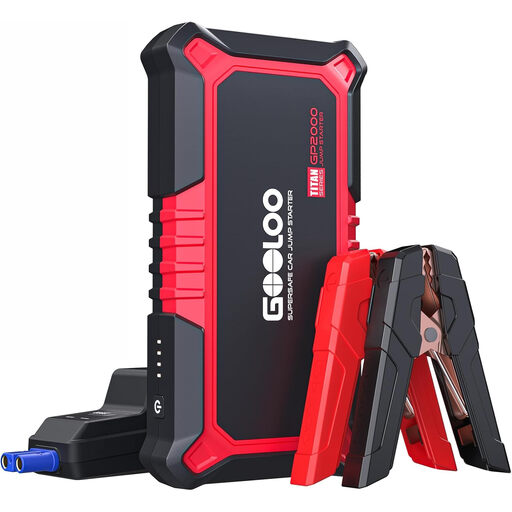
Why it suits this profile: According to the product specifications, this compact model is designed for 12V vehicles with petrol engines up to 8.0 litres and diesel engines up to 6.0 litres. It weighs approximately 545 grams.
The product specifications state the engine limits, 10 safety features and a connection status light. Before buying, check that your vehicle uses a 12V lead-acid battery.
2000 A peak current, two USB outputs, a 400-lumen lamp and a stated standby time of up to 24 months.
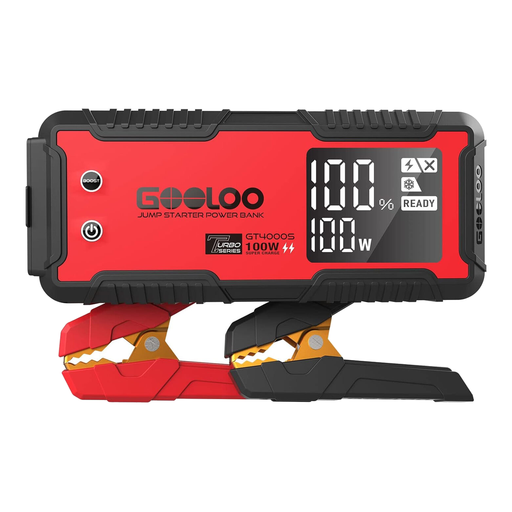
Why it suits this profile: According to the product description, this model supports 12V vehicles, petrol engines up to 12.0 litres and diesel engines up to 10.0 litres.
The display shows the product status, while the supplied smart jump leads feature multiple safety protections. The vehicle and engine details remain the deciding factors when choosing.
4000 A peak current, support for fast charging up to 100 W, plus USB and 12V/15V connections.
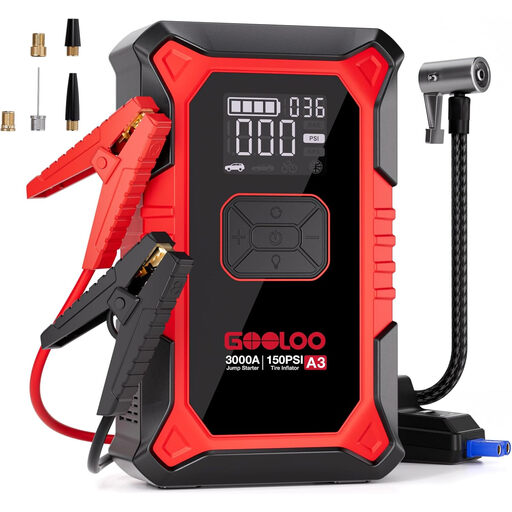
Why it suits this profile: This model combines a car jump starter with a tyre inflator, digital pressure gauge and several inflation modes. That makes it suitable for motorhomes, SUVs and travellers.
The product specifications state an airflow of 35 L/min, automatic shut-off and an operating time of up to 45 minutes on a full charge. Allow the compressor to cool down between uses.
3000 A peak current, up to 150 PSI, five inflation modes, five nozzles and 10 stated safety features.
Use a compressor with the correct nozzle and set the vehicle’s recommended tyre pressure. This value is usually shown on a sticker inside the door pillar or in the manual, not on the sidewall of the tyre.
We have put together a complete, up-to-date list of products that fully meet these strict selection criteria and the applicable European safety regulations.
No. Check the voltage, engine type and maximum engine size. Most models in this category are designed for 12V vehicles. They are not intended for 24V systems or the high-voltage batteries of electric cars.
This depends on the battery type, temperature, usage and storage. Product descriptions may state more than 1000 charging cycles or a standby time of up to 24 months. These are stated product specifications, so you should still recharge the device regularly, for example every few months.
It can be if you want to top up your tyres regularly as well as use the device as a car jump starter, for example while travelling or camping. If you only need to start a car with a flat battery, a compact model without a compressor is often lighter and simpler. Before buying, compare the airflow, maximum operating time and automatic shut-off in particular.
