
Vandaag of morgen in huis

Kwaliteit gegarandeerd

Welkomstaanbiedingen ontgrendelen: GRATIS bezorging | Tot 80% korting | Gratis 30 dagen JoyPlus-proefperiode
Download de app
A flat car battery often happens at the worst possible time: on a cold morning, after a long journey or when your car has been sitting for a few days. With a car battery jump starter, you can often get a vehicle with a flat 12V battery going again yourself. But not every model is right for every car.
A high amp rating on the packaging, for example, isn’t the only thing to consider. Engine type, battery voltage, cable protection and maintenance all affect how practical a portable jump starter will be.
A rating such as 2.000A, 4.000A or even 8.000A sounds impressive, but peak current doesn’t tell the whole story. Check which petrol and diesel engines the manufacturer says the product is suitable for. A model may support a large petrol engine but have a lower limit for diesel engines.
The stated figures come from the manufacturer’s product information. Treat them as a guide to compatibility and always check your vehicle’s manual.
Most cars, SUVs, motorbikes and vans use a 12V battery. That doesn’t mean every jump starter is suitable for every vehicle. Check that your vehicle has a 12V lead-acid battery and not a different electrical system. A jump starter also won’t fix a damaged, leaking or frozen battery.
A car battery booster can sit in your boot for months. A flat device won’t help when you break down. Look for a clear charge indicator, smart jump leads and protection against reverse polarity, short circuits, overheating and overloading, among other things.
Store the jump starter somewhere cool and dry. Many product manuals recommend recharging the device every two to six months, depending on the model. Always follow the manufacturer’s instructions.
Match the stated engine capacity to your vehicle:
A higher rating isn’t automatically necessary for every driver. The key is to choose a model whose official compatibility information matches your engine.
Check that the included leads have sturdy metal clamps, enough cable length and a smart connector. Ideally, a good car jump starter will warn you if the clamps are connected incorrectly. Some models offer eight to ten safety features, but exactly how they work varies from product to product.
A CE mark is the manufacturer’s declaration that the product meets the relevant European requirements. It’s no substitute for reading the manual or checking the product details.
A jump starter with power bank can charge phones, tablets or sat navs via USB. An LED light with steady, flashing and SOS modes is handy if you break down in the dark.
A jump starter with compressor is worth considering if you want to top up your tyres as well as jump-start your car in an emergency. Check the maximum pressure, airflow, hose, included valve adaptors and automatic shut-off. A compressor can get hot, so it’s still important to take breaks as instructed in the manual.

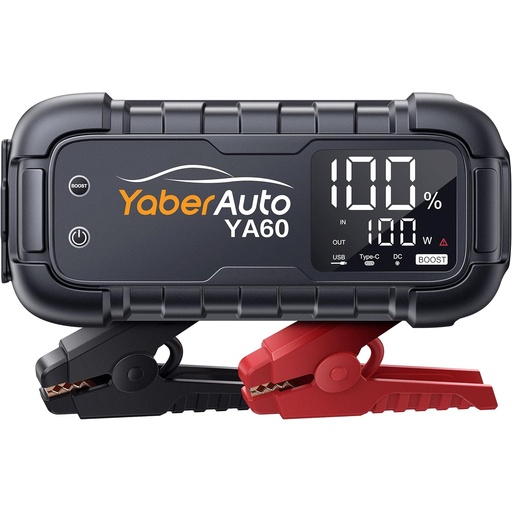
Why it suits this profile: Weighing around 330 grams, this compact model is aimed at drivers of cars, motorbikes or SUVs who want to keep a straightforward car battery jump starter in their vehicle.
The product specifications list the 1200A peak current and 600A starting current separately, and state that it supports 12V petrol and diesel vehicles. The LCD screen shows the remaining charge.
12800mAh battery according to the product information, 10W USB output, LCD status display and LED light with three modes.
Why it suits this profile: A good fit for drivers looking for a powerful 12V jump starter with fast charging, multiple outputs and compatibility with a wider range of vehicles.
The product description lists 10 smart safety features, 8AWG jump leads and a clear limit of up to 12.0 litres for diesel or petrol engines, according to the manufacturer.
26800mAh, USB-C 65W, two USB-A outputs, 150W DC output and a 600-lumen LED light according to the product specifications.
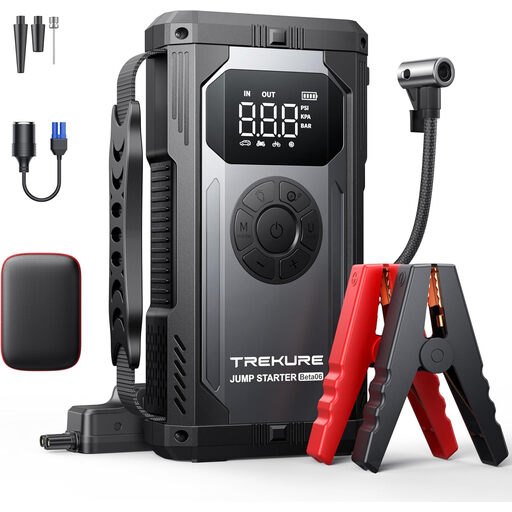
Why it suits this profile: A practical choice for travellers, campervan owners and outdoor enthusiasts who want to carry a car battery jump starter and tyre inflator in one unit.
According to the product information, the digital display shows the battery level and tyre pressure. The compressor has a preset pressure and automatic shut-off; allow the device to cool down between uses.
5500A peak current, compressor up to 150 PSI, airflow up to 35 l/min, two USB-A ports and three light modes according to the product description.
We’ve put together a complete, up-to-date list of products that meet these strict selection criteria and the applicable European safety requirements.
Don’t use the leads if the clamps are damaged. Don’t try to start a vehicle if its battery is visibly leaking, swollen or frozen.
It depends on the model and the situation. Some manufacturers specify a boost or force-start function for low battery voltage. According to the product information provided by various brands, this can help with a very flat battery, but the battery itself must still be in working order. Always follow the manual.
Its lifespan depends on storage temperature, how often it’s charged and how it’s used. Don’t leave the device in extreme heat for long periods, and recharge it regularly. An LCD indicator helps you see when it needs charging.
Once you’ve bought it, the only direct running cost is charging the internal lithium battery. A jump starter with a compressor may use more energy than a basic model. Before choosing extra capacity or accessories, check which features you actually need.
